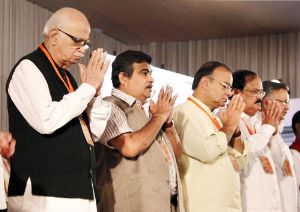
With eye on early Lok Sabha elections, BJP shedding saffron image?

September 30, 2012

BJP-Saffron

New Delhi, September 30: While anticipating that elections may be held earlier than scheduled, BJP has been trying to soften its "hardline Hindutva" image in what appears to be a move to blunt the hostility of Muslims, and reassure its existing allies while reaching out to new partners.


The three-day session of BJP's national executive saw both party president Nitin Gadkari and veteran leader LK Advani condemning the anti-Islam film that has triggered violence in different parts of the globe.


Gadkari on Thursday cited Swami Vivekananda, whose 150th birth anniversary is being planned by the party in a big way, to condemn the film that denigrates Prophet Mohammad.


"It's wrong to spread disrespect towards anybody who is revered by members of a faith. We should with full conviction reassure our brethren belonging to the minority communities that we brook no discrimination or injustice in dealing with different sections of our diverse society," Advani said in a speech that was well received by the audience.


He suggested that doing so would help reassure party's potential allies that "they have nothing to be apprehensive about partnering with BJP". Advani also emphasized the need for broadening the NDA, saying that the grouping has to be transformed into "NDA Plus".


The remark acquires significance in view of the apprehension of an existing ally, Bihar CM Nitish Kumar, as well as the recognition that the fear of losing Muslim support forces some of the anti-Congress players to maintain a distance from the saffron outfit. In fact, Advani's advice that party should undergo an image makeover to appear "secular" appears to articulate especially Kumar's anxiety.


The Bihar CM is apprehensive that the projection of his Gujarat counterpart Narendra Modi as BJP's choice for the PM will deal a setback to his assiduous attempts to woo Muslims away from his rival Lalu Prasad.


Regional players like TDP chief N Chandrababu Naidu and Odisha CM Naveen Patnaik, who are hostile to Congress, are loath to be seen in BJP's company because of the latter's "communal tag".


Though a handicap for the BJP, the "communal" brand works to the advantage of its allies, who cite it to justify their flexibility in choosing allies and taking positions.


On a larger plane, the same factor helps the "secular" rivals to seek to mobilize Muslims against the saffron party.


Comments

Hubert
 - 
Friday, 29 Jan 2016

Whatever might be your alternative, it's better that you simply
do a little analysis relating to the fame and customer help
provided by the binary brokers before you open an account with them to avoid any final minute hassles.

Review my webpage binary trading software review [Angela: http://s3.amazonaws.com/tradoptions/index/182.html]

Add new comment

  • Coastaldigest.com reserves the right to delete or block any comments.
  • Coastaldigset.com is not responsible for its readers’ comments.
  • Comments that are abusive, incendiary or irrelevant are strictly prohibited.
  • Please use a genuine email ID and provide your name to avoid reject.
News Network
January 1,2020

Jan 1: The ban on the practice of instant triple talaq, making it a penal offence and the increase in the strength of Supreme Court judges were two of the major achievements of the law ministry in 2019.

In July, Parliament gave its nod to The Muslim Women (Protection of Rights on Marriage) Bill, 2019. The new law makes talaq-e-biddat or any other similar form of talaq having the effect of instantaneous and irrevocable divorce pronounced by a Muslim husband void and illegal.

It makes it illegal to pronounce talaq three times in spoken, written or through SMS or WhatsApp or any other electronic chat in one sitting.

According to the new law, any Muslim who pronounces the illegal form of talaq upon his wife shall be punished with imprisonment for a term which may extend to three years, and shall also be liable to fine.

During the year, four new judges were appointed to the Supreme Court in September, taking its strength to 34, the highest-ever.

However, vacancies in high courts and lower courts are on the rise and convincing state governments and the 25 high courts to come on board to create an all-India judicial service to recruit judges for the subordinate courts tops the agenda of the Law Ministry in 2020.

Besides creating a consensus on setting up the All-India Judicial Services, the ministry will also have to focus on filling up vacancies in the high court. On an average, the vacancies stood at 400 throughout this year.

With more than 5,000 positions of judicial officers in district and subordinate courts lying vacant, the Law Ministry has pitched for setting up all-India judicial services.

The sanctioned strength of the judicial officers in district and subordinate courts was 22,644. The number of judicial officers in position and vacant posts is 17,509 and 5,135, respectively.

The government has proposed that while states and high courts can recruit judicial officers, the Union Public Service Commission (UPSC) can hold pan-India entrance tests.

The ministry has made it clear that such services would not encroach on the powers of the states.

As of now, the selection and appointment of judges in subordinate courts is the responsibility of the high courts and state governments concerned.

The Narendra Modi government has given a fresh push to the long-pending proposal to set up the new service to have a separate cadre for the lower judiciary in the country.

But there is a divergence of opinion among state governments and respective high courts on the constitution of the All India Judicial Service (AIJS).

One of the problems cited is that since several states have used powers under Code of Criminal Procedure (CrPC) and Code of Civil Procedure (CPC) to declare that the local language would be used in lower courts even for writing orders, a person say selected from Tamil Nadu may find it difficult to hold proceedings in states like Uttar Pradesh and Bihar.

The other point of opposition is that an all India service may hamper the career progression of state judicial services officers.

Another key issue the ministry has to handle in 2020 is vacancies in the 25 high courts.

Throughout 2019, on an average, the high courts faced a shortage of 400 judges.

According to Law Ministry data, as on September 1, the high courts had 414 vacant positions as compared to the sanctioned strength of 1,079 judges. The figure was 409 in August and 403 in July, as per the data.

A three-member Supreme Court collegium recommends the names of candidates for appointment as high court judges. In case of appointments to the Supreme Court, the collegium consists of five top judges of the top court.

High court collegiums shortlist candidates for their respective high courts and send the names to the law ministry.

The ministry, along with background check reports by the Intelligence Bureau, forwards it to the Supreme Court collegium for a final call.

The government has maintained that appointment of judges in the high courts is a "continuous collaborative process" between the Executive and the Judiciary, as it requires consultation and approval from various Constitutional authorities.

Vacancies keep arising on account of retirement, resignation or elevation of judges and increase in judges' strength. In June last year, the vacancy position stood at 399, while it was 396 in May.

In April, 399 posts of judges were vacant, while the figure was 394 in March. The vacancy position in February stood at 400 and in January, it was 392, according to the data collated by the Department of Justice.

Over 43 lakh cases are pending in the 25 high courts.

Another priority would be the finalisation of the memorandum of the procedure to guide the appointment and transfer of the Supreme Court and high court judges. The issue had now been pending for over two years now with the SC collegium and the government failing to reach a consensus.

Successive governments have also been working on making India a hub of international arbitration. It has taken several steps to change laws dealing with commercial disputes.


Comments

Add new comment

  • Coastaldigest.com reserves the right to delete or block any comments.
  • Coastaldigset.com is not responsible for its readers’ comments.
  • Comments that are abusive, incendiary or irrelevant are strictly prohibited.
  • Please use a genuine email ID and provide your name to avoid reject.
News Network
July 20,2020

New Delhi, Jul 20: Alleging that 2,426 companies have "looted" people's savings to the tune of Rs 1.47 lakh crore from banks, Congress leader Rahul Gandhi has asked if the Prime Minister Narendra Modi led government will conduct a probe into it to punish those guilty.

"2,426 companies looted 1.47 lakh crore rupees of people's savings from banks. Will this government investigate this loot and punish the culprits?" Gandhi said on Twitter, without elaborating.

"Or will it allow them to flee like Nirav and Lalit Modi?" he asked.

Gandhi's attack came after media reports claimed that the All India Bank Employees Association (AIBEA) had released a list of 2,426 borrower accounts that have been categorised as “wilful defaulters” with dues amounting to Rs 1,47,350 crore to the banking system.

Comments

Add new comment

  • Coastaldigest.com reserves the right to delete or block any comments.
  • Coastaldigset.com is not responsible for its readers’ comments.
  • Comments that are abusive, incendiary or irrelevant are strictly prohibited.
  • Please use a genuine email ID and provide your name to avoid reject.
Agencies
July 23,2020

Jerusalem, Jul 23: Merging Israel's technological expertise with India's mass production capabilities, experts from the two countries have joined hands to develop rapid testing for Covid-19 in under 30 seconds.

Israel will soon send a high-level research delegation to India to conduct a series of "final stages of testing" as part of the joint effort to develop the rapid testing kits for Covid-19 .

A high ranking team from the Directorate of Defence Research and Development (DDR&D), in the Ministry of Defense, which has been working with India's DRDO to develop rapid testing for Covid-19 in under 30 seconds, is to leave from Tel Aviv to New Delhi on a special flight in a few days, Israel's Ministry of Defence said in a statement on Thursday.

Israel's Ministry of Foreign Affairs (MFA) and Ministry of Health are also involved in this unprecedented cooperation between the two countries which aims at "merging Israeli technology with Indian development and production capabilities to allow a swift resumption of normal life alongside the virus".

The DDR&D team will conduct a series of "final stages of testing" to determine the effectiveness of a number of rapid diagnostic solutions with their Indian counterparts.

Since the start of the pandemic, the DDR&D has tested dozens of diagnostic technologies. Some of them have matured and passed initial trials in Israel, however in order to complete testing and prove their effectiveness, these must be tested on a wide range of patients, IMoD said.

The four tech systems that will be tested are - voice test, breathalyzer test based on terra-hertz waves, isothermal test, and polyamino acids test.

"What they all have in common is the ability to detect the presence of the virus in the body quickly- usually within minutes. Developing diagnostic capabilities is a goal for the State of Israel and of many additional countries around the world. It is the most effective way to cut off 'chains of infection', prevent prolonged quarantine and enable the reopening of the global economy," the statement said.

"We hope that the research and development led by the DDR&D together with our excellent industries and academic institutions, will lead to a breakthrough that will change the way we diagnose and fight the virus, while giving the boost necessary to 'restart' our economy," Defense Minister Benny Gantz said.

Foreign Minister Gabi Ashkenazi noted that this cooperation provides a unique opportunity for scientific and technological cooperation that can assist Israel, India and the world in coping both with the pandemic and with the economic crisis that came with it.

The cooperation between Israel and India will enable the delegation and its Indian counterparts, to collect tens of thousands of samples in just ten days, and analyze them using computer systems based on artificial intelligence. This massive sampling will shorten processes and advance the approval of effective technology. All tests will be validated using PCR tests.

"The cooperation between India and Israel on Covid-19 is a good example of harnessing the scientific and technological strengths that the two countries have for larger, common good. It will also further deepen our strategic ties,” India's Ambassador Sanjeev Singla told PTI.

The flight will be carrying some breakthrough emerging Israeli technologies for combatting Covid-19, which have been donated by the Israeli foreign ministry and the private sector, in order to bolster India’s response to the virus outbreak.

The plane will also deliver mechanical ventilators which were given special permission by Israel for export to India.

Prime Minister Narendra Modi and his Israeli counterpart Benjamin Netanyahu have held three telephonic conversations since the outbreak of the pandemic and promised mutual assistance in dealing with the virus, committing to joint technological and scientific research between the countries.

The Israeli media widely reported that Modi lifted a ban on the export of Hydroxychloroquine at Netanyahu's request.

"The past few years have cemented the strategic relations between India and Israel and have included two historical visits of the Prime Ministers in Israel and in India," a press statement from the ministry of defence said.

"India seeks to integrate advanced technologies in its hospitals as they prepare to treat massive waves of Covid-19 patients on an Indian scale. The Israeli companies chosen by the MFA, MOD and Israel Defence Forces to be sent to India are potentially given unique access to one of the largest economies in the world to provide monitoring and treatment technologies while significantly reducing contact between the patients and the medical staff," it said.

"By opening the door to India’s market with its development and production capabilities, these Israeli technologies can be mass produced at a lower cost and could in future be jointly exported to third countries," it said.

"The COVID-19 pandemic is a global challenge, so it is only right that the solution be a global scientific cooperation between countries. India and Israel’s military R&D cooperation is well known for its success. I have no doubt the same will be seen in the private sector joined by brilliant scientific minds from both countries to introduce a breakthrough in swift and simple testing procedures,” said Prof. Nati Keller, an infectious diseases specialist from Sheba Medical Center, who is leading the medical side of the delegation.

Comments

Add new comment

  • Coastaldigest.com reserves the right to delete or block any comments.
  • Coastaldigset.com is not responsible for its readers’ comments.
  • Comments that are abusive, incendiary or irrelevant are strictly prohibited.
  • Please use a genuine email ID and provide your name to avoid reject.