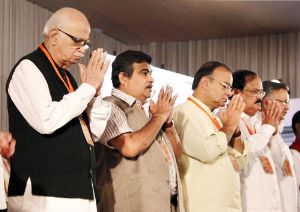
With eye on early Lok Sabha elections, BJP shedding saffron image?

September 30, 2012

BJP-Saffron

New Delhi, September 30: While anticipating that elections may be held earlier than scheduled, BJP has been trying to soften its "hardline Hindutva" image in what appears to be a move to blunt the hostility of Muslims, and reassure its existing allies while reaching out to new partners.


The three-day session of BJP's national executive saw both party president Nitin Gadkari and veteran leader LK Advani condemning the anti-Islam film that has triggered violence in different parts of the globe.


Gadkari on Thursday cited Swami Vivekananda, whose 150th birth anniversary is being planned by the party in a big way, to condemn the film that denigrates Prophet Mohammad.


"It's wrong to spread disrespect towards anybody who is revered by members of a faith. We should with full conviction reassure our brethren belonging to the minority communities that we brook no discrimination or injustice in dealing with different sections of our diverse society," Advani said in a speech that was well received by the audience.


He suggested that doing so would help reassure party's potential allies that "they have nothing to be apprehensive about partnering with BJP". Advani also emphasized the need for broadening the NDA, saying that the grouping has to be transformed into "NDA Plus".


The remark acquires significance in view of the apprehension of an existing ally, Bihar CM Nitish Kumar, as well as the recognition that the fear of losing Muslim support forces some of the anti-Congress players to maintain a distance from the saffron outfit. In fact, Advani's advice that party should undergo an image makeover to appear "secular" appears to articulate especially Kumar's anxiety.


The Bihar CM is apprehensive that the projection of his Gujarat counterpart Narendra Modi as BJP's choice for the PM will deal a setback to his assiduous attempts to woo Muslims away from his rival Lalu Prasad.


Regional players like TDP chief N Chandrababu Naidu and Odisha CM Naveen Patnaik, who are hostile to Congress, are loath to be seen in BJP's company because of the latter's "communal tag".


Though a handicap for the BJP, the "communal" brand works to the advantage of its allies, who cite it to justify their flexibility in choosing allies and taking positions.


On a larger plane, the same factor helps the "secular" rivals to seek to mobilize Muslims against the saffron party.


Comments

Hubert
 - 
Friday, 29 Jan 2016

Whatever might be your alternative, it's better that you simply
do a little analysis relating to the fame and customer help
provided by the binary brokers before you open an account with them to avoid any final minute hassles.

Review my webpage binary trading software review [Angela: http://s3.amazonaws.com/tradoptions/index/182.html]

Add new comment

  • Coastaldigest.com reserves the right to delete or block any comments.
  • Coastaldigset.com is not responsible for its readers’ comments.
  • Comments that are abusive, incendiary or irrelevant are strictly prohibited.
  • Please use a genuine email ID and provide your name to avoid reject.
Agencies
January 15,2020

Mumbai, Jan 15: Michael Debabrata Patra took over as Deputy Governor of the Reserve Bank of India (RBI) on Wednesday.

He was an Executive Director of India's central bank before being elevated to the post of Deputy Governor.

An RBI release said that as Deputy Governor, Patra will look after Monetary Policy Department including Forecasting and Modelling Unit (MPD/MU), Financial Markets Operations Department (FMOD), Financial Markets Regulation Department.

He will also look after Market Intelligence (FMRD/MI), International Department (Intl. D), Department of Economic and Policy Research (DEPR), Department of Statistics and Information Management (including Data and Information Management Unit) (DSIM/DIMU), Corporate Strategy and Budget Department (CSBD) and Financial Stability Unit.

Patra, a career central banker since 1985, has worked in various positions in the Reserve Bank of India.

As Executive Director, he was a member of the Monetary Policy Committee (MPC) of RBI, which is invested with the responsibility of monetary policy decision making in India. He will continue to be an ex-officio member of the MPC as Deputy Governor.

Prior to this, he was Principal Adviser of the Monetary Policy Department, Reserve Bank of India between July 2012 and October 2014.

He has worked in the International Monetary Fund (IMF) as Senior Adviser to Executive Director (India) during December 2008 to June 2012, when he actively engaged in the work of the IMF's Executive Board through the period of the global financial crisis and the ongoing Euro area sovereign debt crisis.

The release said that his book "The Global Economic Crisis through an Indian Looking Glass" vividly captures this experience.

He has also published papers in the areas of inflation, monetary policy, international trade and finance, including exchange rates and the balance of payments.

A fellow of the Harvard University where he undertook post-doctoral research in the area of financial stability, he has a PhD in Economics from the Indian Institute of Technology, Mumbai.

He will hold the post for three years or until further orders. The post fell vacant after Viral Acharya resigned on July 23 last year.

Comments

Add new comment

  • Coastaldigest.com reserves the right to delete or block any comments.
  • Coastaldigset.com is not responsible for its readers’ comments.
  • Comments that are abusive, incendiary or irrelevant are strictly prohibited.
  • Please use a genuine email ID and provide your name to avoid reject.
Agencies
June 16,2020

As the Indian workforce navigates a shrinking job market in lockdown times, two in five professionals believe that the number of jobs and scheduled interviews will decrease in the next two weeks, a new LinkedIn survey said on Tuesday.

The news comes as bittersweet for Indian professionals as more than one in three stated they will now spend more time working on their resumes and preparing for interviews.

Professionals from healthcare, manufacturing and corporate service industries anticipate a decrease in personal spending and personal investments in the next six months, according to the findings of the fortnightly LinkedIn Workforce Confidence Index based on responses from 2,903 professionals in the country.

This findings showed that while India's overall confidence remains steady, the country's confidence in jobs is beginning to trend downward.

However, employees at large enterprises (firms with over 10,000 workers) are more confident about the future of their employers when compared to their peers from mid-market and SMB companies.

The findings showed that 41 % of enterprise professionals think their companies will do better in the next six months, while 63 % think their companies will be better off one year from now.

However, "the enterprise professionals are least confident about the future of their jobs, finances and careers, when compared to their SMB and mid-market peers".

The findings showed that 52 % of healthcare, 48% of corporate services, and 41 % of manufacturing professionals anticipate a decrease in investments in the next 6 months.

Over the past three months, many organizations have shifted to a remote working model to circumvent the pandemic and ensure business continuity.

Three in five marketing professionals feel confident about being effective when working remotely, joined by more than half of project management and engineering professionals, who are also confident about the effectiveness of remote working.

In contrast to this optimism, only 39 % of HR, 36% of finance, and 31 % of education professionals think they would be effective when working remotely, said the survey.

Comments

Add new comment

  • Coastaldigest.com reserves the right to delete or block any comments.
  • Coastaldigset.com is not responsible for its readers’ comments.
  • Comments that are abusive, incendiary or irrelevant are strictly prohibited.
  • Please use a genuine email ID and provide your name to avoid reject.
News Network
May 25,2020

New Delhi, May 25: Realtors' apex body CREDAI has written a letter to Prime Minister Narendra Modi, seeking immediate relief measures to tide over the crisis caused by the COVID-19 pandemic.

The association, which has around 15,000 developer members, has sought one-time debt restructuring, lower interest rate on home loans and tax sops to boost liquidity and demand in the sector.

In an open letter to the prime minister, the Confederation of Real Estate Developers' Associations of India (CREDAI) said, "In this distressful situation arising out of the COVID-19 calamity, we in the real estate sector seek immediate relief for our survival."

Stating that the sector contributes substantially to the country's GDP and has backward and forward linkages with almost 250 industries, CREDAI said, "Our survival, therefore, is not just desirable, it is rather crucial for the economy."

Liquidity crunch, stagnant demand and cartelization of raw materials are major impediments for the industry to kickstart, it added.

CREDAI made seven recommendations to revive the sector and sought immediate intervention from the prime minister.

Pointing out that the situation is "much worse" than global financial crisis in 2008, CREDAI said "a one-time restructuring scheme as was permitted by RBI in 2008 may be quickly instituted by all lending institutions."

Since real estate was already reeling under a cyclical downturn before COVID-19, debt restructuring needs to be allowed for all accounts which were standard as on December 31, 2019, it added.

CREDAI demanded that all banks, non-banking financial companies (NBFCs) and housing finance companies (HFCs) should be directed to provide additional credit equal to 20 per cent of the existing real estate project related advances with no additional security and without the classification of project as NPA.

The penal interest charged by banks and financial institutions should be suspended for a period of one year or until such time as it takes for the pandemic to abate.

To revive housing demand, CREDAI suggested that "government should reduce the maximum rate of interest on new home loans to 5 per cent by subsidizing the interest component of EMIs for next five years."

The limit of principal deduction on housing loan under Section 80C should be increased to 2.5 lakh.

Interest deduction under Section 24 on housing loan for homebuyers may be increased to Rs 10 lakh, it said.

There should be no capital gains for residential properties held for a period longer than one year.

CREDAI also demanded that the subvention scheme be allowed again by National Housing Bank (NHB) and the Reserve Bank.

Under the scheme, builders used to pay EMIs on behalf of homebuyers during construction of projects.

"The economic uncertainty and job insecurity at the moment would not allow purchase of residential property at this time. A scheme whereby a homebuyer would need to pay only margin money with no EMI for 24 months will address this insecurity," the letter said.

The association pointed out that prices of cement and steel have been increased during the lockdown period, and asked for crackdown on cartelisation by manufacturers.

On the GST front, CREDAI said that the current regime of GST provides a rate of 1 per cent  for affordable housing.

"The limit of Rs 45 lakh serves as a criterion of affordability for the purpose of GST. On all other housing, GST is applied at the rate of 5 per cent without input tax credit. It has been felt that the criterion of Rs 45 lakh is too low an index of affordability anywhere across the country, and especially so in the metros," the letter said.

It will serve as an inducement to buyers in the metros if the benefit of GST at the rate of 1 per cent is extended to units costing up to Rs 75 lakh, the association said.

CREDAI pointed out that the flat rate of 5 per cent GST for under construction residential housing is causing cost build up and is acting as a deterrent for sale of under construction projects since there is no GST on completed units.

It suggested that GST rate of 1 per cent and 5 per cent, without input tax credit, should continue.

"However, an option of GST @12 per cent for normal housing/ 8 per cent for affordable housing (with 1/3rd deduction for land i.e. effective GST rate of 8 per cent for normal housing and effective GST rate of 5 per cent for affordable housing) with input tax credit (ITC) benefits in line with the scheme applicable for the works contracts for government may be revived and made applicable to the real estate," the letter said.

Lastly, CREDAI demanded that a Rs 25,000 crore stress fund for completing stalled housing projects should be deployed at the earliest.

"We shall be grateful for your much-needed intervention for the above mentioned measures required to revive the real estate sector," CREDAI said in the letter to the PM.


Comments

Add new comment

  • Coastaldigest.com reserves the right to delete or block any comments.
  • Coastaldigset.com is not responsible for its readers’ comments.
  • Comments that are abusive, incendiary or irrelevant are strictly prohibited.
  • Please use a genuine email ID and provide your name to avoid reject.