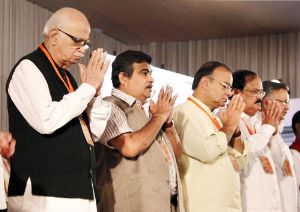
With eye on early Lok Sabha elections, BJP shedding saffron image?

September 30, 2012

BJP-Saffron

New Delhi, September 30: While anticipating that elections may be held earlier than scheduled, BJP has been trying to soften its "hardline Hindutva" image in what appears to be a move to blunt the hostility of Muslims, and reassure its existing allies while reaching out to new partners.


The three-day session of BJP's national executive saw both party president Nitin Gadkari and veteran leader LK Advani condemning the anti-Islam film that has triggered violence in different parts of the globe.


Gadkari on Thursday cited Swami Vivekananda, whose 150th birth anniversary is being planned by the party in a big way, to condemn the film that denigrates Prophet Mohammad.


"It's wrong to spread disrespect towards anybody who is revered by members of a faith. We should with full conviction reassure our brethren belonging to the minority communities that we brook no discrimination or injustice in dealing with different sections of our diverse society," Advani said in a speech that was well received by the audience.


He suggested that doing so would help reassure party's potential allies that "they have nothing to be apprehensive about partnering with BJP". Advani also emphasized the need for broadening the NDA, saying that the grouping has to be transformed into "NDA Plus".


The remark acquires significance in view of the apprehension of an existing ally, Bihar CM Nitish Kumar, as well as the recognition that the fear of losing Muslim support forces some of the anti-Congress players to maintain a distance from the saffron outfit. In fact, Advani's advice that party should undergo an image makeover to appear "secular" appears to articulate especially Kumar's anxiety.


The Bihar CM is apprehensive that the projection of his Gujarat counterpart Narendra Modi as BJP's choice for the PM will deal a setback to his assiduous attempts to woo Muslims away from his rival Lalu Prasad.


Regional players like TDP chief N Chandrababu Naidu and Odisha CM Naveen Patnaik, who are hostile to Congress, are loath to be seen in BJP's company because of the latter's "communal tag".


Though a handicap for the BJP, the "communal" brand works to the advantage of its allies, who cite it to justify their flexibility in choosing allies and taking positions.


On a larger plane, the same factor helps the "secular" rivals to seek to mobilize Muslims against the saffron party.


Comments

Hubert
 - 
Friday, 29 Jan 2016

Whatever might be your alternative, it's better that you simply
do a little analysis relating to the fame and customer help
provided by the binary brokers before you open an account with them to avoid any final minute hassles.

Review my webpage binary trading software review [Angela: http://s3.amazonaws.com/tradoptions/index/182.html]

Add new comment

  • Coastaldigest.com reserves the right to delete or block any comments.
  • Coastaldigset.com is not responsible for its readers’ comments.
  • Comments that are abusive, incendiary or irrelevant are strictly prohibited.
  • Please use a genuine email ID and provide your name to avoid reject.
News Network
March 9,2020

New Delhi, Mar 9: A war of words broke out between the BJP and the Congress on Sunday over the Yes Bank crisis with the ruling party seeking to link it with the Gandhi family, while the opposition wondered if the prime minister and finance minister were "complicit" as the bank's loan book grew manifold.

Posting on Twitter a clip of a news channel report that Rana Kapoor, the arrested Yes Bank founder, had bought a painting from Congress leader Priyanka Gandhi Vadra, BJP's information and technology wing in-charge Amit Malviya alleged that every financial crime in India has "deep links" with the Gandhis.

The Congress dismissed the charge "fake" and called it a "diversionary" tactic.

It said Priyanka Gandhi had sold an M F Hussain painting of her father Rajiv Gandhi to Kapoor for Rs 2 crore, and the entire amount was disclosed in her income tax return of 2010.

Malviya tweeted, "Every financial crime in India has deep link with the Gandhis. Mallya used to send flight upgrade tickets to Sonia Gandhi. Had access to MMS (Manmohan Singh) and PC (P Chidambaram). Is absconding. Rahul inaugurated Nirav Modi’s bridal jewellery collection, he defaulted. Rana bought Priyanka Vadra’s paintings."

Congress' chief spokesperson Randeep Surjewala asked how does an M F Hussain painting of Rajiv Gandhi sold 10 years ago by Priyanka Gandhi to Yes Bank owner Rana Kapoor and disclosed in her tax returns connect with unprecedented giving of loans of Rs 2,00,000 crore in five years of the Modi government.

"More so, when (Kapoor's) proximity to BJP leaders is well known," he said.

Rubbishing the BJP's allegation, Congress spokesperson Abhishek Manu Singhvi at a press conference said it was a "diversionary" tactic by the government.

He noted that the bank's loan book rose from Rs 55,633 crore in March 2014, the year Narendra Modi became prime minister, to Rs 2,41,499 crore in March 2019.

"Why did the loan book rise by 100 per cent in two years after demonetisation i.e from Rs 98,210 cr in March 2016 to Rs 2,03,534 ar in March 2018? Were PM and FM sleeping, ignorant or complicit?" he asked.

The entire amount Priyanka Gandhi had received was in cheque and was fully disclosed in the income tax return, Singhvi said.

Surjewala, taking to Twitter, said instead of diverting from the real issue of people's money sinking into a bad bank, should not the government answer questions like how did loans given by Yes Bank rise from Rs 55,633 crore in March 2014 to Rs 2,41,499 crore in March 2019, an increase of almost Rs 2,00,000 crore in fiver years of the Modi government.

Why did the loans given by Yes Bank rise by a whopping 100 per cent in just two years after demonetisation, he asked.

Surjewala also questioned why did the prime minister address a conference sponsored by Yes Bank on March 6 despite the RBI moratorium.

"Why did the Haryana BJP government deposit over Rs 1,000 crore in Yes Bank a month ago, knowing that it was sinking? Is this figure Rs 3,000 cr? Did Fadnavis government in Maharashtra make similar deposits?" Surjewala asked.

"Of course, the government's media proxies won't dare to ask these questions. But the nation wants to know!" he said in a series of tweets.

Kapoor, 62, was arrested by the Enforcement Directorate in Mumbai after charges of alleged financial irregularities and mismanagement in the bank's operations surfaced and the RBI and Union government initiated action to control its affairs.

Comments

Add new comment

  • Coastaldigest.com reserves the right to delete or block any comments.
  • Coastaldigset.com is not responsible for its readers’ comments.
  • Comments that are abusive, incendiary or irrelevant are strictly prohibited.
  • Please use a genuine email ID and provide your name to avoid reject.
News Network
July 5,2020

Ahmedabad, Jul 5: A woman police sub-inspector (PSI) with Ahmedabad Police was arrested and sent to three-day police remand, on Saturday, for allegedly accepting a bribe of Rs 20 lakh from an Ahmedabad-based businessman — accused in two rape cases — in exchange for not applying a stringent act against him.

According to police officials, Shweta Jadeja, PSI and incharge of Mahila police station (West) in the city, was arrested by a team of Detection of Crime Branch (DCB) officials in Ahmedabad on Friday after the complainant in the case, the rape accused, approached the Crime Branch and stated that Jadeja had allegedly demanded Rs 35 lakh form him, in exchange for not booking him under the Prevention of Anti-Social Activities (PASA) Act.

The PASA Act in Gujarat gives power to the police to detain an accused and send them to a prison away from their native district. The complainant claimed that he already paid Rs 20 lakh of the total amount to Jadeja on February 3.

On Saturday, a sessions court awarded Jadeja a three-day remand with the Crime Branch, which will end at 11:30 am on July 7. Following this, the PSI will undergo a medical check-up and be presented before the magistrate again.

“We had originally demanded a seven-day remand. The accused officer has been sent to three-day remand for further investigation in the case,” said a senior police official in Ahmedabad.

According to police, complainant Kenal Shah — managing director of GSP Crop Science Private Limited, a crop solution-based company in Ahmedabad — is allegedly facing two separate rape cases under IPC section 376.

PSI Jadeja was first entrusted with the investigation of a rape case against Shah in January this year, lodged at Mahila police station (West).

The rape case complaint is of 2019. Another rape case against Shah was being probed by Assistant Commissioner of Police (Crimes Against Women), Mini Josef, wherein the investigation was reportedly completed.

As per the remand application report filed by the police, Jadeja had allegedly threatened Shah through his brother Bhavesh Shah — a joint managing director at GSP Crop Science Private Limited — and initially demanded Rs 25 lakh for not applying the PASA Act against the accused. The bribe amount was then settled at Rs 20 lakh and in February, the accused allegedly paid the amount via an office accountant to one Jayubha, allegedly a representative of Jadeja, from a finance office in Jamjodhpur area of Ahmedabad.

The report further stated that after the initial amount was paid, a third complaint was allegedly made against Kenal by a security officer at his office, Yograjsinh, for criminal intimidation. After the third complaint, PSI Jadeja had contacted Bhavesh again and demanded an additional sum of Rs 15 lakh for not applying the PASA Act against Kenal. The complaint from the security officer was not converted into an FIR and Shah has not been jailed yet.

However, It was after the demand of Rs 15 lakh that complainant Kenal approached the Crime Branch on June 27. An FIR was lodged against Jadeja at Ahmedabad DCB police station under sections seven and twelve of the Prevention of Corruption Act, charging her for “public servant taking gratification other than legal remuneration in respect of an official act”.

“Now that we have received the remand of the accused officer from the court, we will try to trace and recover the alleged Rs 20 lakh amount she received in this case,” said Deepan Bhadran, Deputy Commissioner of Police, Ahmedabad.

Shweta Jadeja is a PSI of the 2016-’17 batch and a resident of Vastrapur in Ahmedabad, while her native place is in Keshod of Junagadh district. The police have not recovered the bribe amount she allegedly accepted as of late Saturday.

Comments

Add new comment

  • Coastaldigest.com reserves the right to delete or block any comments.
  • Coastaldigset.com is not responsible for its readers’ comments.
  • Comments that are abusive, incendiary or irrelevant are strictly prohibited.
  • Please use a genuine email ID and provide your name to avoid reject.
News Network
May 28,2020

May 28: Abdul Kareem was forced out of school and into a life of odd jobs like repairing bicycles before he finally managed to pull his family out of abject poverty transporting goods across Delhi in a mini truck.

The job, and the slim financial security that came with it, was the first stepping stone to a better life.

All that is now gone as India reels under the economic impact of its protracted coronavirus lockdown. Mr Kareem's out of a job and stranded in his village in Uttar Pradesh with his wife and two children. Their minuscule savings from his Rs 9,000 a month job have been exhausted, and the money he saved for books and school uniforms is spent.

"I don't know what the job situation will be in Delhi once we go back," Mr Kareem said. "We can't stay hungry so I will do whatever I find."

At least 49 million people across the world are expected to plunge into "extreme poverty" -- those living on less than $1.90 per day -- as a direct result of the pandemic's economic destruction and India leads that projection, with the World Bank estimating some 12 million of its citizens will be pushed to the very margins this year.

Some 122 million Indians were forced out of jobs last month alone, according to estimates from the Center for Monitoring Indian Economy, a private sector think tank. Daily wage workers and those employed by small businesses have taken the worst hit. These include hawkers, roadside vendors, workers employed in the construction industry and many who eke out a living by pushing handcarts and rickshaws.

For Prime Minister Narendra Modi, who came to power in 2014 promising to lift the poorest citizens out of poverty, the fallout from the lockdown brings with it significant political risk. He won an even larger second term majority last year on the strength of his government's popular social programs that directly targeted the poor, such as the provision of cooking gas cylinders, power and public housing. The breadth and depth of this renewed economic pain will only increase the pressure on his government as it works to steer the country's economy back on track.

"Much of the Indian government's efforts to mitigate poverty over the years could be negated in a matter of just a few months," said Ashwajit Singh, managing director of IPE Global, a development sector consultancy that advises several multinational aid agencies. Noting that he did not expect unemployment rates to improve this year, Singh said: "More people could die from hunger than the virus."

Desperate Times

Mr Singh points to a United Nations University study estimating 104 million Indians could fall below the World Bank-determined poverty line of $3.2 a day for lower-middle-income countries. This will take the proportion of people living in poverty from 60% -- or 812 million currently, to 68% or 920 million -- a situation last seen in the country more than a decade ago, he said.

A World Bank report found the country had been making significant progress and was close to losing its status as the country with the most poor citizens. The impact of PM Modi's lockdown risks reversing those gains.

The World Bank and the CMIE estimates were published in late April and early May respectively. Since then the situation has only become grimmer, with harrowing images of people making desperate attempts to reach their villages, on crowded buses, the flatbeds of trucks and even on foot or on bicycles dominating media coverage.

The Rustandy Center for Social Sector Innovation at the University of Chicago Booth School of Business analyzed the unemployment data from the CMIE, collected through surveys covering about 5,800 homes across 27 states in April.

Researchers found rural areas were the hardest hit, and the economic misery was the result of the lockdown, rather than the spread of infections in the hinterland. More than 80% of households had experienced a drop income and many won't survive much longer without aid, they wrote in a report.

The government has promised cheap credit to farmers, direct transfer of money to the poor and eased access to food security programs -- but these help people who have some documentation, which many of the poorest don't. With millions of impoverished people now in transit across the country, the food security situation is dire -- news reports are emerging of people foraging through piles of rotting fruit or eating leaves.

Shattered Economy

The economy was already growing at its slowest pace in over a decade when the virus struck. The lockdown, which came into effect on March 25, has hammered it, stalling business activity and putting a lid on consumption, pushing the economy to what may be its first full-year contraction in more than four decades.

It's dire enough to warrant the country exiting its lockdown, as it has been doing incrementally since May 4, even as its infections are surging. India is now Asia's virus hotspot with infections crossing 151,000 according to data from Johns Hopkins University.

PM Modi, who has come under criticism for the pain inflicted on the poor, has said his government will spend $265 billion or about 10% of its GDP to help Asia's third-largest economy weather the pandemic's fallout. But experts say only a part of it is direct fiscal stimulus, and probably smaller than the total damage done to the economy during the lockdown period.

"What is especially worrying is the government's response," said Reetika Khera, an economics professor at the Indian Institute of Technology in Delhi. "The epidemic will magnify existing -- and already high -- inequalities in India."

Still, the economic measures aren't going to kick in for some time and industry will likely struggle to restart because of the flight of labour from industrial hubs.

And as the harsh summer unfolds more pain lies in store in the villages now dealing with returning migrant workers.

"There are no factories or industries here, there are just hills," said Surendra Hadia Damor, who had walked nearly 100 km from Ahmedabad, Gujarat, before a voluntary organisation drove him to his village in the neighboring state of Rajasthan. "We can survive for a month or two and then try and find a job nearby -- we will see what happens."


Comments

Add new comment

  • Coastaldigest.com reserves the right to delete or block any comments.
  • Coastaldigset.com is not responsible for its readers’ comments.
  • Comments that are abusive, incendiary or irrelevant are strictly prohibited.
  • Please use a genuine email ID and provide your name to avoid reject.