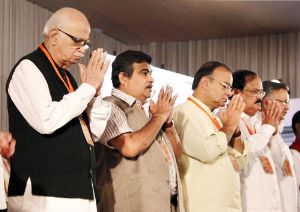
With eye on early Lok Sabha elections, BJP shedding saffron image?

September 30, 2012

BJP-Saffron

New Delhi, September 30: While anticipating that elections may be held earlier than scheduled, BJP has been trying to soften its "hardline Hindutva" image in what appears to be a move to blunt the hostility of Muslims, and reassure its existing allies while reaching out to new partners.


The three-day session of BJP's national executive saw both party president Nitin Gadkari and veteran leader LK Advani condemning the anti-Islam film that has triggered violence in different parts of the globe.


Gadkari on Thursday cited Swami Vivekananda, whose 150th birth anniversary is being planned by the party in a big way, to condemn the film that denigrates Prophet Mohammad.


"It's wrong to spread disrespect towards anybody who is revered by members of a faith. We should with full conviction reassure our brethren belonging to the minority communities that we brook no discrimination or injustice in dealing with different sections of our diverse society," Advani said in a speech that was well received by the audience.


He suggested that doing so would help reassure party's potential allies that "they have nothing to be apprehensive about partnering with BJP". Advani also emphasized the need for broadening the NDA, saying that the grouping has to be transformed into "NDA Plus".


The remark acquires significance in view of the apprehension of an existing ally, Bihar CM Nitish Kumar, as well as the recognition that the fear of losing Muslim support forces some of the anti-Congress players to maintain a distance from the saffron outfit. In fact, Advani's advice that party should undergo an image makeover to appear "secular" appears to articulate especially Kumar's anxiety.


The Bihar CM is apprehensive that the projection of his Gujarat counterpart Narendra Modi as BJP's choice for the PM will deal a setback to his assiduous attempts to woo Muslims away from his rival Lalu Prasad.


Regional players like TDP chief N Chandrababu Naidu and Odisha CM Naveen Patnaik, who are hostile to Congress, are loath to be seen in BJP's company because of the latter's "communal tag".


Though a handicap for the BJP, the "communal" brand works to the advantage of its allies, who cite it to justify their flexibility in choosing allies and taking positions.


On a larger plane, the same factor helps the "secular" rivals to seek to mobilize Muslims against the saffron party.


Comments

Hubert
 - 
Friday, 29 Jan 2016

Whatever might be your alternative, it's better that you simply
do a little analysis relating to the fame and customer help
provided by the binary brokers before you open an account with them to avoid any final minute hassles.

Review my webpage binary trading software review [Angela: http://s3.amazonaws.com/tradoptions/index/182.html]

Add new comment

  • Coastaldigest.com reserves the right to delete or block any comments.
  • Coastaldigset.com is not responsible for its readers’ comments.
  • Comments that are abusive, incendiary or irrelevant are strictly prohibited.
  • Please use a genuine email ID and provide your name to avoid reject.
News Network
April 7,2020

New Delhi, Apr 7: The death toll due to novel coronavirus rose to 114 and the number of cases in the country climbed to 4,421 on Tuesday, according to the Union Health Ministry.

While the number of active COVID-19 cases stood at 3,981, as many as 325 people were cured and discharged, and one had migrated, it stated. The total number of cases include 66 foreign nationals.

According to the ministry's data updated at 9 am, three new deaths were reported from Rajasthan, while Tripura recorded its first coronavirus case.

Maharashtra has reported the most coronavirus deaths at 45, followed by Gujarat at 12, Madhya Pradesh nine, Telangana and Delhi seven each, Punjab six and Tamil Nadu five fatalities.

Karnataka registered four deaths, while West Bengal, Uttar Pradesh, Andhra Pradesh and Rajasthan have recorded three fatalities each. Two deaths each have been reported from Jammu and Kashmir and Kerala. Bihar, Himachal Pradesh and Haryana have reported one fatality each, according to the health ministry data.

However, a PTI tally based on figures reported by states directly on Monday night showed at least 138 deaths across the country, while the confirmed cases reached 4,683. Of them, 359 have been cured and discharged.

There has been a lag in the Union Health Ministry figures, compared to the numbers announced by different states, which officials attribute to procedural delays in assigning the cases to individual states.

The highest number of confirmed cases are from Maharashtra at 748, followed by Tamil Nadu at 621 and Delhi with 523 cases. Kerala reported 327 COVID-19 cases, Telangana 321, Uttar Pradesh 305 and Rajasthan 288 cases. Andhra Pradesh reported 226 coronavirus cases.

Novel coronavirus cases have risen to 165 in Madhya Pradesh, 151 in Karnataka and 144 in Gujarat. Jammu and Kashmir has 109 cases, West Bengal has 91, Haryana 90 and Punjab 76 cases of the infection.

Thirty-two people were infected with the virus in Bihar while Uttarakhand has 31 patients and Assam 26. Odisha reported 21 coronavirus cases, Chandigarh 18, Ladakh 14 and Himachal Pradesh 13 cases.

Ten cases each have been reported from the Andaman and Nicobar Islands and Chhattisgarh. Goa has reported seven COVID-19 infections, followed by Puducherry with five cases. Jharkhand has reported four cases and Manipur two. Tripura, Mizoram and Arunachal Pradesh have reported one case of the infection each.

"State-wise distribution is subject to further verification and reconciliation," the ministry said on its website.

Comments

Add new comment

  • Coastaldigest.com reserves the right to delete or block any comments.
  • Coastaldigset.com is not responsible for its readers’ comments.
  • Comments that are abusive, incendiary or irrelevant are strictly prohibited.
  • Please use a genuine email ID and provide your name to avoid reject.
News Network
June 16,2020

New Delhi, Jun 16: Jet fuel or ATF price on Tuesday was hiked by 16.3 per cent while petrol price was increased by 47 paise per litre and that of diesel by a record 93 paise on the back of firming international oil rates.

Aviation turbine fuel (ATF) price was hiked by ₹5,494.5 per kilolitre (kl), or 16.3 per cent, to ₹39,069.87 per kl in the national capital, according to a price notification by state-owned oil marketing companies.

This is the second straight increase in ATF price this month. Rates were hiked by a record 56.5 per cent (₹12,126.75 per kl) on June 1.

Simultaneously, petrol and diesel prices were hiked for the 10th day in a row.

Petrol price in Delhi was hiked to ₹76.73 per litre from ₹76.26, while diesel rates were increased to ₹75.19 a litre from ₹74.26, the price notification said.

In 10 hikes, petrol price has gone up by ₹5.47 per litre and diesel by Rs 5.8 a litre.

Rates have been increased across the country and vary from state to state depending on the incidence of local sales tax or VAT.

The hike in diesel rates is the highest daily increase since the state-owned fuel retailers started daily revision in rates in May 2017.

Hike for 10th consecutive day

Tuesday’s increase in petrol and diesel price marks the 10th straight day of rise in rates since oil companies on June 7 restarted revising prices in line with costs, after ending an 82-day hiatus.

The freeze in rates was imposed in mid-March soon after the government hiked excise duty on petrol and diesel to shore up additional finances.

Oil PSUs Indian Oil Corp (IOC), Bharat Petroleum Corp Ltd (BPCL) and Hindustan Petroleum Corp Ltd (HPCL) instead of passing on the excise duty hikes to customers adjusted them against the fall in the retail rates that was warranted because of fall in international oil prices.

The June 1 hike in jet fuel price had come after seven consecutive reductions in rates since February. ATF price in Delhi before the reduction cycle began in February was ₹64,323.76 per kilolitre, which got reduced to ₹21,448.62 last month.

Industry officials said the hike was necessitated because benchmark international rates have bounced back from a two-decade low.

While ATF prices are revised on 1st and 16th of every month, petrol and diesel prices are revised on a daily basis.

Oil companies used to revise ATF prices on the first of every month, but adopted fortnightly revisions on March 21 to pass on the benefit of falling international oil prices to airlines.

Comments

Add new comment

  • Coastaldigest.com reserves the right to delete or block any comments.
  • Coastaldigset.com is not responsible for its readers’ comments.
  • Comments that are abusive, incendiary or irrelevant are strictly prohibited.
  • Please use a genuine email ID and provide your name to avoid reject.
Agencies
June 30,2020

United Nations, Jun 30: India accounts for 45.8 million of the world's 142.6 million "missing females" over the past 50 years, a report by the United Nations said on Tuesday, noting that the country along with China form the majority of such women globally.

The State of World Population 2020 report released on Tuesday by the United Nations Population Fund (UNFPA), the world organisation's sexual and reproductive health agency, said that the number of missing women has more than doubled over the past 50 years - from 61 million in 1970 to a cumulative 142.6 million in 2020.

Of this global figure, India accounted for 45.8 million missing females as of 2020 and China accounted for 72.3 million.

Missing females are women missing from the population at given dates due to the cumulative effect of postnatal and prenatal sex selection in the past, the agency said.

Between 2013 and 2017, about 460,000 girls in India were missing' at birth each year. According to one analysis, gender-biased sex selection accounts for about two-thirds of the total missing girls, and post-birth female mortality accounts for about one-third, the report said.

Citing data by experts, it said that China and India together account for about 90-95 per cent of the estimated 1.2 million to 1.5 million missing female births annually worldwide due to gender-biased (prenatal) sex selection.

The two countries also account for the largest number of births each year, it said.

The report cites data by Alkema, Leontine and others, 2014 National, Regional, and Global Sex Ratios of Infant, Child, and under-5 Mortality and Identification of Countries with Outlying Ratios: A Systematic Assessment' from The Lancet Global Health.

According to their analysis, India has the highest rate of excess female deaths, 13.5 per 1,000 female births, which suggests that an estimated one in nine deaths of females below the age of 5 may be attributed to postnatal sex selection.

The report notes that governments have also taken action to address the root causes of sex selection. India and Vietnam have included campaigns that target gender stereotypes to change attitudes and open the door to new norms and behaviours.

They spotlight the importance of daughters and highlight how girls and women have changed society for the better. Campaigns that celebrate women's progress and achievements may resonate more where daughter-only families can be shown to be prospering, it said.

The report said that successful education-related interventions include the provision of cash transfers conditional on school attendance; or support to cover the costs of school fees, books, uniforms and supplies, taking note of successful cash-transfer initiatives such as Apni Beti Apna Dhan' in India.

It said that preference for a male child manifested in sex selection has led to dramatic, long-term shifts in the proportions of women and men in the populations of some countries.

This demographic imbalance will have an inevitable impact on marriage systems. In countries where marriage is nearly universal, many men may need to delay or forego marriage because they will be unable to find a spouse, the report said.

This so-called "marriage squeeze", where prospective grooms outnumber prospective brides, has already been observed in some countries and affects mostly young men from lower economic strata.

"At the same time, the marriage squeeze could result in more child marriages, the report said citing experts.

Some studies suggest that the marriage squeeze will peak in India in 2055. The proportion of men who are still single at the age of 50 is forecast to rise after 2050 in India to 10 per cent, it said.

The UN report said that every year, millions of girls globally are subjected to practices that harm them physically and emotionally, with the full knowledge and consent of their families, friends and communities.

At least 19 harmful practices, ranging from breast ironing to virginity testing, are considered human rights violations, according to the UNFPA report, which focuses on the three most prevalent ones: female genital mutilation, child marriage, and extreme bias against daughters in favour of sons.

Harmful practices against girls cause profound and lasting trauma, robbing them of their right to reach their full potential, says UNFPA Executive Director Dr. Natalia Kanem.

This year, an estimated 4.1 million girls will be subjected to female genital mutilation. Today, 33,000 girls under age 18 will be forced into marriages, usually to much older men and an extreme preference for sons over daughters in some countries has fuelled gender-biased sex selection or extreme neglect that leads to their death as children, resulting in the 140 million missing females.

The report said that ending child marriage and female genital mutilation worldwide is possible within 10 years by scaling up efforts to keep girls in school longer and teach them life skills and to engage men and boys in social change.

Investments totalling USD 3.4 billion a year through 2030 would end these two harmful practices and end the suffering of an estimated 84 million girls, it said.

A recent analysis revealed that if services and programmes remain shuttered for six months due to the COVID-19 pandemic, an additional 13 million girls may be forced into marriage and 2 million more girls may be subjected to female genital mutilation between now and 2030.

The pandemic both makes our job harder and more urgent as so many more girls are now at risk, Kanem said.


Comments

Add new comment

  • Coastaldigest.com reserves the right to delete or block any comments.
  • Coastaldigset.com is not responsible for its readers’ comments.
  • Comments that are abusive, incendiary or irrelevant are strictly prohibited.
  • Please use a genuine email ID and provide your name to avoid reject.