



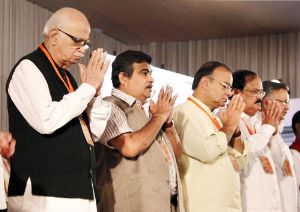
With eye on early Lok Sabha elections, BJP shedding saffron image?

September 30, 2012

BJP-Saffron

New Delhi, September 30: While anticipating that elections may be held earlier than scheduled, BJP has been trying to soften its "hardline Hindutva" image in what appears to be a move to blunt the hostility of Muslims, and reassure its existing allies while reaching out to new partners.


The three-day session of BJP's national executive saw both party president Nitin Gadkari and veteran leader LK Advani condemning the anti-Islam film that has triggered violence in different parts of the globe.


Gadkari on Thursday cited Swami Vivekananda, whose 150th birth anniversary is being planned by the party in a big way, to condemn the film that denigrates Prophet Mohammad.


"It's wrong to spread disrespect towards anybody who is revered by members of a faith. We should with full conviction reassure our brethren belonging to the minority communities that we brook no discrimination or injustice in dealing with different sections of our diverse society," Advani said in a speech that was well received by the audience.


He suggested that doing so would help reassure party's potential allies that "they have nothing to be apprehensive about partnering with BJP". Advani also emphasized the need for broadening the NDA, saying that the grouping has to be transformed into "NDA Plus".


The remark acquires significance in view of the apprehension of an existing ally, Bihar CM Nitish Kumar, as well as the recognition that the fear of losing Muslim support forces some of the anti-Congress players to maintain a distance from the saffron outfit. In fact, Advani's advice that party should undergo an image makeover to appear "secular" appears to articulate especially Kumar's anxiety.


The Bihar CM is apprehensive that the projection of his Gujarat counterpart Narendra Modi as BJP's choice for the PM will deal a setback to his assiduous attempts to woo Muslims away from his rival Lalu Prasad.


Regional players like TDP chief N Chandrababu Naidu and Odisha CM Naveen Patnaik, who are hostile to Congress, are loath to be seen in BJP's company because of the latter's "communal tag".


Though a handicap for the BJP, the "communal" brand works to the advantage of its allies, who cite it to justify their flexibility in choosing allies and taking positions.


On a larger plane, the same factor helps the "secular" rivals to seek to mobilize Muslims against the saffron party.


Comments

Hubert
 - 
Friday, 29 Jan 2016

Whatever might be your alternative, it's better that you simply
do a little analysis relating to the fame and customer help
provided by the binary brokers before you open an account with them to avoid any final minute hassles.

Review my webpage binary trading software review [Angela: http://s3.amazonaws.com/tradoptions/index/182.html]

Add new comment

  • Coastaldigest.com reserves the right to delete or block any comments.
  • Coastaldigset.com is not responsible for its readers’ comments.
  • Comments that are abusive, incendiary or irrelevant are strictly prohibited.
  • Please use a genuine email ID and provide your name to avoid reject.
News Network
August 7,2020

Idukki, Aug 7: Several people lost their lives and dozens of tea estate workers are feared trapped under soil in Kerala’s Munnar after torrential rains triggered a massive landslide on today. 

As many as five bodies have been recovered and rescue workers are fighting inclement weather to remove the debris.

According to rescue workers, four lanes of quarters and a church are buried under mud and around 80 people are feared trapped.

Seven people have been rescued so far and shifted to the hospital.

Sources said a portion of Pettimudi came crashing down on the workers colony with a deafening roar in the wee hours of Friday.

As people were sleeping in the quarters, there was little time to escape.

Further, with the Periyavara bridge being washed away, it became all the more difficult for rescue workers to reach the spot.

The construction of a new temporary Periyavara bridge however, is underway.

The bridge was previously destructed during the deluge of August 2018. Later during the north west monsoons and the south west monsoon of 2019, it suffered damage again.

The present bridge, which got damaged on Thursday after Kannimala river levels rose, was constructed under the leadership of Coir fed.

Although a new concrete bridge has been constructed near the temporary bridge in Periyavara, vehicle  movement has not been possible because the authorities are yet to build its approach via road.

The new bridge is to be constructed at a cost of Rs 4.75 crore from Devikulam MLA S Rajendran's fund.

The entire area has been cut off from outside world and communication networks have also crashed.

Teams of Fire and Rescue personnel, NDRF, revenue officials, estate workers and police are struggling to conduct rescue operations.

Meanwhile, District collector H Dhineshan said a team of rescue personnel was sent to Pettymudy after he was briefed about the mishap and search operations to locate and rescue people are underway.

Facilities have been arranged at the hospitals nearby to provide necessary treatment facilities to the people being rescued.

Comments

Add new comment

  • Coastaldigest.com reserves the right to delete or block any comments.
  • Coastaldigset.com is not responsible for its readers’ comments.
  • Comments that are abusive, incendiary or irrelevant are strictly prohibited.
  • Please use a genuine email ID and provide your name to avoid reject.
Agencies
January 7,2020

New Delhi, Jan 7: Services at various bank branches and ATMs are likely to be affected as hundreds of employees will go on a bank strike across the country on Wednesday.

The bank strike is part of the Bharat Bandh call given by trade unions to protest against the labour reforms and economic policies of the Central government, according to reports.

The protestors' main demand during the Bharat Bandh is that the Centre should drop the proposed labour reforms.

A Bill in this regard was passed and proposes to merge 44 labour laws into four codes -- wages, industrial relations, social security, and safe working conditions.

Comments

Add new comment

  • Coastaldigest.com reserves the right to delete or block any comments.
  • Coastaldigset.com is not responsible for its readers’ comments.
  • Comments that are abusive, incendiary or irrelevant are strictly prohibited.
  • Please use a genuine email ID and provide your name to avoid reject.
Agencies
June 15,2020

New Delhi, Jun 15: Average temperature of India experienced a rise of 0.7 degree Celsius, along with decline in rainfall, significant increase in frequency of very severe cyclonic storms and droughts in over a decade due to human activities, the Ministry of Earth Sciences in its research report said.

The contentions were made in a report issued by the ministry on the impact of climate change. It will be published by Union Minister Harsh Vardhan on June 19.

According to the report, "Since the middle of the twentieth century, India witnessed rise in temperature; decrease in monsoon; rise in extreme temperature and rainfall, droughts, and sea levels; and increase intensity of severe cyclones.

The report, prepared by researchers of the Centre for Climate Change Research, a cell under The Ministry's Indian Institute of Tropical Meteorology, Pune, further stated that there is compelling scientific evidence that human activities have influenced these changes in regional climate.

India's average temperature has risen by around 0.7 degrees Celsius during 1901-2018, it said, adding that the rise is largely on account of GHG-induced warming and partially offset by forcing due to anthropogenic aerosols.

It states that the average temperature over India is projected to rise by 4.4 degrees Celsius, while the intensity of heat waves is likely to increase by 3-4 times by the end of the century.

In the 30-year period between 1986 and 2015, temperatures of the warmest day and the coldest night of the year have risen by about 0.63 degrees Celsius and 0.4 degree Celsius.

According to the report, by the end of the century, the temperatures of the warmest day and the coldest night are projected to rise by approximately 4.7 degrees Celsius and 5.5 degrees Celsius, respectively.

Alarmingly, sea surface temperature of the tropical Indian Ocean has also risen by one degrees Celsius on average during 1951-2015.

"The frequency of very severe cyclonic storms during the post-monsoon season has increased significantly (+1 event per decade) during the last two decades (2000-2018)," it added.

This came in the backdrop of Cyclone 'Amphan' and 'Nisarga' which made landfalls on May 20 and June 3 and killed several people, flattened villages, and destroyed farms.

"This is the first-ever climate change assessment report for India. This report will be very useful for policy makers, researchers, social scientists, economists, and students," said M. Rajeevan, secretary, the Ministry of Earth Sciences.

Besides this, the report also highlighted various other unnerving data on climate change in the country. Both the frequency and extent of droughts have increased significantly during 1951-2016.

The overall decrease of seasonal "summer monsoon rainfall" during the last 6-7 decades has led to an increased propensity for droughts over India.

"In particular, areas over central India, southwest coast, southern peninsula and north-eastern India have experienced more than 2 droughts per decade, on average, during this period. The area affected by drought has also increased by 1.3 per cent per decade over the same period."

The Hindu Kush Himalayas (HKH) also experienced a temperature rise of about 1.3 degree Celsius during 1951-2014.

Several areas of the Himalayas have experienced a declining trend in snowfall and also retreat of glaciers in recent decades. By the end of the twenty-first century, its annual mean surface temperature is projected to increase by about 5.2 degree Celsius.

The summer monsoon precipitation from June to September over India has also declined by around 6 per cent from 1951 to 2015, with notable decreases over the Indo-Gangetic Plains and the Western Ghats, the report further states.

Comments

Add new comment

  • Coastaldigest.com reserves the right to delete or block any comments.
  • Coastaldigset.com is not responsible for its readers’ comments.
  • Comments that are abusive, incendiary or irrelevant are strictly prohibited.
  • Please use a genuine email ID and provide your name to avoid reject.