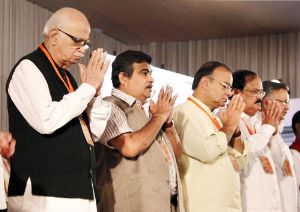
With eye on early Lok Sabha elections, BJP shedding saffron image?

September 30, 2012

BJP-Saffron

New Delhi, September 30: While anticipating that elections may be held earlier than scheduled, BJP has been trying to soften its "hardline Hindutva" image in what appears to be a move to blunt the hostility of Muslims, and reassure its existing allies while reaching out to new partners.


The three-day session of BJP's national executive saw both party president Nitin Gadkari and veteran leader LK Advani condemning the anti-Islam film that has triggered violence in different parts of the globe.


Gadkari on Thursday cited Swami Vivekananda, whose 150th birth anniversary is being planned by the party in a big way, to condemn the film that denigrates Prophet Mohammad.


"It's wrong to spread disrespect towards anybody who is revered by members of a faith. We should with full conviction reassure our brethren belonging to the minority communities that we brook no discrimination or injustice in dealing with different sections of our diverse society," Advani said in a speech that was well received by the audience.


He suggested that doing so would help reassure party's potential allies that "they have nothing to be apprehensive about partnering with BJP". Advani also emphasized the need for broadening the NDA, saying that the grouping has to be transformed into "NDA Plus".


The remark acquires significance in view of the apprehension of an existing ally, Bihar CM Nitish Kumar, as well as the recognition that the fear of losing Muslim support forces some of the anti-Congress players to maintain a distance from the saffron outfit. In fact, Advani's advice that party should undergo an image makeover to appear "secular" appears to articulate especially Kumar's anxiety.


The Bihar CM is apprehensive that the projection of his Gujarat counterpart Narendra Modi as BJP's choice for the PM will deal a setback to his assiduous attempts to woo Muslims away from his rival Lalu Prasad.


Regional players like TDP chief N Chandrababu Naidu and Odisha CM Naveen Patnaik, who are hostile to Congress, are loath to be seen in BJP's company because of the latter's "communal tag".


Though a handicap for the BJP, the "communal" brand works to the advantage of its allies, who cite it to justify their flexibility in choosing allies and taking positions.


On a larger plane, the same factor helps the "secular" rivals to seek to mobilize Muslims against the saffron party.


Comments

Hubert
 - 
Friday, 29 Jan 2016

Whatever might be your alternative, it's better that you simply
do a little analysis relating to the fame and customer help
provided by the binary brokers before you open an account with them to avoid any final minute hassles.

Review my webpage binary trading software review [Angela: http://s3.amazonaws.com/tradoptions/index/182.html]

Add new comment

  • Coastaldigest.com reserves the right to delete or block any comments.
  • Coastaldigset.com is not responsible for its readers’ comments.
  • Comments that are abusive, incendiary or irrelevant are strictly prohibited.
  • Please use a genuine email ID and provide your name to avoid reject.
News Network
March 26,2020

New Delhi, Mar 26: Despite repeated assurances by the Centre and state government of no shortage of food and essential services in Delhi, many daily wage earners have started fleeing the national capital on foot to return to their native villages in nearby Uttar Pradesh and other states because of the hardships being faced by them.
Most daily wage earners who are fleeing have complained that they are doing so because they will die of hunger due to lack of resources at their disposal.
"I am going to Azamgarh, my native place which is more than 800 kilometers from here. We have started walking towards our village. On the roads, if we get some vehicles then it will be all right otherwise we will continue on foot. I used to work in the construction sector but all work has stopped, we therefore have no other means to buy our rations. Atleast, food is guaranteed in our homes," Ghanshyam, a daily wage earner, told ANI here.
Rani, another daily wage earner, who was fleeing Delhi along with her family said, "Who would want to leave on foot, but what other options do we have. Our children will die of hunger, even if they are saved from the disease. That is why we are leaving."
While the government has been assuring that it will provide food and other essentials to the low-income groups, the people complained that they are yet to receive any help.
The departing of people has started despite repeated warnings by governments to prevent the influx of persons living in other states to curtail the spread of coronavirus.
Prince, who used to reside in Mongolpuri area of Delhi, said, "If we continue to stay the landlord will pester us for rent. The prices of all commodities are rising with each passing day, this way we will have nothing left to survive. We did not get any help from the government. I am, therefore, returning to Kasganj, which is close to 300 kilometres from Delhi. We will at least get food served twice a day in the village, nobody is offering us even water here."
Earlier on Tuesday, Delhi Chief Minister Arvind Kejriwal had announced Rs 5,000 for each construction worker under Construction Workers Welfare Board Fund.
Addressing a video conference here, he said, "The Delhi government will give Rs 5,000 to each construction worker as their livelihood has been affected due the outbreak of coronavirus."
He also said that the number of night shelters in the city has been increased and more food is being distributed to homeless people.
He also said that due to curfew, several people were not able to get food, and urged the public to send such people to the nearest shelters of the Delhi government, where food was being arranged.

Comments

Add new comment

  • Coastaldigest.com reserves the right to delete or block any comments.
  • Coastaldigset.com is not responsible for its readers’ comments.
  • Comments that are abusive, incendiary or irrelevant are strictly prohibited.
  • Please use a genuine email ID and provide your name to avoid reject.
Agencies
May 27,2020

New Delhi, May 27: India’s fourth recession since Independence, first since liberalisation, and perhaps the worst to date is here, according to rating agency, Crisil.

CRISIL sees the Indian economy shrinking 5 per cent in fiscal 2021 (on-year), because of the Covid-19 pandemic. The first quarter will suffer a staggering 25 per cent contraction.

About 10 per cent of gross domestic product (GDP) in real terms could be permanently lost. "So going back to the growth rates seen before the pandemic is unlikely in the next three fiscals", Crisil said.

Crisil has revised its earlier forecast downwards. "Earlier, on April 28, we had slashed our prediction to 1.8 per cent growth from 3.5 per cent growth. Things have only gone downhill since", it said.

While we expect non-agricultural GDP to contract 6 per cent, agriculture could cushion the blow by growing at 2.5 per cent.

In the past 69 years, India has seen a recession only thrice as per available data in fiscals 1958, 1966 and 1980. The reason was the same each time a monsoon shock that hit agriculture, then a sizeable part of the economy.

"The recession staring at us today is different," it added. For one, agriculture could soften the blow this time by growing near its trend rate, assuming a normal monsoon. Two, the pandemic-induced lockdowns have affected most non-agriculture sectors. And three, the global disruption has upended whatever opportunities India had on the exports front.

Economic conditions have slid precipitously since the April-end forecast of 1.8 per cent GDP growth for fiscal 2021 (baseline), Crisil said.

On the lockdown extension, it said that the government has extended the lockdown four times to deal with the rising number of cases, curtailing economic activity severely (lockdown 4.0 is ending on May 31).

The first quarter of this fiscal will be the worst affected. June is unlikely to see major relaxations as the Covid-19 affliction curve is yet to flatten in India.

"Not only will the first quarter be a washout for the non-agricultural economy, services such as education, and travel and tourism among others, could continue to see a big hit in the quarters to come. Jobs and incomes will see extended losses as these sectors are large employers," Crisil said.

CRISIL also foresees economic activity in states with high Covid-19 cases to suffer prolonged disruption as restrictions could continue longer.

A rough estimate based on a sample of eight states, which contribute over half of India's GDP, shows that their 'red zones' (as per lockdown 3.0) contributed 42 per cent to the state GDP on average regardless of the share of such red zones.

On average, the orange zones contribute 46 per cent, while the green zones where activity is allowed to be close to normal contribute only 12 per cent to state GDP.

The economic costs are higher than earlier expectations, according to Crisil. The economic costs now beginning to show up in the hard numbers are far worse than initial expectations.

Industrial production for March fell by over 16%. The purchasing managers indices for the manufacturing and services sectors were at 27.4 and 5.4, respectively, in April, implying extraordinary contraction. That compares with 51.8 and 49.3, respectively, in March.

Exports contracted 60.3 per cent in April, and new telecom subscribers declined 35 per cent, while railway freight movement plunged 35 per cent on-year.

"Indeed, given one of the most stringent lockdowns in the world, April could well be the worst performing month for India this fiscal," it said.

Added to that is the economic package without enough muscle. The government recently announced a Rs 20.9 lakh crore economic relief package to support the economy. The package has some short-term measures to cushion the economy, but sets its sights majorly on reforms, most of which will have payoffs only over the medium term.

"We estimate the fiscal cost of this package at 1.2 per cent of GDP, which is lower than what we had assumed in our earlier estimate (when we foresaw a growth in GDP)," it said.

"We believe a catch-up to the pre-crisis trend level of GDP growth will not be possible in the next three fiscals despite policy support. Under the base case, we estimate a 10 per cent permanent loss to real GDP (from the decadal-trend level), assuming average growth of about 7 per cent between fiscals 2022 and 2024," Crisil said.

Interestingly, after the Global Financial Crisis (GFC), a sharp growth spurt helped catch up with the trend within two years. GDP grew 8.2 per cent on average in the two fiscals following the GFC. Massive fiscal spending, monetary easing and swift global recovery played a role in a V-shaped recovery.

To catch-up would require average GDP growth to surge to 11 per cent over the next three fiscals, something that has never happened before.

The research said that successive lockdowns have a non-linear and multiplicative effect on the economy a two-month lockdown will be more than twice as debilitating as a one-month imposition, as buffers keep eroding.

Partial relaxations continue to be a hindrance to supply chains, transportation and logistics. Hence, unless the entire supply chain is unlocked, the impact of improved economic activity will be subdued.

Therefore, despite the stringency of lockdown easing a tad in the third and the fourth phases, their negative impact on GDP is expected to massively outweigh the benefits from mild fiscal support and low crude oil prices, especially in the April-June quarter. "Consequently, we expect the current quarter's GDP to shrink 25 per cent on-year," it said.

Counting lockdown 4.0, Indians have had 68 days of confinement. S&P Global estimates that one month of lockdown shaves 3 per cent off annual GDP on average across Asia-Pacific.

Since India's lockdown has been the most stringent in Asia, the impact on economic growth will be correspondingly larger.

Google's Community Mobility Reports show a sharp fall in movement of people to places of recreation, retail shops, public transport and workplace travel. While data for May shows some improvement in India, mobility trends are much below the average or baseline, and lower compared with countries such as the US, South Korea, Brazil and Indonesia.


Comments

Add new comment

  • Coastaldigest.com reserves the right to delete or block any comments.
  • Coastaldigset.com is not responsible for its readers’ comments.
  • Comments that are abusive, incendiary or irrelevant are strictly prohibited.
  • Please use a genuine email ID and provide your name to avoid reject.
News Network
March 26,2020

New Delhi, Mar 26: Finance Minister Nirmala Sitharaman on Thursday announced a Rs 50 lakh insurance cover for healthcare workers who are at the forefront of dealing with coronavirus pandemic.

Sitharaman said the government has finalised an economic stimulus package to deal with the impact of 21-day countrywide lockdown to prevent spread of the virus.

“It’s only 36 hours since the lockdown has been imposed. Now we have come with a package which immediately take care of the welfare concerns of the poor and suffering workers and those who need immediate help,” Sitharaman said.

She also said that 80 crore poor people, nearly two thirds of the population  will get five kg of rice or wheat per month for three months, in addition to the 5 kg they already receive, for free."

The rationcard holders can take the foodgrains and pulses from the Public Distribution System (PDS) in two installments, she added.

"This measure will ensure no gareeb (poor) remains hungry," Sitharaman said.

The package will include cash transfer and food subsidy, she said.

"Farmers who currently receive Rs 6,000 annually, will be given the first installment of the next financial year immediately. 8.7 crore farmers will benefit from it," said Sitharaman.

As many of 20.5 crore women Jan Dhan Account holders will get Rs 500 per month for next three months to run their households.

For poor senior citizens, widow and disabled will get an ex-gratia of Rs 1,000.

Also, the daily wage under MNREGA has been increased to Rs 202 a day from Rs 182 to benefit 5 crore workers.

The minister said the government will front-load Rs 2,000 payment to farmers in the first week of April under the existing PM Kishan Yojana to benefit 8.69 crore farmers.

Also, the beneficiaries of Ujjwala LPG scheme will get free cooking gas for the next three months, she said.

This forms part of the Rs 1.70 lakh crore Gramin Kalyan Package.

Prime Minister Narendra Modi last week had constituted a task force headed by the Finance Minister to work out package for economy hit by coronavirus.

Comments

Add new comment

  • Coastaldigest.com reserves the right to delete or block any comments.
  • Coastaldigset.com is not responsible for its readers’ comments.
  • Comments that are abusive, incendiary or irrelevant are strictly prohibited.
  • Please use a genuine email ID and provide your name to avoid reject.