


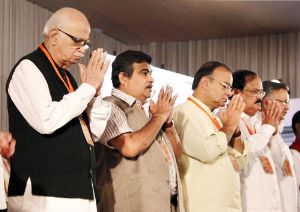
With eye on early Lok Sabha elections, BJP shedding saffron image?

September 30, 2012

BJP-Saffron

New Delhi, September 30: While anticipating that elections may be held earlier than scheduled, BJP has been trying to soften its "hardline Hindutva" image in what appears to be a move to blunt the hostility of Muslims, and reassure its existing allies while reaching out to new partners.


The three-day session of BJP's national executive saw both party president Nitin Gadkari and veteran leader LK Advani condemning the anti-Islam film that has triggered violence in different parts of the globe.


Gadkari on Thursday cited Swami Vivekananda, whose 150th birth anniversary is being planned by the party in a big way, to condemn the film that denigrates Prophet Mohammad.


"It's wrong to spread disrespect towards anybody who is revered by members of a faith. We should with full conviction reassure our brethren belonging to the minority communities that we brook no discrimination or injustice in dealing with different sections of our diverse society," Advani said in a speech that was well received by the audience.


He suggested that doing so would help reassure party's potential allies that "they have nothing to be apprehensive about partnering with BJP". Advani also emphasized the need for broadening the NDA, saying that the grouping has to be transformed into "NDA Plus".


The remark acquires significance in view of the apprehension of an existing ally, Bihar CM Nitish Kumar, as well as the recognition that the fear of losing Muslim support forces some of the anti-Congress players to maintain a distance from the saffron outfit. In fact, Advani's advice that party should undergo an image makeover to appear "secular" appears to articulate especially Kumar's anxiety.


The Bihar CM is apprehensive that the projection of his Gujarat counterpart Narendra Modi as BJP's choice for the PM will deal a setback to his assiduous attempts to woo Muslims away from his rival Lalu Prasad.


Regional players like TDP chief N Chandrababu Naidu and Odisha CM Naveen Patnaik, who are hostile to Congress, are loath to be seen in BJP's company because of the latter's "communal tag".


Though a handicap for the BJP, the "communal" brand works to the advantage of its allies, who cite it to justify their flexibility in choosing allies and taking positions.


On a larger plane, the same factor helps the "secular" rivals to seek to mobilize Muslims against the saffron party.


Comments

Hubert
 - 
Friday, 29 Jan 2016

Whatever might be your alternative, it's better that you simply
do a little analysis relating to the fame and customer help
provided by the binary brokers before you open an account with them to avoid any final minute hassles.

Review my webpage binary trading software review [Angela: http://s3.amazonaws.com/tradoptions/index/182.html]

Add new comment

  • Coastaldigest.com reserves the right to delete or block any comments.
  • Coastaldigset.com is not responsible for its readers’ comments.
  • Comments that are abusive, incendiary or irrelevant are strictly prohibited.
  • Please use a genuine email ID and provide your name to avoid reject.
News Network
June 11,2020

Washington, Jun 11: Observing that historically India has been a tolerant, respectful country for all religions, a top Trump administration official has said the US is "very concerned" about what is happening in India over religious freedom.

The comments by Samuel Brownback, Ambassador-At-Large for International Religious Freedom, came hours after the release of the "2019 International Religious Freedom Report" on Wednesday.

Mandated by the US Congress, the report documenting major instances of violation of religious freedom across the world was released by Secretary of State Mike Pompeo at the State Department.

India has previously rejected the US religious freedom report, saying it sees no locus standi for a foreign government to pronounce on the state of its citizens' constitutionally protected rights.

"We do remain very concerned about what's taking place in India. It's historically just been a very tolerant, respectful country of religions, of all religions," Mr Brownback said during a phone call with foreign journalists on Wednesday.

The trend lines have been troubling in India because it is such a religious subcontinent and seeing a lot more communal violence, Mr Brownback said. "We're seeing a lot more difficulty. I think really they need to have a - I would hope they would have an - interfaith dialogue starting to get developed at a very high level in India, and then also deal with the specific issues that we identified as well," he said.

"It really needs a lot more effort on this topic in India, and my concern is, too, that if those efforts are not put forward, you're going to see a growth in violence and increased difficulty within the society writ large," said the top American diplomat.

Responding to a question, Mr Brownback said he hoped minority faiths are not blamed for the COVID-19 spread and that they would have access to healthcare amid the crisis.

Prime Minister Narendra Modi has criticised any form of discrimination, saying the COVID-19 pandemic affects everyone equally. "COVID-19 does not see race, religion, colour, caste, creed, language or border before striking. Our response and conduct thereafter should attach primacy to unity and brotherhood," PM Modi said in a post on LinkedIn in February.

The government, while previously rejecting the US religious freedom report, had said: "India is proud of its secular credentials, its status as the largest democracy and a pluralistic society with a longstanding commitment to tolerance and inclusion".

"The Indian Constitution guarantees fundamental rights to all its citizens, including its minority communities… We see no locus standi for a foreign entity/government to pronounce on the state of our citizens' constitutionally protected rights," the Foreign Ministry said in June last year.

According to the Home Ministry, 7,484 incidents of communal violence took place between 2008 and 2017, in which more than 1,100 people were killed.

Comments

Add new comment

  • Coastaldigest.com reserves the right to delete or block any comments.
  • Coastaldigset.com is not responsible for its readers’ comments.
  • Comments that are abusive, incendiary or irrelevant are strictly prohibited.
  • Please use a genuine email ID and provide your name to avoid reject.
News Network
July 19,2020

New Delhi, Jul 19: India's Covid-19 case fatality rate is "progressively falling" and is currently at 2.49 per cent, which is one of the lowest in the world, the Union Health Ministry said on Sunday, crediting efficient clinical management of hospitalised cases for it.

There are 29 states and union territories with a case fatality rate (CFR) lower than India's average, with five of them having a CFR of zero and 14 having fatality rate of less than 1 per cent.

The focused efforts of the Centre and state and UT governments on efficient clinical management of hospitalised cases have ensured that India's case fatality rate has fallen below 2.5 per cent, the ministry said.

With effective containment strategy, aggressive testing and standardized clinical management protocols based on holistic standard of care approach, the CFR has significantly dipped, it said.

"The CFR is progressively falling and currently, it is 2.49 per cent. India has one of the lowest fatality rates in the world," the ministry said.

From 2.82 per cent over a month earlier, India's Covid-19 case fatality rate declined to 2.72 per cent on July 10 and has further reduced to 2.49 per cent presently.

Under the guidance of the Centre, the state and UT governments have ramped up testing and hospital infrastructure by combining public and private sector efforts, the ministry said.

Many states have conducted the population surveys to map and identify the vulnerable population like the elderly, pregnant women and those with co-morbidities.

This, with the help of technological solutions like mobile apps, has ensured keeping the high-risk population under continuous observation, thus aiding early identification, timely clinical treatment and reducing fatalities, the ministry said.

"At the ground level, frontline health workers like ASHAs (Accredited Social Health Activists) and ANMs (Auxiliary Nursing Midwives) have done a commendable job of managing the migrant population and to enhance awareness at the community level.

"As a result, there are 29 States and UTs with CFR lower than India's average. This shows commendable work done by public health apparatus of the country," the ministry said.

Manipur, Nagaland, Sikkim, Mizoram, Andaman and Nicobar Islands have zero case fatality rate.

States and UTs having a CFR below the national average include Tripura (0.19 pc),  Assam (0.23 pc), Kerala (0.34 pc), Odisha (0.51 pc), Goa (0.60 pc), Himachal Pradesh (0.75 pc), Bihar (0.83 pc), Telangana (0.93 pc), Andhra Pradesh (1.31 pc), Tamil Nadu (1.45 pc), Chandigarh (1.71 pc), Rajasthan (1.94 pc), Karnataka (2.08 pc) and Uttar Pradesh (2.36 pc).

India saw a record single-day jump of 38,902 Covid-19 cases pushing its tally to 10,77,618 on Sunday, while the total number of recoveries increased to 6,77,422.

A total of 23, 672 patients have recuperated in the past 24 hours, the highest so far in a day, according to the health ministry data updated at 8 AM.

According to the Indian Council of Medical Research (ICMR), a cumulative total of 1,37,91,869 samples have been tested up to July 18 with 3,58,127 samples being tested on Saturday. 

Comments

Add new comment

  • Coastaldigest.com reserves the right to delete or block any comments.
  • Coastaldigset.com is not responsible for its readers’ comments.
  • Comments that are abusive, incendiary or irrelevant are strictly prohibited.
  • Please use a genuine email ID and provide your name to avoid reject.
News Network
April 22,2020

New Delhi, Apr 22: Prime Minister Narendra Modi on Wednesday said that The Epidemic Diseases (Amendment) Ordinance, 2020, manifests his government's commitment to protecting healthcare workers braving COVID-19 on the frontline.
"The Epidemic Diseases (Amendment) Ordinance, 2020, manifests our commitment to protect each and every healthcare worker, who is bravely battling COVID-19 on the frontline. It will ensure the safety of our professionals. There can be no compromise on their safety!," Prime Minister Modi tweeted.
The Central government on Wednesday brought an ordinance to end the violence against health workers, making it a cognizable, non-bailable offence with the imprisonment of up to seven years for those found guilty.

"We have brought an ordinance under which any attack on health workers will be a cognizable, non-bailable offence. In the case of grievous injuries, the accused can be sentenced from 6 months to 7 years. They can be penalised from Rs 1 lakh to Rs 5 lakh," Union Minister Prakash Javadekar briefed media after the meeting of the Cabinet.

"Such crime will now be cognisable and non-bailable. An investigation will be done within 30 days. Accused can be sentenced from three months to five years, and penalised from Rs 50,000 up to Rs 2 lakh," said Javadekar.

Moreover, if the damage is done to vehicles or clinics of healthcare workers, then a compensation amounting to twice the market value of the damaged property will be taken from the accused, said Javadekar.

Comments

Add new comment

  • Coastaldigest.com reserves the right to delete or block any comments.
  • Coastaldigset.com is not responsible for its readers’ comments.
  • Comments that are abusive, incendiary or irrelevant are strictly prohibited.
  • Please use a genuine email ID and provide your name to avoid reject.