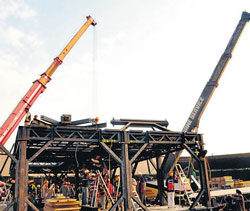
10-storey building in 48 hrs!

November 30, 2012

building-48hr

Chandigarh, November 30: It is a sort of an epitome of architectural efficacy. Engineers in Punjab’s Mohali have set their sight on erecting a 10-storey building in the next 48 hours. Work to accomplish the unprecedented feat started on Thursday.

Businessman Harpal Singh, who conceived the project, claimed that the “building will be an energy efficient model with one sample floor fully furnished.” Engineers in charge of the project said the whole building was pre-fabricated. Components like doors, floors, water supply and wiring components were ready and needs to be fitted as the building scales up. A special transportation vehicle was deployed to ferry the components to the building site.

“Doors just need to be fitted. Water supply components, wiring, sanitation, air conditioning ducts are ready to be installed,” Singh said. Punjab Deputy Chief Minister Sukhbir Singh Badal laid the foundation stone of the building, INSTACON, on Thursday.

The idea behind the exercise, Singh said, was to draw attention towards a better, energy efficient construction technology that will enable builders and owners generate revenue within days, instead of waiting months together for the building to be completed.

Hundreds of workers, engineers and technicians are involved in the project. “The technology could revolutionise the infrastructure sector and speed up construction of commercial towers, luxury hotels, high-rise buildings, hospitals, educational institutions, universities and retail outlets,” Singh said. Architects, planners and engineers from various places have been invited to witness the construction.

Badal said the Punjab government will soon notify a new policy for attracting investment in the realty sector. The policy will be in the public domain by December 15. “The new policy is aimed at making it hassle-free for the investors, ensuring time bound clearances, besides offering various other incentives. Punjab will like to encourage high-rise buildings. The government plans to construct two lakh EWS houses in the next one year and the new building technology unveiled today could be used in such houses.”

Punjab DGP S S Saini was also present at the event.


Comments

Add new comment

  • Coastaldigest.com reserves the right to delete or block any comments.
  • Coastaldigset.com is not responsible for its readers’ comments.
  • Comments that are abusive, incendiary or irrelevant are strictly prohibited.
  • Please use a genuine email ID and provide your name to avoid reject.
News Network
March 4,2020

New Delhi, Mar 4: A court in Delhi on Wednesday convicted expelled BJP MLA Kuldeep Singh Sengar of culpable homicide not amounting to murder in the death of the Unnao rape victim's father.

District judge Dharmesh Sharma said Sengar had no intention of killing the victim's father. “He was beaten in a brutal manner that led to his death,” the judge said.

The court had sent Sengar to jail on December 20 for the “remainder of his natural biological life” for raping the woman in 2017, when she was a minor.

The Central Bureau of Investigation (CBI) had examined 55 witnesses in support of the case and the defence examined nine witnesses.

The court had recorded the statements of the rape survivor's uncle, mother, sister and one of her father's colleague who claimed to be an eyewitness to the incident.

Charges were framed against Sengar, his brother Atul, Bhadauria, sub-inspector Kamta Prasad, constable Amir Khan and six others in the case.

The case was transferred to Delhi from a trial court in Uttar Pradesh on the directions of the Supreme Court on August 1 last year.

In July, 2019 a truck rammed into the car the rape victim was travelling in with some family members and her lawyer.

Two of her aunts died in the incident. She was airlifted from a hospital in Lucknow and to AIIMS in Delhi.

The victim has been provided accommodation in Delhi and is under CRPF protection.

Comments

Add new comment

  • Coastaldigest.com reserves the right to delete or block any comments.
  • Coastaldigset.com is not responsible for its readers’ comments.
  • Comments that are abusive, incendiary or irrelevant are strictly prohibited.
  • Please use a genuine email ID and provide your name to avoid reject.
News Network
April 21,2020

New Delhi, Apr 21: The historic rout in oil markets that sent US crude prices plummeting to as much as minus USD 40 a barrel is unlikely to translate into any big reduction in petrol and diesel prices in India as domestic pricing is based on different benchmark, and refineries are already filled up to brim and cannot buy US crude just yet.

With storage capacity already overflowing amid coronavirus-induced demand collapse, traders rushed to to get rid of unwanted stocks triggering the collapse of US West Texas Intermediate (WTI) crude for May delivery.

Indian Oil Corp (IOC) Chairman Sanjiv Singh said the collapse was triggered by traders unable to take deliveries of crude they had previously booked because of a demand collapse. And so they paid the seller to keep oil in their storage.

"If you look at June futures, it is trading in positive territory... around USD 20 per barrel," he said.

Low oil prices may seem good in short-term but in the long run it will hurt the oil economy as producers will have no surplus to invest in exploration and production which will lead to a drop in production, he said.

He did not comment on retail fuel prices that have been static since March 16.

Oil companies have not changed rates despite a fall in international prices as they first adjusted them against the increase that was warranted from a Rs 3 per litre hike in excise duty and close to Re 1 per litre additional cost of switching over to cleaner BS-VI grade fuel from April 1.

Petrol in Delhi is priced at Rs 69.59 a litre and diesel comes for Rs 62.29 per litre.

"The negative price has no direct impact on India or Indian oil prices, as this has taken place due to crude oil produced and traded within the US. India's prices are driven partly by another benchmark, the Brent, which is still trading at USD 25/barrel. Therefore, the retail price of fuels in India are unlikely to fall," said Amit Bhandari, Fellow, Energy and Environment Studies, Gateway House.

Also, Indian refineries are already overflowing as fuel demand has evaporated due to the unprecedented nationwide lockdown imposed to curb spread of COVID-19. So, they can't rush to buy US crude.

The refineries have already cut operating rate to half because the fuel they produce has not been sold yet.

India imports 4 million barrels/day (1.4 billion barrels/year) of oil. The country has been benefitting from the falling prices of oil for the last five years, when oil dropped from a peak of USD 110/barrel to USD 50-60/barrel last year, enabling India to invest in public service programmes.

"However, the additional USD 30 fall of this week is good for India - but there is also a downside. If oil prices are too low, the economies of oil-rich gulf countries will be hurt, threatening the job prospects of the 8 million Indians working in the Gulf countries. India is the largest recipient of foreign remittances due to these workers – very low oil prices will hurt this cash stream," Bhandari said.

He said the negative price of oil shows how much oil oversupply exists in international markets today. "Global oil consumption has fallen due to the COVID-19 pandemic that traders are willing to pay customers to get rid of the barrels they can't store. The world does not have enough storage capacity, and dumping the oil is an environmental crime."

The first half of April saw Brent crude oil prices plummet 63.6 per cent to USD 26.9 per barrel. Prices of Western Texas Intermediate (WTI), the American oil, had also fallen similarly by 63.1 per cent.

But on April 20, WTI prices turned rapidly negative because traders on the Nymex exchange rushed to offload their May futures positions a day before expiry of contracts (on April 21).

Such WTI futures are traded on the Nymex exchange with contracts settled in physical crude oil. Problem is, those who had gone long are unable to find storage facilities for the oil and had to liquidate their contracts before expiry. This caused the plunge in WTI prices.

Contrast to this, June WTI Nymex futures prices is hovering around USD 21, while Brent for June delivery is at USD 25.

Miren Lodha, Director, CRISIL Research said the demand for crude oil was declining already because of economic slowdown when the COVID-19 pandemic-driven lockdowns crushed it further.

Consequently, oil demand is expected to contract by 8-10 million barrels per day (mbpd) in 2020 assuming demand recovery begins from the third quarter of the year, he said, adding if recovery doesn't happen by then, further demand destruction could occur.

On the supply side, producers reining in output following a strategic deal between OPEC members, Russia and the US.

Under this agreement, OPEC+ would reduce oil production by 9.7 mbpd for May and June, but gradually ease the curb to 7.7 mbpd between July and December 2020, and to 5.8 mbpd till April 2022 to stabilise prices.

"This is expected to reduce some surplus in the market by the end of 2020," Lodha said.

Crude oil demand is expected to decline by over 20 mbpd in April alone. Typically, monthly global demand is about 100 mbpd. Given this scenario, supply curbs would have limited influence.

Consequently, Brent oil prices is expected to be in the USD 25-30 range for the second quarter while increasing marginally in the last 2 quarters of 2020.

"The gigantic inventory build-ups and lack of storage facilities would also put pressure on prices," he said, adding overall Brent could average USD 30-35 in 2020, with a strong downward bias.


Comments

Add new comment

  • Coastaldigest.com reserves the right to delete or block any comments.
  • Coastaldigset.com is not responsible for its readers’ comments.
  • Comments that are abusive, incendiary or irrelevant are strictly prohibited.
  • Please use a genuine email ID and provide your name to avoid reject.
News Network
January 18,2020

New Delhi, Jan 18: Asha Devi, the mother of the 2012 Delhi gang-rape victim, on Saturday slammed senior lawyer Indira Jaising for her suggestion that she should forgive her daughter's rapists.

"Who is Indira Jaising to give me such a suggestion? The whole country wants the convicts to be executed. Just because of people like her, justice is not done with rape victims," Asha Devi said here.

"Cannot believe how Indira Jaising even dared to suggest this. I met her many times over the years in Supreme Court, not even once has she asked for my well being and today she is speaking for the convicts. Such people earn their livelihoods by supporting rapists, hence rape incidents do not stop," she added.

Asha Devi further accused Jaising of using "the garb of human rights" to make a living.

'People like her keep earning money under the garb of human rights. I do not need her suggestions... Just because of people who think like her incidents like rape keep happening, she is a disgrace to women," she said.

Earlier yesterday, Indira Jaising, through a tweet, had urged Asha Devi to forgive the perpetrators and had used the example of Congress interim president Sonia Gandhi, who had forgiven Nalini, one of the convicts who was given the death penalty by the courts.

"While I fully identify with the pain of Asha Devi I urge her to follow the example of Sonia Gandhi who forgave Nalini and said she did not want the death penalty for her. We are with you but against the death penalty," Jaising's tweet read.

Comments

Add new comment

  • Coastaldigest.com reserves the right to delete or block any comments.
  • Coastaldigset.com is not responsible for its readers’ comments.
  • Comments that are abusive, incendiary or irrelevant are strictly prohibited.
  • Please use a genuine email ID and provide your name to avoid reject.