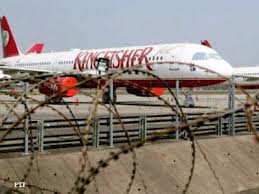
Kingfisher Airlines has lost licence: DGCA chief

January 1, 2013

Mumbai, Jan 1: India's troubled Kingfisher Airlines has lost its permit to fly after a deadline to renew its suspended licence expired, the national aviation regulator said on Tuesday.

The news is a fresh blow for the debt-laden carrier whose operations have been grounded since October after employees went on strike over unpaid wages.

"Kingfisher's flying permit has lapsed," DGCA chief Arun Mishra told AFP.

"They failed to provide additional details on the funding of operations," Mishra added, referring to Kingfisher's revival plan submitted to the DGCA last month.

But the airline said there is no "cause for concern" as the rules allow for the renewal of a permit within two years of expiry.kf

"Kingfisher is confident of securing approval from the regulator on the restart plan, licence approval and reinstatement of its operating permit," its spokesman Prakash Mirpuri said in a statement late Monday.

Kingfisher, controlled by liquor baron Vijay Mallya, owes millions of dollars to banks, airports, fuel suppliers and its staff and has been looking for a foreign investor to inject fresh funds.

The firm has been the worst-hit of India's airlines in 2012, with the industry plagued by high jet fuel prices, fierce competition, price wars and shabby airport infrastructure.

The carrier was India's second-largest until a year ago but its share shrank to just 3.5% — the smallest in the country —before operations stalled completely.

Kingfisher said it was in talks with foreign investors including Abu Dhabi-based Etihad Airways after the government cleared investment by foreign airlines in the key transport sector.

Aviation analysts have expressed doubt over Etihad's purported interest in Bangalore-based Kingfisher given the Indian firm's debt load, which is estimated at $2.5 billion by the consultancy firm Centre for Asia Pacific Aviation.

Comments

Add new comment

  • Coastaldigest.com reserves the right to delete or block any comments.
  • Coastaldigset.com is not responsible for its readers’ comments.
  • Comments that are abusive, incendiary or irrelevant are strictly prohibited.
  • Please use a genuine email ID and provide your name to avoid reject.
News Network
July 26,2020

New Delhi, Jul 26: Nidan Singh Sachdeva, the Afghan Sikh who was kidnapped a month ago and released recently, arrived here earlier in the day and narrated the ordeals that he faced at the hands of abductors and also thanked the Indian government for bringing him back to his 'motherland'.

Facing threats from Pakistan-backed Taliban, eleven members of Sikh community from Afghanistan, who were granted short-term visas by Indian Embassy in Kabul, including Sachdeva, who was abducted from a gurudwara in Paktia province last month, touched down in New Delhi on Sunday afternoon.

Speaking to news agency on his return, an emotional Sachdeva, said, "I don't know what to call Hindustan -- whether it is my mother or my father -- Hindustan is Hindustan."

"I was abducted from the gurudwara and 20 hours later, I was covered with blood. I was tied to a tree as well. They used to beat me and ask me to convert into a Muslim. I repeatedly told them that why should I convert, I have my own religion," he said while describing
Nidan Singh thanked Government of India for bringing him here.

"I am more than thankful to the Indian government for bringing us here to our motherland. I have no words to describe my feelings here. I arrived here after much struggle. The atmosphere of fear prevails there.

Gurudwara is where we can be safe but a step outside the Gurdwara is fearful," he said.
"They used to beat me every day and every night," he said further and added, "It is because of sheer happiness, I am speechless. I am very grateful to them."

Ministry of External Affairs recently announced that India has decided to facilitate the return of Afghan Hindu and Sikh community members facing security threats in Afghanistan to India.
The decision comes four months after a terror attack at a gurdwara in Kabul's Shor Bazaar killed at least 25 members of the community.

India has condemned the "targeting and persecution" of minority community members by terrorists in Afghanistan at the behest of their external supporters remains a matter of grave concern.

Leaders of the Afghan Sikh community have appealed to the Indian government to accommodate the Sikhs and Hindus from Afghanistan and grant them legal entry with long term residency multiple entry visas.

Once a community of nearly 250,000 people, the Sikh and Hindu community in Afghanistan has endured years of discrimination and violence from extremists, and the community is now estimated to comprise fewer than 100 families across the country.

Comments

Add new comment

  • Coastaldigest.com reserves the right to delete or block any comments.
  • Coastaldigset.com is not responsible for its readers’ comments.
  • Comments that are abusive, incendiary or irrelevant are strictly prohibited.
  • Please use a genuine email ID and provide your name to avoid reject.
News Network
May 4,2020

Munbai/New Delhi, May 4: India expects bad debts at its banks could double after the coronavirus crisis brought the economy to a sudden halt, a senior government official and four top bankers said.

Indian banks are already grappling with 9.35 trillion rupees ($123 billion) of soured loans, which was equivalent to about 9.1% of their total assets at the end of September 2019.

"There is a considered view in the government that bank non-performing assets (NPAs) could double to 18-20% by the end of the fiscal year, as 20-25% of outstanding loans face a risk of default," the official with direct knowledge of the matter said.

A fresh surge in bad debt could hit credit growth and delay India's recovery from the coronavirus pandemic.

"These are unprecedented times and the way it's going we can expect banks to report double the amount of NPAs from what we've seen in earlier quarters," the finance head of a top public sector bank told Reuters.

The official and bankers declined to be named as they were not officially authorized to discuss the matter with media.

India's finance ministry declined to comment, while the Reserve Bank of India and Indian Banks' Association, the main industry body, did not immediately respond to emails seeking comment.

The Indian economy has ground to a standstill amid a 40-day nationwide lockdown to rein in the spread of coronavirus cases.

The lockdown has now been extended by a further two weeks, but the government has begun to ease some restrictions in districts that are relatively unscathed by the virus.

India has so far recorded nearly 40,000 cases of the coronavirus and more than 1,300 deaths from COVID-19, the respiratory disease caused by the coronavirus.

'RIDING THE TIGER'

Bankers fear it is unlikely that the economy will fully open up before June or July, and loans, especially those to small- and medium-sized businesses which constitute nearly 20% of overall credit, may be among the worst affected.

This is because all 10 of India's largest cities fall in high-risk red zones, where restrictions will remain stringent.

A report by Axis Bank said that these red zones, which contribute significantly to India's economy, account for roughly 83% of the overall loans made by its banks as of December.

One of the sources, an executive director of a public sector bank, said that economic growth had been sluggish and risks had been heightened, even ahead of the coronavirus crisis.

"Now we have this Black Swan event which means without any meaningful government stimulus, the economy will be in tatters for several more quarters," he said.

McKinsey & Co last month forecast India's economy could contract by around 20% in the three months through June, if the lockdown was extended to mid-May, and growth in the fiscal year was likely to fall 2% to 3%.

Bankers say the only way to stem the steep rise in bad loans is if the RBI significantly relaxes bad asset recognition rules.

Banks have asked the central bank to allow all loans to be categorized as NPAs only after 180 days, which is double the current 90-day window.

"The lockdown is like riding the tiger, once we get off it we'll be in a difficult position," a senior private sector banker said.

Comments

Add new comment

  • Coastaldigest.com reserves the right to delete or block any comments.
  • Coastaldigset.com is not responsible for its readers’ comments.
  • Comments that are abusive, incendiary or irrelevant are strictly prohibited.
  • Please use a genuine email ID and provide your name to avoid reject.
Agencies
March 3,2020

Kashmir, Mar 3: Four days after the National Investigation Agency made a major breakthrough in the Pulwama terror attack case over a year after the bombing, arresting one person who had sheltered the suicide bomber Adil Ahmad Dar, the NIA on Tuesday arrested two more people in the case - a father-daughter duo - who had also provided shelter to the bomber, officials said.

The NIA also claimed that the video of the suicide bomber was also recorded at their residence and released by the Jaish-e-Mohammad (JeM) terror group from Pakistan after the attack. An NIA spokesperson in Delhi said: "Two more persons have been arrested by the agency in the Pulwama terror attack case and they have been identified as Insha Jan, 23, and her father Tariq Ahmed Shah, 50, who works as a tipper driver."

The official said that the father-daughter duo have been arrested from Hakripora area in Pulwama for their involvement in the attack. The two were arrested on early Tuesday morning after senior officials of the NIA raided their house on Monday night.

A senior NIA official related to the probe told IANS: "The video of Dar, who attacked the CRPF convoy, was recorded at the home of the duo. And the same video was released soon after the Pulwama terror attack by the JeM terrorists from a Pakistani IP address."

He said, "The video was shared by them to their handlers in Pakistan."

The spokesperson further claimed that during the probe Tariq Ahmed Shah disclosed that his house in Hakripora area was used by Dar, Mohammad Umar Farooq, a Pakistani terrorist and IED maker, Kamran - another Pakistani terrorist (both were later killed in encounters with security forces), Sameer Ahmed Dar, a Jaish-e-Mohammad terrorist from Pulwama and Mohammad Ismail aka Ibrahim, a Pakistani terrorist.

The spokesperson said that Shah facilitated all the terrorists at his house for sheltering and for planning of the heinous attack on the CRPF convoy. He said Jan, daughter of Shah, facilitated the terrorists at their home and provided food and other logistics during their stay on more than 15 occasions for two to four days each time, in their house during the year 2018-2019.

"Initial interrogation has revealed that Jan was in constant touch with Farooq and was in communication with him over telephone and other social media applications," the spokesperson said. The fresh arrests of the two accused brings the total number of arrests in the case to three.

The arrests were made on the revelations of Shakir Bashir Magrey, who was arrested by the anti-terror probe agency on February 28. According to senior NIA officials, more arrests will be made in the coming days. Magrey, a resident of Hajibal, Kakapora in Pulwama district of Jammu & Kashmir, is an overground worker (OGW) of the Pakistan-based Jaish-e-Mohammad (JeM).

According to agency sources, Magrey allegedly provided shelter and other logistical assistance to the Pulwama suicide bomber. He was sent to 15 days' NIA custody by a special NIA court in Jammu & Kashmir on Friday. During interrogation, Magrey revealed that he had harboured Dar and Pakistan-based terrorist Mohammad Umar Farooq in his house from late 2018 till the attack in February 2019 and assisted them in the preparation of the Improvised Explosive Device (IED). His shop is located near Lethpora bridge, and as advised by Mohammad Umar, he started conducting reconnaissance of the movement of CRPF convoys on Jammu-Srinagar Highway in January 2019, and informed Mohammad Umar and Adil Ahmad Dar about it.

Magrey was also involved in modifying the Maruti Eeco car and fitting the IED into it in early February, 2019 and was introduced to Adil Ahmad Dar in mid-2018 by Mohammad Umar and he became a full-time OGW of JeM.

"During his initial interrogation, he disclosed that on several occasions, he collected and delivered arms, ammunition, cash and explosive material to JeM terrorists, including those involved in the Pulwama attack," the agency had said on February 28.

"During investigation, the make, model and number of the car used in the attack was quickly ascertained by NIA to be a Maruti Eeco through forensic examination of the tiny remnants of the car which were found at the spot during extended searches," the agency stated.

"This has been corroborated by accused Shakir Bashir Magrey. The explosives used in the attack were determined to be ammonium nitrate, nitro-glycerin and RDX, through forensic investigation," it said.


Comments

Add new comment

  • Coastaldigest.com reserves the right to delete or block any comments.
  • Coastaldigset.com is not responsible for its readers’ comments.
  • Comments that are abusive, incendiary or irrelevant are strictly prohibited.
  • Please use a genuine email ID and provide your name to avoid reject.