


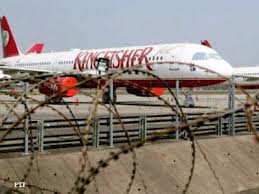
Kingfisher Airlines has lost licence: DGCA chief

January 1, 2013

Mumbai, Jan 1: India's troubled Kingfisher Airlines has lost its permit to fly after a deadline to renew its suspended licence expired, the national aviation regulator said on Tuesday.

The news is a fresh blow for the debt-laden carrier whose operations have been grounded since October after employees went on strike over unpaid wages.

"Kingfisher's flying permit has lapsed," DGCA chief Arun Mishra told AFP.

"They failed to provide additional details on the funding of operations," Mishra added, referring to Kingfisher's revival plan submitted to the DGCA last month.

But the airline said there is no "cause for concern" as the rules allow for the renewal of a permit within two years of expiry.kf
"Kingfisher is confident of securing approval from the regulator on the restart plan, licence approval and reinstatement of its operating permit," its spokesman Prakash Mirpuri said in a statement late Monday.

Kingfisher, controlled by liquor baron Vijay Mallya, owes millions of dollars to banks, airports, fuel suppliers and its staff and has been looking for a foreign investor to inject fresh funds.

The firm has been the worst-hit of India's airlines in 2012, with the industry plagued by high jet fuel prices, fierce competition, price wars and shabby airport infrastructure.

The carrier was India's second-largest until a year ago but its share shrank to just 3.5% — the smallest in the country —before operations stalled completely.

Kingfisher said it was in talks with foreign investors including Abu Dhabi-based Etihad Airways after the government cleared investment by foreign airlines in the key transport sector.

Aviation analysts have expressed doubt over Etihad's purported interest in Bangalore-based Kingfisher given the Indian firm's debt load, which is estimated at $2.5 billion by the consultancy firm Centre for Asia Pacific Aviation.

Comments

Add new comment

  • Coastaldigest.com reserves the right to delete or block any comments.
  • Coastaldigset.com is not responsible for its readers’ comments.
  • Comments that are abusive, incendiary or irrelevant are strictly prohibited.
  • Please use a genuine email ID and provide your name to avoid reject.
News Network
August 8,2020

The Kozhikode International Airport located at Karipur is not safe for the landing of flights in rainy season, according to an air-safety expert, who had warned the aviation ministry and the civil aviation regulator about this in 2011. 

The warning was particularly about the dangers of permitting passenger aircraft to land on runway 10 of the airport during rains and unfavourable wind conditions. 

Nine years later, on August 7, 2020, the warning became a reality when an Air India Express pilots landed in tailwind conditions and the aircraft overshot the tabletop runway to drop off the end and crash.

 “An aircraft landing on runway 10 in tailwind will experience poor braking action due to heavy rubber deposits … All such flights … are endangering the lives of all on board,’’ said Capt Mohan Ranganathan, in a letter sent on June 17, 2011 to then director general of civil aviation Bharat Bhushan and Nasim Zaidi, chairman of a civil aviation safety advisory committee, which was formed after the May 2010 Mangaluru air crash which killed 158 people.

“My warning issued after the Mangaluru crash was ignored. It is a table-top runway with a down slope. The buffer zone at the end of the runway is inadequate,” Capt Ranganathan said. Given the topography, he pointed out, the airport should have a buffer of 240m at the end of the runway, but it only has 90m (which the DGCA had approved). “Moreover, the space on either side of the runway is only 75m instead of the mandatory 100m,” he added.

Capt Ranganathan said there is no guideline for operations on a table-top runway when it is raining. “Runway 10 approach should not be permitted in view of the lack of runway end safety area (RESA) and the terrain beyond the end of the runway. RESA of 240m should be immediately introduced and runway length has to be reduced to make the operations safe,” his letter said.

If an aircraft is unable to stop within the runway, there is no RESA beyond the end. The ILS localiser antenna is housed on a concrete structure and the area beyond is a steep slope. “The Air India Express accident in Mangalore should have alerted AAI to make the runway conditions safe. We have brought up the issue of RESA during the initial Casac-sub group meetings. We had specifically mentioned that the declared distances for both runways have to be reduced in order to comply with ICAO Annex 14 requirement,” Capt Ranganathan said.

He said the condition of the runway strip was known to DGCA teams that have been conducting inspection and safety assessments. “Have they considered the danger involved? Did the DGCA or the airlines lay down any operational restrictions or special procedures?”

The letter also refers to Approach and Landing Accident Reduction (ALAR) training, which is supposed to be mandatory before every monsoon, but airlines don’t follow it, he said. “70% of accidents take place during approach and landing and that is why this training is essential,” he added.

stm88 info live rtp slot

slot auto scatter hitam

Comments

Add new comment

  • Coastaldigest.com reserves the right to delete or block any comments.
  • Coastaldigset.com is not responsible for its readers’ comments.
  • Comments that are abusive, incendiary or irrelevant are strictly prohibited.
  • Please use a genuine email ID and provide your name to avoid reject.
News Network
May 24,2020

New Delhi, May 24: The Indian economy is likely to slip into recession in the third quarter of this fiscal as loss in income and jobs and cautiousness among consumers will delay recovery in consumer demand even after the pandemic, says a report.

According to Dun & Bradstreet's latest Economic Observer, the country's economic recovery will depend on the efficacy and duration of implementation of the government's stimulus package.

"The multiplier effect of the stimulus measures on the economy will depend on three key aspects i.e. the time taken for effecting the withdrawal of the lockdown, the efficacy of implementation and duration of execution of the measures announced," Dun & Bradstreet India Chief Economist Arun Singh said.

The report noted that the government's larger-than-expected stimulus package is likely to re-start economic activities.

Besides, measures taken by the Reserve Bank of India like reducing the repo rate by a further 40 basis points to 4 per cent, extending the moratorium period by three months and facilitating working capital financing will also help stimulate the momentum.

Singh said while the measures announced by the government are "positive", most of them have been directed towards strengthening the supply side of the economy, and "it is to be noted that supply needs to be matched with demand", he said.

Besides, "in the absence of cash-in-hand benefits under the government's stimulus package, demand for goods and services is expected to remain depressed", he added.

He further said the loss in income and employment opportunities, and cautiousness among consumers, will lead to a delayed recovery in consumer demand, even after the pandemic. As debt and bad loan levels increase, the banking sector might face challenges.

The report further noted that even as the monetary stimulus is expected to inject liquidity and stimulate demand for a wider section of the economy, the channelisation of funds from the financial institutions will be subjected to several constraints.

The foremost concern being increase in risk averseness, as the balance sheets of firms, households, and banks/NBFCs have weakened considerably and low demand for funds by firms as production activities have been on a standstill during the lockdown period, Singh said.

India has been under lockdown since March 25 to contain the spread of the coronavirus, resulting in supply disruptions and demand compression.

Prime Minister Narendra Modi imposed a nationwide lockdown to control the spread of coronavirus on March 25. It has been extended thrice, with some relaxations. The fourth phase of the lockdown is set to expire on May 31. 

Comments

Add new comment

  • Coastaldigest.com reserves the right to delete or block any comments.
  • Coastaldigset.com is not responsible for its readers’ comments.
  • Comments that are abusive, incendiary or irrelevant are strictly prohibited.
  • Please use a genuine email ID and provide your name to avoid reject.
Agencies
March 1,2020

Allahabad, Mar 1: Shabista Khan, wife of suspended pediatrician Dr Kafeel Khan, fears that her husband's life is in danger.

In a letter written to the chief justice of the Allahabad High Court and senior government authorities, Shabista has sought security for her husband who is lodged in Mathura jail for allegedly delivering provocative speech during anti-CAA protest at Aligarh Muslim University.

"My husband is being mentally tortured in jail and is being subjected to inhuman behaviour," Shabista wrote in her letter to the chief justice of Allahabad High Court, additional chief secretary (home) and director general (jail), among others.

She said that she apprehended that an attempt could be made on her husband's life in jail and demanded adequate security for him.

She also demanded that her husband should be kept away from active criminals and lodged with common prisoners.

Comments

Add new comment

  • Coastaldigest.com reserves the right to delete or block any comments.
  • Coastaldigset.com is not responsible for its readers’ comments.
  • Comments that are abusive, incendiary or irrelevant are strictly prohibited.
  • Please use a genuine email ID and provide your name to avoid reject.