


Kingfisher Airlines has lost licence: DGCA chief

January 1, 2013

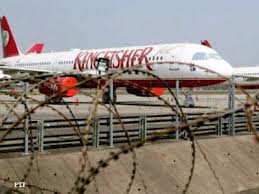
Mumbai, Jan 1: India's troubled Kingfisher Airlines has lost its permit to fly after a deadline to renew its suspended licence expired, the national aviation regulator said on Tuesday.

The news is a fresh blow for the debt-laden carrier whose operations have been grounded since October after employees went on strike over unpaid wages.

"Kingfisher's flying permit has lapsed," DGCA chief Arun Mishra told AFP.

"They failed to provide additional details on the funding of operations," Mishra added, referring to Kingfisher's revival plan submitted to the DGCA last month.

But the airline said there is no "cause for concern" as the rules allow for the renewal of a permit within two years of expiry.kf
"Kingfisher is confident of securing approval from the regulator on the restart plan, licence approval and reinstatement of its operating permit," its spokesman Prakash Mirpuri said in a statement late Monday.

Kingfisher, controlled by liquor baron Vijay Mallya, owes millions of dollars to banks, airports, fuel suppliers and its staff and has been looking for a foreign investor to inject fresh funds.

The firm has been the worst-hit of India's airlines in 2012, with the industry plagued by high jet fuel prices, fierce competition, price wars and shabby airport infrastructure.

The carrier was India's second-largest until a year ago but its share shrank to just 3.5% — the smallest in the country —before operations stalled completely.

Kingfisher said it was in talks with foreign investors including Abu Dhabi-based Etihad Airways after the government cleared investment by foreign airlines in the key transport sector.

Aviation analysts have expressed doubt over Etihad's purported interest in Bangalore-based Kingfisher given the Indian firm's debt load, which is estimated at $2.5 billion by the consultancy firm Centre for Asia Pacific Aviation.

Comments

Add new comment

  • Coastaldigest.com reserves the right to delete or block any comments.
  • Coastaldigset.com is not responsible for its readers’ comments.
  • Comments that are abusive, incendiary or irrelevant are strictly prohibited.
  • Please use a genuine email ID and provide your name to avoid reject.
Agencies
June 16,2020

Mumbai, Jun 16: Saudi Arabia’s sovereign wealth fund, PIF, is all set to pick up a stake in Jio Platforms, which would complete 25% of Jio’s equity dilution to the investors, said a report by the Gulf News.

Jio Platforms is part of the Reliance Industries empire owned by Mukesh Ambani. The Public Investment Fund (PIF) will acquire 2.33% for an estimated $1.5 billion, the report said.

So far, Jio Platforms has raised investment from 10 different global investors in seven weeks, the latest being TPG Capital buying 0.93% equity for Rs 4,547 crore and private equity firm L Catterton picking up a 0.39% stake for Rs 1894.50 crore.

Jio Platforms has raised a total of Rs 1.04 lakh crore so far from leading global investors including Facebook, Silver Lake, Vista Equity Partners, General Atlantic, KKR, Mubadala, ADIA, TPG and L Catterton since April 22.

With PIF coming on board, Jio Platforms would have diluted 25% of its equity. That's the maximum they intend to dilute to financial investors, which includes Mark Zukerberg's Facebook.

Any new investors coming on board in future will have to be "strategic investors, a tech giant, for instance," said a source who was part of the deal-making process, the report said.

In recent days, Jio Platforms, which will merge telecom, content streaming, gaming and ecommerce features into its app, has seen Abu Dhabi's Mubadala and ADIA pick up significant stakes amounting to $1.2 billion and $750 million, respectively.

Reliance Industries' owner, Ambani, Asia's richest man, has been on an investor acquisition spree, with the likes of Facebook and private equity majors such as KKR and Silver Lake Capital investing in Jio Platforms.

The contours of the deal with Saudi Arabia's PIF was finalised during Ramadan. "It was always Mukesh Ambani's wish to have a special relationship with Saudi Arabia and the UAE," said Anshuman Mishra, a London-based confidante and family friend of the Ambani family of longstanding, Gulf News quoted as saying.

He has also worked extensively with Gulf sovereign wealth funds over the years.

"Saudi Arabia's coming in to close the financial investor round in Jio is indicative of the special nature of the relationship. This is also indicative of the multi-billion-dollar partnership announced last year with Saudi Aramco.

"This is a major success for the present Indian government's foreign policy initiative in the gulf and symbolic of India's significance in the GCC," it said.

Comments

Add new comment

  • Coastaldigest.com reserves the right to delete or block any comments.
  • Coastaldigset.com is not responsible for its readers’ comments.
  • Comments that are abusive, incendiary or irrelevant are strictly prohibited.
  • Please use a genuine email ID and provide your name to avoid reject.
Agencies
March 15,2020

New Delhi, Mar 15: The new rules for debit and credit cards to increase security and reduce frauds kick in from Monday. In January, the Reserve Bank of India (RBI) had issued new rules to improve user convenience and increase the security of card transactions. These rules will help in curbing the misuse of debit and credit cards.

RBI has directed banks to allow only domestic card transactions at ATMs and PoS terminals in India at the time of issuance/reissuance of card. For international transactions, online transactions, card-not-present transactions and contactless transactions, customers will have to separately set up services on their card.

These rules will be applicable for new cards from March 16. Those with old cards can decide whether to disable any of these features.

As per the existing rules, these services used to come automatically with the card, but now it will start at the request of the customer.

Debit or credit card customers who have not yet done any online transaction, contactless transaction or international transaction with the card, then these services on the card will automatically stop from March 16.

The Reserve Bank has asked all banks to provide mobile banking, net banking option to enable limit and enable and disable service 24 hours a day, seven days a week.

If the customer makes any change in the status of the card, the bank will alert the customer through SMS/email and send the information.

Issuers shall provide to all cardholders facility to switch on/off and set/modify transaction limits (within the overall card limit, if any, set by the issuer) for all types of transactions -- domestic and international, at PoS/ATMs/online transactions/contactless transactions, etc.,

The provisions, however, are not mandatory for prepaid gift cards and those used at mass transit systems.

The latest instructions come in the wake of rising instances of cyber frauds and the huge increase in the use of cards.

Comments

Add new comment

  • Coastaldigest.com reserves the right to delete or block any comments.
  • Coastaldigset.com is not responsible for its readers’ comments.
  • Comments that are abusive, incendiary or irrelevant are strictly prohibited.
  • Please use a genuine email ID and provide your name to avoid reject.
News Network
February 21,2020

Washington, Feb 21: Days ahead of his India visit, US President Donald Trump on Thursday said the two countries could make a "tremendous" trade deal.

"We're going to India, and we may make a tremendous deal there," Trump said in his commencement address at the Hope for Prisoners Graduation Ceremony in Las Vegas.

Trump, accompanied by First Lady Melania Trump, is scheduled to travel to Ahmedabad, Agra and New Delhi on February 24 and 25.

Ahead of the visit, there have been talks about India and the United States agreeing on a trade package as a precursor to a major trade deal.

During his commencement address, Trump indicated that the talks on this might slowdown if he did not get a good deal.

"Maybe we'll slow down. We'll do it after the election. I think that could happen too. So, we'll see what happens," he said.

"But we're only making deals if they're good deals because we're putting America first. Whether people like it or not, we're putting America first," Trump said.

Bilateral India-US trade in goods and services is about three per cent of the US' world trade.

In a recent report, the Congressional Research Service (CRS) said the trading relationship is more consequential for India -- in 2018 the United States was its second largest goods export market (16.0 per cent share) after the European Union (EU, 17.8 per cent), and third largest goods import supplier (6.3 per cent) after China (14.6 per cent) and the EU 28 (10.2 per cent).

"The Trump Administration takes issue with the US trade deficit with India, and has criticised India for a range of 'unfair' trading practices," the CRS said.

"Indian Prime Minister Modi's first term fell short of many observers' expectations, as India did not move forward with anticipated market opening reforms, and instead increased tariffs and trade restrictions," it said.

"Modi's strong electoral mandate may embolden the Indian government to press ahead with its reform agenda with greater vigour. Slowing economic growth in India raises concerns about its business environment," CRS said.

As per a fact sheet issued by the Council on Foreign Relations (CFR), trade in goods and services between the two countries from 1999 to 2018 surged from $16 billion to $142 billion.

India is now the United States' eighth-largest trading partner in goods and services and is among the world's largest economies.

India's trade with the United States now resembles, in terms of volume, the US' trade with South Korea ($167 billion in 2018) or France ($129 billion), said Alyssa Ayres from CFR.

"The United States for two years now has set out in stone pretty clearly the things that they wanted to see to try to get an agreement, and it's basically then on India's doorstep on whether they want to take those steps," Rick Rossow, Wadhwani Chair in US-India Policy Studies at the Center for Strategic and International Studies think-tank told reporters during a conference call.

"The list of US asks has been pretty static all throughout. Not to say that any of these things are easy for India to do, but the United States to my knowledge didn't change the goalposts just because we now consider India to be a middle-income country. The things that we wanted to see happen to get this trade agreement have been pretty static all throughout, no matter how difficult they are," he said in response to a question.

Comments

Add new comment

  • Coastaldigest.com reserves the right to delete or block any comments.
  • Coastaldigset.com is not responsible for its readers’ comments.
  • Comments that are abusive, incendiary or irrelevant are strictly prohibited.
  • Please use a genuine email ID and provide your name to avoid reject.