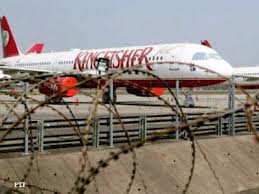
Kingfisher Airlines has lost licence: DGCA chief

January 1, 2013

Mumbai, Jan 1: India's troubled Kingfisher Airlines has lost its permit to fly after a deadline to renew its suspended licence expired, the national aviation regulator said on Tuesday.

The news is a fresh blow for the debt-laden carrier whose operations have been grounded since October after employees went on strike over unpaid wages.

"Kingfisher's flying permit has lapsed," DGCA chief Arun Mishra told AFP.

"They failed to provide additional details on the funding of operations," Mishra added, referring to Kingfisher's revival plan submitted to the DGCA last month.

But the airline said there is no "cause for concern" as the rules allow for the renewal of a permit within two years of expiry.kf

"Kingfisher is confident of securing approval from the regulator on the restart plan, licence approval and reinstatement of its operating permit," its spokesman Prakash Mirpuri said in a statement late Monday.

Kingfisher, controlled by liquor baron Vijay Mallya, owes millions of dollars to banks, airports, fuel suppliers and its staff and has been looking for a foreign investor to inject fresh funds.

The firm has been the worst-hit of India's airlines in 2012, with the industry plagued by high jet fuel prices, fierce competition, price wars and shabby airport infrastructure.

The carrier was India's second-largest until a year ago but its share shrank to just 3.5% — the smallest in the country —before operations stalled completely.

Kingfisher said it was in talks with foreign investors including Abu Dhabi-based Etihad Airways after the government cleared investment by foreign airlines in the key transport sector.

Aviation analysts have expressed doubt over Etihad's purported interest in Bangalore-based Kingfisher given the Indian firm's debt load, which is estimated at $2.5 billion by the consultancy firm Centre for Asia Pacific Aviation.

Comments

Add new comment

  • Coastaldigest.com reserves the right to delete or block any comments.
  • Coastaldigset.com is not responsible for its readers’ comments.
  • Comments that are abusive, incendiary or irrelevant are strictly prohibited.
  • Please use a genuine email ID and provide your name to avoid reject.
News Network
June 17,2020

New Delhi, Jun 17: Petrol and diesel prices were increased in metros on Wednesday, marking the eleventh straight day of increase since state-owned oil companies returned to the normal practice of daily reviews following a 12-week pause. With effect from 6 am, the price of petrol was increased by 55 paise per litre, and diesel by 69 paise per litre in Delhi, compared to the previous day. While the price of petrol was revised to Rs 77.28 per litre in the national capital from Rs 76.73 per litre the previous day, the diesel rate was increased to Rs 75.79 per litre from Rs 75.19 per litre, according to notifications from state-run Indian Oil Corporation, the country's largest fuel retailer. In the 11-day period, the price of petrol has been increased by a cumulative Rs 6.02 per litre, and diesel by Rs 6.49 per litre.

International crude oil prices retreated on Wednesday, weighed down by an increase in US crude inventories and worries about a potential second wave of the coronavirus pandemic. Brent crude futures - the global benchmark for crude oil - were last seen trading 1.0 per cent lower at $40.56 per barrel.

State-run oil marketing companies revise the prices of petrol and diesel from time to time, besides aviation turbine fuel (ATF) - or jet fuel - and liquefied petroleum gas (LPG). However, since March 16, the oil companies had kept petrol and diesel prices on hold, possibly due to the volatility in global oil markets.

Fuel retailing in the country is dominated by state refiners - Indian Oil Corporation, Bharat Petroleum Corporation and Hindustan Petroleum Corporation. The three own about 90 per cent of the retail fuel outlets in the country.

Comments

Add new comment

  • Coastaldigest.com reserves the right to delete or block any comments.
  • Coastaldigset.com is not responsible for its readers’ comments.
  • Comments that are abusive, incendiary or irrelevant are strictly prohibited.
  • Please use a genuine email ID and provide your name to avoid reject.
News Network
January 20,2020

Davos, Jan 20: India's richest 1 per cent hold more than four-times the wealth held by 953 million people who make up for the bottom 70 per cent of the country's population, while the total wealth of all Indian billionaires is more than the full-year budget, a new study said on Monday.

Releasing the study 'Time to Care' here ahead of the 50th annual meeting of the World Economic Forum (WEF), rights group Oxfam also said the world's 2,153 billionaires have more wealth than the 4.6 billion people who make up 60 per cent of the planet's population.

The report flagged that global inequality is shockingly entrenched and vast and the number of billionaires has doubled in the last decade, despite their combined wealth having declined in the last year.

"The gap between rich and poor can't be resolved without deliberate inequality-busting policies, and too few governments are committed to these," said Oxfam India CEO Amitabh Behar, who is here to represent the Oxfam confederation this year.

The issues of income and gender inequality are expected to figure prominently in discussions at the five-day summit of the WEF, starting Monday. The WEF's annual global risks Report has also warned that the downward pressure on the global economy from macroeconomic fragilities and financial inequality continued to intensify in 2019.

Concern about inequality underlies recent social unrest in almost every continent, although it may be sparked by different tipping points such as corruption, constitutional breaches, or the rise in prices for basic goods and services, as per the WEF report.

Although global inequality has declined over the past three decades, domestic income inequality has risen in many countries, particularly in advanced economies and reached historic highs in some, the Global Risks Report flagged last week.

The Oxfam report further said "sexist" economies are fuelling the inequality crisis by enabling a wealthy elite to accumulate vast fortunes at the expense of ordinary people and particularly poor women and girls.

Regarding India, Oxfam said the combined total wealth of 63 Indian billionaires is higher than the total Union Budget of India for the fiscal year 2018-19 which was at Rs 24,42,200 crore.

"Our broken economies are lining the pockets of billionaires and big business at the expense of ordinary men and women. No wonder people are starting to question whether billionaires should even exist," Behar said.

As per the report, it would take a female domestic worker 22,277 years to earn what a top CEO of a technology company makes in one year.

With earnings pegged at Rs 106 per second, a tech CEO would make more in 10 minutes than what a domestic worker would make in one year.

It further said women and girls put in 3.26 billion hours of unpaid care work each and every day -- a contribution to the Indian economy of at least Rs 19 lakh crore a year, which is 20 times the entire education budget of India in 2019 (Rs 93,000 crore).

Besides, direct public investments in the care economy of 2 per cent of GDP would potentially create 11 million new jobs and make up for the 11 million jobs lost in 2018, the report said.

Behar said the gap between rich and poor cannot be resolved without deliberate inequality-busting policies, and too few governments are committed to these.

He said women and girls are among those who benefit the least from today's economic system.

"They spend billions of hours cooking, cleaning and caring for children and the elderly. Unpaid care work is the 'hidden engine' that keeps the wheels of our economies, businesses and societies moving.

"It is driven by women who often have little time to get an education, earn a decent living or have a say in how our societies are run, and who are therefore trapped at the bottom of the economy,” Behar added.

Oxfam said governments are massively under-taxing the wealthiest individuals and corporations and failing to collect revenues that could help lift the responsibility of care from women and tackle poverty and inequality.

Besides, the governments are also underfunding vital public services and infrastructure that could help reduce women and girls' workload, the report said.

As per the global survey, the 22 richest men in the world have more wealth than all the women in Africa.

Besides, women and girls put in 12.5 billion hours of unpaid care work each and every day -- a contribution to the global economy of at least USD 10.8 trillion a year, more than three times the size of the global tech industry.

Getting the richest one per cent to pay just 0.5 per cent extra tax on their wealth over the next 10 years would equal the investment needed to create 117 million jobs in sectors such as elderly and childcare, education and health.

Governments must prioritise care as being as important as all other sectors in order to build more human economies that work for everyone, not just a fortunate few, Behar said.

Oxfam said its calculations are based on the latest data sources available, including from the Credit Suisse Research Institute's Global Wealth Databook 2019 and Forbes' 2019 billionaires list.


Comments

Add new comment

  • Coastaldigest.com reserves the right to delete or block any comments.
  • Coastaldigset.com is not responsible for its readers’ comments.
  • Comments that are abusive, incendiary or irrelevant are strictly prohibited.
  • Please use a genuine email ID and provide your name to avoid reject.
Agencies
March 12,2020

The Ministry of Health and Family Welfare has prepared a draft for guidelines for home quarantine, as well as for the use of masks by public, in view of coronavirus.

What to do in Home Quarantine?

The government says, for those taking refuge to home quarantine should stay in a well-ventilated single-room preferably with an attached or separate toilet. It adds that if another family member needs to stay in the same room, it's advisable to maintain a distance of at least 1 metre between the two.

The government advised, coronavirus patients to stay away from elderly people, pregnant women, children and persons with co-morbidities within the household as their immune system may be low. The health minister also suggested to restrict the patient's movement within the house. "Under no circumstances attend any social/religious gathering e.g. wedding, condolences, etc, said the guideline.

It also instructed the corona virus infected person to avoid sharing household items like dishes, drinking glasses, cups, eating utensils, towels, bedding, or other items with others at home. The guideline also demanded that even though home quarantine, the patient should wear a surgical mask at all times. "The mask should be changed every 6-8 hours and disposed off. Disposable masks are never to be reused, it added.

"Masks used by patients/ caregivers/ close contacts during home care should be disinfected using ordinary bleach solution (5 per cent) or sodium hypochlorite solution (1%) and then disposed of either by burning or deep burial," instructs the government.

Even for family members of a patient, the health ministry clearly instructs to use disposable gloves when cleaning the surfaces or handling soiled linen. No visitors, under any circumstances will be allowed, said the guideline.

"In case the person being quarantined becomes symptomatic, all his close contacts will be home quarantined (for 14 days) and followed up for an additional 14 days or till the report of such case turns out negative on lab testing," states the draft.

How to wear & dump masks?

There is a specific and elaborate do's and don'ts also released by the ministry. For those unsure in which mask to choose, it says, "Medical masks of different sizes and shapes are available in the market. The common ones are flat pleated masks of woven fabric which covers the nose and mouth and affixed behind the head with straps/ elastic fasteners. There are also conical or duck bill shaped masks with valves (or without valves) that fit in the contour of face over the nose and mouth, but are costlier."

However, the ministry warns, medical masks should not be used by healthy persons who are not having any symptoms "because it creates a false sense of security". Instead, it suggests to refrain from touching face, mouth, nose and eyes as well as washing hands regularly with soap for 20 seconds each time.

However, when a person develops a cough or fever, the suspected patient needs to switch to medical masks. "Use of medical three layer masks when ill, will prevent your infection from spreading to others. However you also need to wash your hands frequently to avoid spreading infection to others," read the guideline.

Even if one is not tested positive but showing symptoms, they are advised to wear masks while visiting a healthcare facility. "Close family contacts of such suspect/confirmed cases undergoing home care should also use Triple layer medical mask," it warns.

The ministry has also given point by point guideline on how to use a mask like to make sure that they are facing down while unfolding or for that matter to ensure there are no gaps on either side of the mask.

It even warns, "Fit flexible nose piece (a metallic strip that can easily be located) over nose-bridge" to ensure no one else are infected. The government also warns against simple dumping of the masks once used. Instead one should disinfect "using ordinary bleach solution (5 per cent) or sodium hypochlorite solution (1 per cent) and then disposed of either by burning or deep burial," says the Health Ministry.

COVID-19 emerged in early December 2019 in China's Wuhan province and has now spread to over 100 countries. As on March 9, 2020, India has reported 42 cases mostly among those who had travelled from affected countries.

However the government says, "It causes a minor illness in majority of patients with symptoms of fever and or cough. A small proportion of such persons may progress to severe disease with difficulty in breathing."

Comments

Add new comment

  • Coastaldigest.com reserves the right to delete or block any comments.
  • Coastaldigset.com is not responsible for its readers’ comments.
  • Comments that are abusive, incendiary or irrelevant are strictly prohibited.
  • Please use a genuine email ID and provide your name to avoid reject.