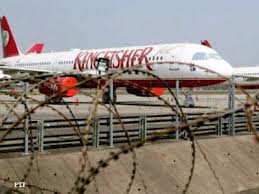
Kingfisher Airlines has lost licence: DGCA chief

January 1, 2013

Mumbai, Jan 1: India's troubled Kingfisher Airlines has lost its permit to fly after a deadline to renew its suspended licence expired, the national aviation regulator said on Tuesday.

The news is a fresh blow for the debt-laden carrier whose operations have been grounded since October after employees went on strike over unpaid wages.

"Kingfisher's flying permit has lapsed," DGCA chief Arun Mishra told AFP.

"They failed to provide additional details on the funding of operations," Mishra added, referring to Kingfisher's revival plan submitted to the DGCA last month.

But the airline said there is no "cause for concern" as the rules allow for the renewal of a permit within two years of expiry.kf

"Kingfisher is confident of securing approval from the regulator on the restart plan, licence approval and reinstatement of its operating permit," its spokesman Prakash Mirpuri said in a statement late Monday.

Kingfisher, controlled by liquor baron Vijay Mallya, owes millions of dollars to banks, airports, fuel suppliers and its staff and has been looking for a foreign investor to inject fresh funds.

The firm has been the worst-hit of India's airlines in 2012, with the industry plagued by high jet fuel prices, fierce competition, price wars and shabby airport infrastructure.

The carrier was India's second-largest until a year ago but its share shrank to just 3.5% — the smallest in the country —before operations stalled completely.

Kingfisher said it was in talks with foreign investors including Abu Dhabi-based Etihad Airways after the government cleared investment by foreign airlines in the key transport sector.

Aviation analysts have expressed doubt over Etihad's purported interest in Bangalore-based Kingfisher given the Indian firm's debt load, which is estimated at $2.5 billion by the consultancy firm Centre for Asia Pacific Aviation.

Comments

Add new comment

  • Coastaldigest.com reserves the right to delete or block any comments.
  • Coastaldigset.com is not responsible for its readers’ comments.
  • Comments that are abusive, incendiary or irrelevant are strictly prohibited.
  • Please use a genuine email ID and provide your name to avoid reject.
News Network
June 17,2020

New Delhi, Jun 17: Prime Minister Narendra Modi on Wednesday called for an all-party meeting to be held on June 19 to discuss the situation at the border areas with China.

The virtual conference meeting, presided by PM Modi, will be attended by presidents of various political parties in the country.

"In order to discuss the situation in the India-China border areas, Prime Minister Narendra Modi has called for an all-party meeting at 5 PM on 19th June. Presidents of various political parties would take part in this virtual meeting," a tweet by the PMO India read.

At least 20 Indian Army personnel, including a Colonel rank officer, had lost their lives in the violent face-off in the Galwan valley area of Ladakh on June 15.

The violent face-off happened on late evening and the night of June 15 in Ladakh's Galwan Valley as a result of an attempt by the Chinese troops to "unilaterally change" the status quo during de-escalation in Eastern Ladakh and the situation could have been avoided if the agreement at the higher level been scrupulously followed by the Chinese side, India said on June 16.

The Chinese side also suffered casualties, including the death of the commanding officer of the Chinese Unit involved in the violent face-off with Indian troops, sources confirmed to news agency.

Comments

Add new comment

  • Coastaldigest.com reserves the right to delete or block any comments.
  • Coastaldigset.com is not responsible for its readers’ comments.
  • Comments that are abusive, incendiary or irrelevant are strictly prohibited.
  • Please use a genuine email ID and provide your name to avoid reject.
News Network
March 10,2020

Mar 10: Indian energy tycoon Mukesh Ambani is no longer Asia’s richest man, relinquishing the title to Jack Ma after oil prices collapsed along with global stocks.

The rout, exacerbated by mounting fears that the spread of the novel coronavirus will thrust the world into a recession, erased $5.8 billion from Ambani’s net worth on Monday and pushed him to No. 2 on the list of Asia’s richest people, according to the Bloomberg Billionaires Index. Ma, the Alibaba Group Holding Ltd. founder who relinquished the No. 1 ranking in mid-2018, is back on top with a $44.5 billion fortune, about $2.6 billion more than Ambani.

Oil plunged the most in 29 years on Monday as Saudi Arabia and Russia vowed to pump more in a struggle for market share. The slump comes just as the coronavirus is spurring the first decline in demand in more than a decade. That raises questions about whether Ambani’s flagship Reliance Industries Ltd. will be able to cut net debt to zero by early 2021, as he has pledged. The plan hinges on a proposal to sell a stake in the group’s oil and petrochemicals division to Saudi Arabian Oil Co., the world’s biggest crude producer.

While the coronavirus has curtailed some of tech giant Alibaba’s businesses, the damage has been mitigated by increased demand for its cloud computing services and mobile apps.

Reliance Industries, by comparison, has no such silver lining. The Indian conglomerate’s shares plunged 12% on Monday, the most since 2009, extending this year’s decline to 26%. Alibaba’s American depositary receipts have slipped 6.8% so far in 2020.

Ma reclaims crown after Reliance shares were pummeled in 2020.

Few of the world’s billionaires fared well in Monday’s collapse as the S&P 500 Index and Dow Jones Industrial Average each plunged more than 7.5%, the most since the 2008 financial crisis, threatening to end the longest bull market in history. But no one did worse than those whose fortunes are underpinned by oil. Wildcatter Harold Hamm’s fortune was cut almost in half to $2.4 billion and fellow oil magnate Jeff Hildebrand lost $3 billion, bumping both from Bloomberg’s 500-member wealth ranking.

In a pivot toward new businesses such as telecommunications, technology and retail, Ambani’s Reliance Industries has piled on billions of dollars of debt over the years.

It spent almost $50 billion -- most of it funded by borrowings -- to build Reliance Jio Infocomm Ltd., which became India’s No. 1 wireless carrier within about three years of its debut. As the mobile venture took off, Ambani also unveiled plans for an e-commerce empire to rival Amazon.com Inc. in India.

Addressing concerns over the liabilities, Ambani pledged in August to cut the group’s net debt to zero from about $21 billion as of last March. The Aramco deal is crucial to that plan for which Reliance Industries has valued its oil-to-chemicals division at $75 billion including debt, implying a $15 billion valuation for the 20% stake that’s for sale.

Signs of a potential delay to that deal unnerved some investors, hammering the stock since it touched a record high on Dec. 19.

Reliance Industries expected the Aramco transaction to be completed by March, but people familiar with the matter said in February that talks were still ongoing to bridge differences between the two parties over the deal’s structure.

Adding to the uncertainty, Indian Prime Minister Narendra Modi’s administration has petitioned a court to halt the proposed stake sale, threatening a key source of funds needed to pare net debt.

But Ambani, 62, may soon bounce back from the setback, said Harish H.V., managing partner at ECube Investment Advisors in Bengaluru, India.

“The game isn’t over,” he said. “Ambani has successfully built a robust business model which would keep him in the game. Moreover, his telecom business will start yielding results in coming years.”


Comments

SmR
 - 
Tuesday, 10 Mar 2020

The curses of the bank depositors savings which vanished with collapsing economy and fraudlent seems to have gradully affecting riches of Ambani's.


AU
 - 
Tuesday, 10 Mar 2020

in Holy Quran Allah says; but they plan and Allah plans, and Allah is the best planners..(Surah Al Anfal 8:30)

Add new comment

  • Coastaldigest.com reserves the right to delete or block any comments.
  • Coastaldigset.com is not responsible for its readers’ comments.
  • Comments that are abusive, incendiary or irrelevant are strictly prohibited.
  • Please use a genuine email ID and provide your name to avoid reject.
News Network
July 1,2020

Jul 1: Gold prices in India hit an all-time high on Wednesday, tracking a global rally, as surging coronavirus cases in many countries raised the metal's safe-haven appeal.

Local gold futures hit an all-time high of Rs 48,871 ($646.66) per 10 grams in early trade, taking their gains to 25% in 2020 so far. The contract had gained nearly 25% in 2019.

However, this dampened the retail demand for gold in India, the world's second-largest consumer of the precious metal.

"Retail demand is negligible. Buyers are postponing purchases anticipating a correction in prices," said a Mumbai-based bank dealer with a bullion importing bank.

In thin trade, dealers were offering a discount of up to $22 an ounce over official domestic prices on Wednesday afternoon, up from the last week's $18. The domestic price includes a 12.5% import tax and 3% sales tax.

The country's gold imports in May plunged 99% from a year earlier as international air travel was banned and jewellery shops were closed amid a nationwide lockdown to curb the spread of coronavirus.

In overseas market, spot gold firmed near an eight-year peak on Wednesday, as a spike in coronavirus cases in the United and States and many other countries has cast a shadow on hopes for a quicker global economic recovery, driving inflows into safe-haven assets.

According to a latest Reuters tally, the coronavirus has infected more than 10.48 million people worldwide so far.

Comments

Add new comment

  • Coastaldigest.com reserves the right to delete or block any comments.
  • Coastaldigset.com is not responsible for its readers’ comments.
  • Comments that are abusive, incendiary or irrelevant are strictly prohibited.
  • Please use a genuine email ID and provide your name to avoid reject.