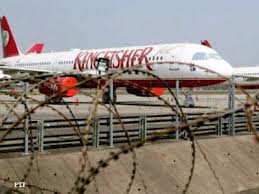
Kingfisher Airlines has lost licence: DGCA chief

January 1, 2013

Mumbai, Jan 1: India's troubled Kingfisher Airlines has lost its permit to fly after a deadline to renew its suspended licence expired, the national aviation regulator said on Tuesday.

The news is a fresh blow for the debt-laden carrier whose operations have been grounded since October after employees went on strike over unpaid wages.

"Kingfisher's flying permit has lapsed," DGCA chief Arun Mishra told AFP.

"They failed to provide additional details on the funding of operations," Mishra added, referring to Kingfisher's revival plan submitted to the DGCA last month.

But the airline said there is no "cause for concern" as the rules allow for the renewal of a permit within two years of expiry.kf

"Kingfisher is confident of securing approval from the regulator on the restart plan, licence approval and reinstatement of its operating permit," its spokesman Prakash Mirpuri said in a statement late Monday.

Kingfisher, controlled by liquor baron Vijay Mallya, owes millions of dollars to banks, airports, fuel suppliers and its staff and has been looking for a foreign investor to inject fresh funds.

The firm has been the worst-hit of India's airlines in 2012, with the industry plagued by high jet fuel prices, fierce competition, price wars and shabby airport infrastructure.

The carrier was India's second-largest until a year ago but its share shrank to just 3.5% — the smallest in the country —before operations stalled completely.

Kingfisher said it was in talks with foreign investors including Abu Dhabi-based Etihad Airways after the government cleared investment by foreign airlines in the key transport sector.

Aviation analysts have expressed doubt over Etihad's purported interest in Bangalore-based Kingfisher given the Indian firm's debt load, which is estimated at $2.5 billion by the consultancy firm Centre for Asia Pacific Aviation.

Comments

Add new comment

  • Coastaldigest.com reserves the right to delete or block any comments.
  • Coastaldigset.com is not responsible for its readers’ comments.
  • Comments that are abusive, incendiary or irrelevant are strictly prohibited.
  • Please use a genuine email ID and provide your name to avoid reject.
News Network
April 2,2020

Mumbai, Apr 2: NCP chief Sharad Pawar on Thursday

urged Muslims to observe Shab-e-Barat staying inside their homes, and also suggested that the birth anniversary celebrations of Dalit icon Dr B R Ambedkar be postponed in view of the coronavirus outbreak.

Pawar said Ram Navami, being observed on Thursday, is celebrated with fervour every year across the country.

"Unfortunately, there is this threat of coronavirus this year and we have to observe some restrictions...but I am sure people must be remembering Lord Ram staying inside their homes," he said in his address via Facebook.

Shab-e-Barat, also known as the night of forgiveness,will be observed on April 8.

Members of the Muslim community visit graveyards to remember their relatives who are no more, Pawar said, and called for taking precautions to avoid gathering of people given the coronavirus crisis.

Pawar said congregation such as the one held last month in Delhi's Nizamuddin area by Tablighi Jamaat could have been avoided, and urged people to ensure there is no repeat of such meetings on Shab-e-Barat.

"The meeting should have been avoided, but it was notand others may have to pay for it," Pawar said referring to the religious meeting in the national capital.

He said the "possibility of some people who attended the meeting carrying the disease cannot be ruled out" and pressed for maintaining discipline given the situation caused by the COVID-19 outbreak.

"Shab-e-Barat is on April 8. Muslims remember their relatives, who are not more, by visiting kabrastan (graveyard). It should be observed inside home. Precaution should be taken to see there is no repeat of the Nizamuddin meeting-like episode," he said.

The birth anniversary of Ambedkar, the architect of the Indian Constitution, is observed on April 14.

Pawar said people should also think about postponing Ambedkar's birth anniversary celebrations.

"We normally celebrate it (the anniversary) for two or so months. We should think whether we should really observe the programme at this juncture (given the coronavirus threat).

If we come together, we may have to face health issues," the former Union minister said.

He said in general, 90 per cent people have been observing the lockdown, but 10 per cent are not doing so.

The Centre and the Maharashtra government may have to extend the lockdown period if discipline is not observed till April 14 (till when the lockdown is in force), he said, urging people to toe the line in the interest of each other.

Pawar also praised Chief Minister Uddhav Thackeray, the state administration and police for working round-the- clock, and asked people to cooperate with them by staying at home.

Comments

Add new comment

  • Coastaldigest.com reserves the right to delete or block any comments.
  • Coastaldigset.com is not responsible for its readers’ comments.
  • Comments that are abusive, incendiary or irrelevant are strictly prohibited.
  • Please use a genuine email ID and provide your name to avoid reject.
Agencies
April 24,2020

New Delhi, Apr 24: Congress leader Rahul Gandhi has termed the government decision to freeze Dearness Allowance of Central government employees for a year as "insensitive and inhuman."

The former Congress President in a tweet said: "Lakhs and crores are being spent on the Bullet Train and New Delhi's Central Vista which should have been suspended, but the government has deducted DA of Central government employees and pensioners... It is insensitive and inhuman."

"The tragic part is that by deducting this amount from January 1, 2020 up to 30th June, 2021 for a period of 1.5 years, the government of India proceeds to deduct almost Rs 38 thousand crore from the income of these middle class government employees and pensioners, who rely completely on the pay and pensions that they receive," said Randeep Surjewala, chief spokesperson of Congress.

There are about 50 lakh such serving government employees and about 62 lakh pensioners.

"Even more tragic and objectionable is the fact that the government of India has not even spared our armed forces. The government has deducted Rs 11 thousand crore of the 15 lakh serving armed forces personnel and nearly 26 lakh military pensioners. What is their fault? They are serving the nation in times of all types of crises," said Surjewala.

The Congress alleged that the government did not spare the savings scheme.

Instead of curbing the wasteful expenditure, the government has been constantly hitting at the income of government employees and the middle class, it added.

Comments

Add new comment

  • Coastaldigest.com reserves the right to delete or block any comments.
  • Coastaldigset.com is not responsible for its readers’ comments.
  • Comments that are abusive, incendiary or irrelevant are strictly prohibited.
  • Please use a genuine email ID and provide your name to avoid reject.
Agencies
June 15,2020

New Delhi, Jun 15: Average temperature of India experienced a rise of 0.7 degree Celsius, along with decline in rainfall, significant increase in frequency of very severe cyclonic storms and droughts in over a decade due to human activities, the Ministry of Earth Sciences in its research report said.

The contentions were made in a report issued by the ministry on the impact of climate change. It will be published by Union Minister Harsh Vardhan on June 19.

According to the report, "Since the middle of the twentieth century, India witnessed rise in temperature; decrease in monsoon; rise in extreme temperature and rainfall, droughts, and sea levels; and increase intensity of severe cyclones.

The report, prepared by researchers of the Centre for Climate Change Research, a cell under The Ministry's Indian Institute of Tropical Meteorology, Pune, further stated that there is compelling scientific evidence that human activities have influenced these changes in regional climate.

India's average temperature has risen by around 0.7 degrees Celsius during 1901-2018, it said, adding that the rise is largely on account of GHG-induced warming and partially offset by forcing due to anthropogenic aerosols.

It states that the average temperature over India is projected to rise by 4.4 degrees Celsius, while the intensity of heat waves is likely to increase by 3-4 times by the end of the century.

In the 30-year period between 1986 and 2015, temperatures of the warmest day and the coldest night of the year have risen by about 0.63 degrees Celsius and 0.4 degree Celsius.

According to the report, by the end of the century, the temperatures of the warmest day and the coldest night are projected to rise by approximately 4.7 degrees Celsius and 5.5 degrees Celsius, respectively.

Alarmingly, sea surface temperature of the tropical Indian Ocean has also risen by one degrees Celsius on average during 1951-2015.

"The frequency of very severe cyclonic storms during the post-monsoon season has increased significantly (+1 event per decade) during the last two decades (2000-2018)," it added.

This came in the backdrop of Cyclone 'Amphan' and 'Nisarga' which made landfalls on May 20 and June 3 and killed several people, flattened villages, and destroyed farms.

"This is the first-ever climate change assessment report for India. This report will be very useful for policy makers, researchers, social scientists, economists, and students," said M. Rajeevan, secretary, the Ministry of Earth Sciences.

Besides this, the report also highlighted various other unnerving data on climate change in the country. Both the frequency and extent of droughts have increased significantly during 1951-2016.

The overall decrease of seasonal "summer monsoon rainfall" during the last 6-7 decades has led to an increased propensity for droughts over India.

"In particular, areas over central India, southwest coast, southern peninsula and north-eastern India have experienced more than 2 droughts per decade, on average, during this period. The area affected by drought has also increased by 1.3 per cent per decade over the same period."

The Hindu Kush Himalayas (HKH) also experienced a temperature rise of about 1.3 degree Celsius during 1951-2014.

Several areas of the Himalayas have experienced a declining trend in snowfall and also retreat of glaciers in recent decades. By the end of the twenty-first century, its annual mean surface temperature is projected to increase by about 5.2 degree Celsius.

The summer monsoon precipitation from June to September over India has also declined by around 6 per cent from 1951 to 2015, with notable decreases over the Indo-Gangetic Plains and the Western Ghats, the report further states.


Comments

Add new comment

  • Coastaldigest.com reserves the right to delete or block any comments.
  • Coastaldigset.com is not responsible for its readers’ comments.
  • Comments that are abusive, incendiary or irrelevant are strictly prohibited.
  • Please use a genuine email ID and provide your name to avoid reject.