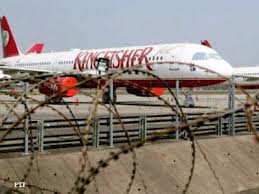
Kingfisher Airlines has lost licence: DGCA chief

January 1, 2013

Mumbai, Jan 1: India's troubled Kingfisher Airlines has lost its permit to fly after a deadline to renew its suspended licence expired, the national aviation regulator said on Tuesday.

The news is a fresh blow for the debt-laden carrier whose operations have been grounded since October after employees went on strike over unpaid wages.

"Kingfisher's flying permit has lapsed," DGCA chief Arun Mishra told AFP.

"They failed to provide additional details on the funding of operations," Mishra added, referring to Kingfisher's revival plan submitted to the DGCA last month.

But the airline said there is no "cause for concern" as the rules allow for the renewal of a permit within two years of expiry.kf

"Kingfisher is confident of securing approval from the regulator on the restart plan, licence approval and reinstatement of its operating permit," its spokesman Prakash Mirpuri said in a statement late Monday.

Kingfisher, controlled by liquor baron Vijay Mallya, owes millions of dollars to banks, airports, fuel suppliers and its staff and has been looking for a foreign investor to inject fresh funds.

The firm has been the worst-hit of India's airlines in 2012, with the industry plagued by high jet fuel prices, fierce competition, price wars and shabby airport infrastructure.

The carrier was India's second-largest until a year ago but its share shrank to just 3.5% — the smallest in the country —before operations stalled completely.

Kingfisher said it was in talks with foreign investors including Abu Dhabi-based Etihad Airways after the government cleared investment by foreign airlines in the key transport sector.

Aviation analysts have expressed doubt over Etihad's purported interest in Bangalore-based Kingfisher given the Indian firm's debt load, which is estimated at $2.5 billion by the consultancy firm Centre for Asia Pacific Aviation.

Comments

Add new comment

  • Coastaldigest.com reserves the right to delete or block any comments.
  • Coastaldigset.com is not responsible for its readers’ comments.
  • Comments that are abusive, incendiary or irrelevant are strictly prohibited.
  • Please use a genuine email ID and provide your name to avoid reject.
News Network
June 9,2020

New Delhi, Jun 9: A record rise in COVID-19 cases in India for the seventh consecutive day has pushed the tally to over 2.6 lakh on Tuesday, with the daily nationwide spike in coronavirus cases inching close to 10,000.

The rise in cases comes at a time when the country has stepped out of a 75-day coronavirus lockdown with malls, religious places and offices opening in several parts of the country under strict conditions.

Since the onset of June, the country has also been witnessing over 200 COVID-19 fatalities each day that has taken the country's death toll to 7,466.

India is the fifth worst-hit nation by the COVID-19 pandemic after the US, Brazil, Russia and the UK, according to the Johns Hopkins University data.

Several states like Haryana, Jammu and Kashmir, Assam, Haryana, Karnataka, Chhattisgarh and Tripura among others have been showing a spurt in cases.

A total 266 new COVID-19 fatalities and 9,987 cases have been reported in the last 24 hours till Tuesday 8 am, according to the Union Health Ministry data.

The country has registered over 9,000 coronavirus infection cases for the sixth day in a row taking the country tally to 2,66,598.

The number of active novel coronavirus cases stands at 1,29,917, while 1,29,214 people have recovered and one patient has migrated, according to the Health Ministry data updated till 8 am.

"Thus, 48.47 per cent patients have recovered so far," a ministry official said.

According to the ICMR, a total of 49,16,116 samples have been tested as on 9 am, Tuesday, with 1,41,682 samples been tested in the last 24 hours.

Out of the total 7,466 fatalities reported till Tuesday 8 am, Maharashtra tops the tally with 3,169 deaths followed by Gujarat with 1,280 deaths, Delhi with 874, Madhya Pradesh with 414, West Bengal with 405, Tamil Nadu with 286, Uttar Pradesh with 283, Rajasthan with 246 and Telangana with 137 deaths.

The death toll reached 75 in Andhra Pradesh, 64 in Karnataka and 53 in Punjab.

Jammu and Kashmir has reported 45 fatalities due to the coronavirus disease, while 39 deaths have been reported from Haryana, 31 from Bihar, 16 from Kerala, 13 from Uttarakhand, nine from Odisha and seven from Jharkhand.

Himachal Pradesh and Chandigarh have registered five COVID-19 fatalities each and Assam and Chhattisgarh have recorded four deaths each so far.

Meghalaya and Ladakh have reported one COVID-19 fatality each, according to ministry data.

More than 70 per cent of the deaths are due to comorbidities, the ministry's website stated

The highest number of confirmed cases in the country are from Maharashtra at 88,528 followed by Tamil Nadu at 33,229, Delhi at 29,943, Gujarat at 20,545, Uttar Pradesh at 10,947, Rajasthan at 10,763 and Madhya Pradesh at 9,638, according to the Health Ministry's data updated in the morning.

The number of COVID-19 cases has climbed to 8,613 in West Bengal, 5,760 in Karnataka, 5,202 in Bihar and 4,854 in Haryana.

It has risen to 4,851 in Andhra Pradesh, 4,285 in Jammu and Kashmir, 3,650 in Telangana and 2,994 in Odisha.

Punjab has reported 2,663 novel coronavirus cases so far, while Assam has 2,776 cases. A total of 2,005 people have been infected by the virus in Kerala and 1,411 in Uttarakhand.

Jharkhand has registered 1,256 cases, while 1,160 cases have been reported from Chhattisgarh, 838 from Tripura, 421 from Himachal Pradesh, 330 from Goa and 317 from Chandigarh.

Manipur has 272 cases, Puducherry has 127 and Nagaland has reported 123 cases till now.

Ladakh has 103 COVID-19 cases, Arunachal Pradesh has 51, Mizoram has 42, Meghalaya 36 while Andaman and Nicobar Islands has registered 33 infections so far.

Dadar and Nagar Haveli has 22 cases, while Sikkim has reported seven cases till now.

The ministry's website said that 8,803 cases are being reassigned to states and "our figures are being reconciled with the ICMR".

State-wise distribution is subject to further verification and reconciliation, it said.

Comments

Add new comment

  • Coastaldigest.com reserves the right to delete or block any comments.
  • Coastaldigset.com is not responsible for its readers’ comments.
  • Comments that are abusive, incendiary or irrelevant are strictly prohibited.
  • Please use a genuine email ID and provide your name to avoid reject.
News Network
January 1,2020

Jan 1: The ban on the practice of instant triple talaq, making it a penal offence and the increase in the strength of Supreme Court judges were two of the major achievements of the law ministry in 2019.

In July, Parliament gave its nod to The Muslim Women (Protection of Rights on Marriage) Bill, 2019. The new law makes talaq-e-biddat or any other similar form of talaq having the effect of instantaneous and irrevocable divorce pronounced by a Muslim husband void and illegal.

It makes it illegal to pronounce talaq three times in spoken, written or through SMS or WhatsApp or any other electronic chat in one sitting.

According to the new law, any Muslim who pronounces the illegal form of talaq upon his wife shall be punished with imprisonment for a term which may extend to three years, and shall also be liable to fine.

During the year, four new judges were appointed to the Supreme Court in September, taking its strength to 34, the highest-ever.

However, vacancies in high courts and lower courts are on the rise and convincing state governments and the 25 high courts to come on board to create an all-India judicial service to recruit judges for the subordinate courts tops the agenda of the Law Ministry in 2020.

Besides creating a consensus on setting up the All-India Judicial Services, the ministry will also have to focus on filling up vacancies in the high court. On an average, the vacancies stood at 400 throughout this year.

With more than 5,000 positions of judicial officers in district and subordinate courts lying vacant, the Law Ministry has pitched for setting up all-India judicial services.

The sanctioned strength of the judicial officers in district and subordinate courts was 22,644. The number of judicial officers in position and vacant posts is 17,509 and 5,135, respectively.

The government has proposed that while states and high courts can recruit judicial officers, the Union Public Service Commission (UPSC) can hold pan-India entrance tests.

The ministry has made it clear that such services would not encroach on the powers of the states.

As of now, the selection and appointment of judges in subordinate courts is the responsibility of the high courts and state governments concerned.

The Narendra Modi government has given a fresh push to the long-pending proposal to set up the new service to have a separate cadre for the lower judiciary in the country.

But there is a divergence of opinion among state governments and respective high courts on the constitution of the All India Judicial Service (AIJS).

One of the problems cited is that since several states have used powers under Code of Criminal Procedure (CrPC) and Code of Civil Procedure (CPC) to declare that the local language would be used in lower courts even for writing orders, a person say selected from Tamil Nadu may find it difficult to hold proceedings in states like Uttar Pradesh and Bihar.

The other point of opposition is that an all India service may hamper the career progression of state judicial services officers.

Another key issue the ministry has to handle in 2020 is vacancies in the 25 high courts.

Throughout 2019, on an average, the high courts faced a shortage of 400 judges.

According to Law Ministry data, as on September 1, the high courts had 414 vacant positions as compared to the sanctioned strength of 1,079 judges. The figure was 409 in August and 403 in July, as per the data.

A three-member Supreme Court collegium recommends the names of candidates for appointment as high court judges. In case of appointments to the Supreme Court, the collegium consists of five top judges of the top court.

High court collegiums shortlist candidates for their respective high courts and send the names to the law ministry.

The ministry, along with background check reports by the Intelligence Bureau, forwards it to the Supreme Court collegium for a final call.

The government has maintained that appointment of judges in the high courts is a "continuous collaborative process" between the Executive and the Judiciary, as it requires consultation and approval from various Constitutional authorities.

Vacancies keep arising on account of retirement, resignation or elevation of judges and increase in judges' strength. In June last year, the vacancy position stood at 399, while it was 396 in May.

In April, 399 posts of judges were vacant, while the figure was 394 in March. The vacancy position in February stood at 400 and in January, it was 392, according to the data collated by the Department of Justice.

Over 43 lakh cases are pending in the 25 high courts.

Another priority would be the finalisation of the memorandum of the procedure to guide the appointment and transfer of the Supreme Court and high court judges. The issue had now been pending for over two years now with the SC collegium and the government failing to reach a consensus.

Successive governments have also been working on making India a hub of international arbitration. It has taken several steps to change laws dealing with commercial disputes.

Comments

Add new comment

  • Coastaldigest.com reserves the right to delete or block any comments.
  • Coastaldigset.com is not responsible for its readers’ comments.
  • Comments that are abusive, incendiary or irrelevant are strictly prohibited.
  • Please use a genuine email ID and provide your name to avoid reject.
News Network
March 28,2020

Amaravati, Mar 28: The state governments of Andhra Pradesh and Karnataka carried out a joint quarantine operation to help over a thousand migrant labourers from various districts of Andhra Pradesh.
The Andhra Pradesh administration received the information that 1,334 migrant labourers were trying to return to the state after obtaining passes from the Deputy Director of Fisheries in Mangalore, Karnataka.
The labourers, according to a press release by the Andhra Pradesh government, were headed towards the Nangili Toll Plaza in Kolar district, from where they would enter the state to return to their native places.
"The Chittoor Collector, Superintendent of Police and Sub-Collector rushed to the spot to coordinate with their counterparts from Kolar, Karnataka. The migrant workers were not permitted to enter AP due to the lockdown and the guidelines of the Union as well as state government," according to the release.
Instead, both the governments decided to initiate a joint quarantine operation in Kolar while taking precautionary measures to ensure that none of the labourers are carriers of the COVID-19 infection.
The Andhra government also reassured the Kolar administration that it will provide doctors, healthcare and all other facilities. It has also issued directions for logistical support, food, water, transport to take the labourers to quarantine facility, and medical team, consisting of 12 doctors, 22 supervisors and other staff, to be provided.
While the Prime Minister had imposed a nationwide lockdown, including the suspension of inter-state travel to prevent the spread of coronavirus, migrant workers and labourers around the country have started returning back to their native places fearing joblessness and cash crunch.
Andhra Pradesh as of Saturday 9:30 am, had 14 confirmed cases of coronavirus while Karnataka's count stood at 55, according to the Ministry of Health and Family Welfare.

Comments

Add new comment

  • Coastaldigest.com reserves the right to delete or block any comments.
  • Coastaldigset.com is not responsible for its readers’ comments.
  • Comments that are abusive, incendiary or irrelevant are strictly prohibited.
  • Please use a genuine email ID and provide your name to avoid reject.