



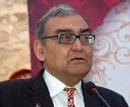
Katju pitches for pardon for Sanjay Dutt

March 22, 2013
katjuNew Delhi, Mar 22: Following the upholding of the sentencing of film star Sanjay Dutt to five years imprisonment by the Supreme Court in 1993 Mumbai blasts case, Press Council of India chief Justice Markandey Katju has appealed to Maharashtra Governor K Sankarnarayanan to pardon the actor.

In a statement issued here, Katju sought pardon for Dutt under Article 161 of the Constitution saying that he had not been found guilty of having played a role in the 1993 blasts and had suffered a lot.

Katju said the Supreme Court, having found that Sanjay Dutt had in his possession a prohibited weapon without a licence, awarded him the minimum imprisonment which was prescribed under law.

"Section  25 (1(A) of the Arms Act states that if a person has in his possession a prohibited weapon without a licence, he shall be awarded punishment of not less than 5 years imprisonment and not more than 10 years," Katju said.

He added the power of pardon under Article 161 by the Constitution is different from judicial power as the Governor or the President can grant pardon or reduce the sentence of the court even if a minimum is prescribed.

"Hence, there is no doubt that the Governor can grant pardon/reduce the sentence. For example, in the case of Commander Nanavati who was held guilty of murder, the Governor gave him pardon although the minimum sentence for murder is life sentence," Katju said.

He said the Supreme Court had not found Dutt guilty for the 1993 bomb blasts but only found him guilty of having in his possession a prohibited weapon without licence.

"Surely, this is a lesser offence than murder. When the Governor of Maharashtra granted pardon to Nanavati, surely he can grant pardon to Sanjay," Katju said.

He added though Dutt had committed an offence there are extenuating circumstances like that the event happened 20 years ago."During this period, Sanjay suffered a lot and had a cloud hovering over his head throughout.

He had to undergo various tribulations and indignities during this period. He had to go to court often, he had to take the permission of the court for foreign shootings, he could not get bank loans, etc," Katju said.

The PCI chairperson said Dutt had already undergone 18 months in jail. He added the actor had got married and they have two small children.

"He has not been held to be a terrorist and had no hand in the bomb blasts. His parents Sunil Dutt and Nargis worked for the good of society and the nation. Sunil Dutt and Nargis often went to border areas to give moral support to our brave jawans and did other social work for society," Katju said.

Katju further added that Dutt in this period of 20 years has through his films revived the memory of Mahatma Gandhi and the message of Gandhiji, the Father of the Nation, an apparent reference to "Gandhigiri" in Munnabhai films.

"In these circumstances, I respectfully appeal to your Excellency to pardon Sanjay Dutt and set him free," Katju said in his letter to the Maharashtra Governor and referred to the speech of Portia in Shakespeare’s ‘Merchant of Venice’ that justice should be tempered with mercy.

Comments

Add new comment

  • Coastaldigest.com reserves the right to delete or block any comments.
  • Coastaldigset.com is not responsible for its readers’ comments.
  • Comments that are abusive, incendiary or irrelevant are strictly prohibited.
  • Please use a genuine email ID and provide your name to avoid reject.
News Network
April 12,2020

Hyderabad, Apr 12: Indicating that prolonged lockdown to contain coronavirus spread may lead to job cuts in the Indian IT industry, NASSCOM former president R Chandrashekhar has said that the work-from-home culture may become a positive development in the long run as it opens up newer avenues and save investments by IT firms.

The former bureaucrat also said startups which are surviving on funds infused by venture capitalists may face tougher situations if the present scenario deteriorates.

"The larger companies may not be actually cutting jobs for two reasons. One is that they do not want to lose their employees and they have money to pay. Many of them ( big companies), even if they do shed some jobs it might be at the most people who are on temporary or intern type and all. But they would not want regular and permanent employees to go. So as long as they have sufficient flexibility in their books, they would continue," said NASSCOM former president.

"But beyond a point that it goes on, for let us say, two months or three months, then even for them, they will feel the pressure. They may not just keep on providing subsidies to the employees. So the key question will be how long that goes on," Chandrasekhar said.

He also said the work-from-home systems being adopted by several firms across the globe, including India, may have a negative impact on the industry in the short-term, but in the long run it would change the work culture which hitherto was not experienced by many of the IT firms in India.

 On impact of the prolonged lockdown on startups, he said it would be a big challenge for the budding enterprises as the investments they get are based on their ideas and future revenues and the present situation under which peoples movement is curbed may shackle their progress.

 "Where will they (startups) get money to pay salaries to their employees. Venture capital investors would not pay the money or invest their money to pay salaries because they are not in the charity business."

If the employees are not paid and if they leave and it is difficult for the startup againto come up. So the whole investment plan goes for a toss, he said.

Former chairman of NASSCOM, B V R Mohan Reddy said a clear picture as to what is going to happen has not yet emerged as the situation with all respects is still evolving. Reddy said there will be a demand shrinkage for the IT industry as the entire world is under stress. "There is no economy in this world that is going to do well in this situation.

So, therefore, there will be a demand shrinkage, he said, indicating tougher times of the industry ahead.

Comments

Add new comment

  • Coastaldigest.com reserves the right to delete or block any comments.
  • Coastaldigset.com is not responsible for its readers’ comments.
  • Comments that are abusive, incendiary or irrelevant are strictly prohibited.
  • Please use a genuine email ID and provide your name to avoid reject.
News Network
July 25,2020

New Delhi, Jul 25: India reported a spike of 48,916 coronavirus cases on Saturday, according to the Union Ministry of Health and Family Welfare.

The total COVID-19 positive cases stand at 13,36,861 including 4,56,071 active cases, 8,49,431 cured/discharged/migrated. With 757 deaths in the last 24 hours, the cumulative toll reached 31,358.

Maharashtra has reported 3,57,117 coronavirus cases, the highest among states and Union Territories in the country.

A total of 1,99,749 cases have been reported from Tamil Nadu till now, while Delhi has recorded a total of 1,28,389 coronavirus cases.

According to the Indian Council of Medical Research (ICMR), 4,20,898 samples were tested for coronavirus on Friday and overall 1,58,49,068 samples have been tested so far.

Comments

Add new comment

  • Coastaldigest.com reserves the right to delete or block any comments.
  • Coastaldigset.com is not responsible for its readers’ comments.
  • Comments that are abusive, incendiary or irrelevant are strictly prohibited.
  • Please use a genuine email ID and provide your name to avoid reject.
Agencies
June 14,2020

New Delhi, Jun 14: Petrol price on Sunday was hiked by a record 62 paise per litre and that of diesel by 64 paise as oil companies for the eighth day in a row adjusted retail rates in line with cost since ending an 82-day hiatus in rate revision.

Petrol price in Delhi was hiked to Rs 75.78 per litre from Rs 75.16 while diesel rates were increased to Rs 74.03 a litre from Rs 73.39, according to a price notification of state oil marketing companies.

Rates have been increased across the country and vary from state to state depending on the incidence of local sales tax or VAT.

The 62 paise a litre increase in petrol and 64 paise hike in diesel price is the highest surge in rates since the daily price revision was started in June 2017.

This is the eighth daily increase in rates in a row since oil companies on June 7 restarted revising prices in line with costs, after ending an 82-day hiatus.

In eight hikes, petrol price has gone up by Rs 4.52 per litre and diesel by Rs 4.64 -- a record increase in rates in any eight days since the daily price revision was introduced.

The freeze in rates was imposed in mid-March soon after the government hiked excise duty on petrol and diesel to shore up additional finances.

Oil PSUs Indian Oil Corp (IOC), Bharat Petroleum Corp Ltd (BPCL) and Hindustan Petroleum Corp Ltd (HPCL), instead of passing on the excise duty hikes to customers, adjusted them against the fall in the retail rates that was warranted because of international oil prices falling to two-decade lows.

The government had first raised excise duty on petrol and diesel by Rs 3 per litre each on March 14 and then again on May 5 by a record Rs 10 per litre in case of petrol and Rs 13 on diesel. The two hikes gave the government Rs 2 lakh crore in additional tax revenues.

State-owned fuel retailers IOC, BPCL and HPCL had frozen petrol and diesel prices since March 16, as if anticipating the government move and set off gains they accrued from continuing drop in international oil prices against the excise duty hike.

They, however, promptly passed the increase in local sales tax or VAT by state governments such as Rs 1.67 increase in VAT on petrol and Rs 7.10 in diesel by the Delhi government on May 4.

The total incidence of excise duty on petrol has risen to Rs 32.98 per litre and that on diesel to Rs 31.83. The excise tax on petrol was Rs 9.48 per litre when the Narendra Modi government took office in 2014 and that on diesel was Rs 3.56 a litre.

The government had between November 2014 and January 2016 raised excise duty on petrol and diesel on nine occasions to take away gains arising from plummeting global oil prices.

In all, duty on petrol rate was hiked by Rs 11.77 per litre and that on diesel by 13.47 a litre in those 15 months that helped government's excise mop up more than double to Rs 2,42,000 crore in 2016-17 from Rs 99,000 crore in 2014-15.

It cut excise duty by Rs 2 in October 2017 and by Rs 1.50 a year later. But it raised excise duty by Rs 2 per litre in July 2019.

It again raised excise duty on March 14 by Rs 3 per litre.

Comments

Add new comment

  • Coastaldigest.com reserves the right to delete or block any comments.
  • Coastaldigset.com is not responsible for its readers’ comments.
  • Comments that are abusive, incendiary or irrelevant are strictly prohibited.
  • Please use a genuine email ID and provide your name to avoid reject.