



NGT declares 100m from edge of Ganga as 'no-development zone'

Agencies
July 13, 2017

New Delhi, Jul 13: The National Green Tribunal today passed a slew of directions to rejuvenate River Ganga, declaring as 'No-Development Zone' an area of 100 metres from the edge of the river between Haridwar and Unnao and prohibiting dumping of waste within 500 metres from the river.
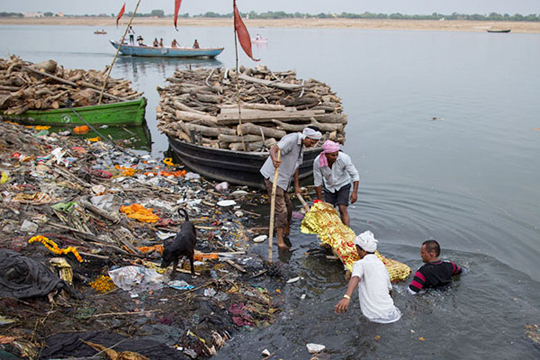
ganga

A bench headed by NGT Chairperson Justice Swatanter Kumar also declared that an environment compensation of Rs 50,000 will be imposed on anyone who dumps waste in the river.

The apex environment watchdog directed all authorities concerned to complete various projects including setting up of a sewage treatment plant and cleaning drains within two years.

It also said the Uttar Pradesh government should be "duty-bound" to shift tanneries within six weeks, from Jajmau in Kanpur to leather parks in Unnao or any other place it considers appropriate.

The NGT also directed the Uttar Pradesh and Uttarakhand governments to formulate guidelines for religious activities on the ghats of Ganga or its tributaries.

The tribunal also appointed a supervisory committee, headed by the secretary of the Water Resources Ministry and comprising IIT professors and officials from UP government to oversee implementation of the directions passed in its 543- page verdict.

It also asked the committee to submit reports at regular intervals.

The NGT said the concept of zero liquid discharge and online monitoring of affluents should not be applied to industrial units.

It said that all industrial units falling in the catchment area of river Ganga should be stopped from indiscriminate extraction of groundwater.

The tribunal had heard the arguments of the Centre, the UP government, pollution control boards and various other stakeholders for almost 18 months before reserving the judgement on May 31.

The green panel has divided the work of cleaning the river in different segments — Gomukh to Haridwar (Phase-I), Haridwar to Unnao (termed as segment B of Phase-I), Unnao to border of Uttar Pradesh, border of Uttar Pradesh to border of Jharkhand and border of Jharkhand to Bay of Bengal.

It has already delivered the verdict in December 2015 with regard to first phase between Gomukh to Haridwar.

The verdict came on a 1985 PIL of noted environment activist M C Mehta which was transferred to the NGT from the Supreme Court in 2014.

Comments

Add new comment

  • Coastaldigest.com reserves the right to delete or block any comments.
  • Coastaldigset.com is not responsible for its readers’ comments.
  • Comments that are abusive, incendiary or irrelevant are strictly prohibited.
  • Please use a genuine email ID and provide your name to avoid reject.
News Network
February 21,2020

Thiruvananthapuram, Feb 21: Hindu temples, dedicated to Lord Shiva, witnessed heavy rush on Friday as devotees celebrated Maha Shivratri festival with traditional zeal and religious fervour across Kerala.

Cutting across age barriers, devotees, including women and children, thronged small and big shrines since early morning to offer prayers and take part in special poojas and rituals on the occasion.

Devotees used to mark the auspicious occasion by observing 'orikkal' (fasting), dedicating the leaves of Koovalam plant, which is considered holy according to Hindu tradition, to the Lord and by abandoning their sleep chanting 'Om Nama Shivaya' mantras.

Ardent devotees even remain awake throughout the night and spend their whole day in temples.

The Sreekandeswaram Mahadeva Temple here, Vadakkunnathan temple in Thrissur and Maha Deva temple in Vaikom were among the major shrines which witnessed heavy rush since early morning.

Temple authorities, especially Devaswom Boards which manage many major shrines in the state, have made elaborate arrangements in Shiva temples to ensure smooth darshan for devotees.

All arrangements have been put in place on the banks of River Periyar in Aluva in Ernakulam for 'Balitharppanam', a ritual in which people pay obeisance to their ancestors.

Performing the ritual on the midnight of Shivratri is considered auspicious by devotees.

Hundreds of 'bali taras' (specially erected platforms) have been set up on the banks of the river to perform the ritual and a large number of priests have been deployed to assist devotees.

Thousands of police personnel were deployed in view of the large turnout of devotees.

Comments

Add new comment

  • Coastaldigest.com reserves the right to delete or block any comments.
  • Coastaldigset.com is not responsible for its readers’ comments.
  • Comments that are abusive, incendiary or irrelevant are strictly prohibited.
  • Please use a genuine email ID and provide your name to avoid reject.
News Network
April 20,2020

New Delhi, Apr 20: With 1,553 more COVID-19 cases, India's total number of coronavirus cases has reached 17,265, the Ministry of Health and Family Welfare said on Monday.

Out of the total cases, 14,175 cases are active, while 2,547 people have been cured/discharged/migrated and 543 deaths have been reported, as per the ministry.

As many as 36 deaths have been reported in the last 24 hours.

According to the Ministry of Health and Family Welfare, Maharashtra continues to be the worst-affected state with a total of 4,203 cases. While 507 patients have recovered, 223 deaths have been reported.

Delhi comes next with 2,003 cases, out of which 72 patients have recovered while 45 patients have died.

Rajasthan has confirmed 1,478 cases, out of which 183 people have recovered while 14 patients are dead.

Tamil Nadu has reported 1,477 cases, out of which 411 have recovered and 15 have succumbed to the virus.

Madhya Pradesh has reported 1,407 cases, including 127 patients recovered and 70 patients dead. On the other hand, Uttar Pradesh has 1,084 COVID-19 positive cases.

In Kerala, which reported the country's first COVID-19 case, 402 people have been detected positive for coronavirus.

Comments

Add new comment

  • Coastaldigest.com reserves the right to delete or block any comments.
  • Coastaldigset.com is not responsible for its readers’ comments.
  • Comments that are abusive, incendiary or irrelevant are strictly prohibited.
  • Please use a genuine email ID and provide your name to avoid reject.
News Network
July 24,2020

New Delhi, Jul 24: The Delhi High Court on Friday asked the ICMR to come out with a clarification that mobile number, government-issued identity card, photographs or even a residential proof ought not to be insisted upon for Covid-19 test of mentally ill homeless persons.

According to an Indian Council of Medical Research (ICMR) advisory of June 19, every person who was to be tested for Covid-19 has to provide a government-issued identity proof and should have a valid phone number for tracing and tracking the individual and his/her contacts.

A bench of Chief Justice D N Patel and Justice Prateek Jalan said that ICMR should issue a clarification by way of a circular or an official order that the identity proof, address proof and mobile number are not required for testing mentally ill homeless persons.

The high court said a camp can be organised for testing such persons as is being done across Delhi for others.

"Guidelines have to be given by you (ICMR). You put it in black and white for the states'' benefit. You only need to clarify in two-three lines that mobile number, address proof and identity cards are not required for testing mentally ill homeless persons," it said.

"Use your powers for the public at large. Once you do so (issue the clarification), all states will comply," the bench added.

Additional Solicitor General Chetan Sharma, appearing for ICMR, sought time to take instructions from the government regarding the observations made by the bench.

The high court, thereafter, listed the matter for further hearing on August 7.

The bench was hearing a PIL moved by advocate Gaurav Kumar Bansal seeking directions to ICMR and Delhi government to issue guidelines for Covid-19 testing of mentally ill homeless persons in the national capital.

Coronavirus India update: State-wise total number of confirmed cases, deaths on July 24

The high court on July 9 had asked the ICMR to consider the plight of the mentally ill homeless persons and see whether they can be tested without insisting upon a mobile number, government issue identity card and residential address proof.

The bench had said to ICMR that many homeless mentally ill persons are institutionalised or in shelter homes and therefore, traceable, so there was no need for their identity proof or phone numbers to test them for Covid-19.

In response to the court''s query, ICMR has filed an affidavit stating that the purpose behind the submission of government identity card and telephone number was to ensure proper tracking and treatment of positive cases and their contacts as ''Test/Track/Treat'' is the best strategy for control of Covid-19 pandemic. 

It further said that since health was a state subject, the concerned state health authority may consider adopting a suitable protocol to ensure that the strategy of ''Test/Track/Treat'' is followed and the grievance raised in the PIL is also addressed.

ICMR, in its affidavit, has said that it has only advised facilitating contact tracing as well as tracking of the Covid-19 infected patients.

"The modalities regarding the contact tracing as well as tracking of the Covid-19 infected patients completely falls under the domain of IDSP. NCDC and state health authorities. 

"ICMR is a research organization and the contact tracing, as well as tracking of the Covid-19 infected patients, is not under the domain of ICMR," it has said in its affidavit.

Bansal has claimed in his petition that the Delhi government has not taken seriously the lack of guidelines with respect to Covid-19 testing of mentally ill homeless persons.

Coronavirus Worldometer | 15 countries with the highest number of cases, deaths due to the Covid-19 pandemic

He has said the high court had on June 9 directed it to address the grievances raised by him in another PIL with regard to mentally ill homeless persons in accordance with law, rules, regulations and government policy.

He said that on June 13 he also sent a representation to the Chief Secretary of Delhi government for providing treatment to mentally ill homeless persons in the national capital who have no residence proof. 

However, nothing was done by the Delhi government, he had told the court.

Comments

Add new comment

  • Coastaldigest.com reserves the right to delete or block any comments.
  • Coastaldigset.com is not responsible for its readers’ comments.
  • Comments that are abusive, incendiary or irrelevant are strictly prohibited.
  • Please use a genuine email ID and provide your name to avoid reject.