


NIA court convicts 13 Muslim youths in 2012 terror module case

September 16, 2016

Bengaluru, Sep 16: A National Investigation Agency (NIA) special court here on Thursdayconvicted 13 persons accused in the Karnataka terror module case, wherein several educated Muslim youths were arrested from their houses and rented rooms in Bengaluru, Hubballi and other places four years ago.
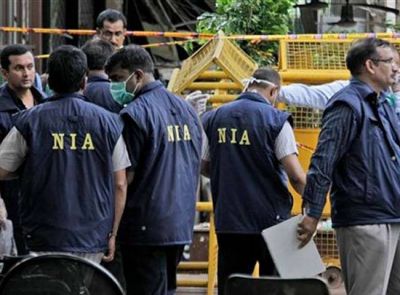
niaSources in the NIA said that this was the first time the accused have pleaded guilty in a terror case. Special court judge Muralidhar Pai adjourned the case to Friday, when he will pronounce the quantum of punishment.

The charge was that the youths had planned to assassinate several prominent personalities including BJP leaders and pro-BJP journalists. Later, a couple of the arrested youths had got clean chit in the case. Some of the accused are still absconding, according to the NIA. The arrest spree started on August 29, 2012 when a team of the Central Crime Branch of the Bengaluru City police nabbed two bike-borne youths in Basaveshwaranagar police limits.

The convicted are: Syed Tanzeem Ahmed of Ben galuru, Dr Imran Ahmed of Bengaluru, Dr Nayeem Siddiqui of Davanagere, Ubaid Ur Rehman of Hyderabad, Shoaib Ahmed Mirza alias Chotu of Hubballi, Abdul Hakeem Jamdar of Hubballi, Riyaz Ahmed Byahatti of Hubballi, Zafar Iqbal Sholapur of Hubb alli, Moha mmed Sa diq Lashkar of Hubballi, Mehaboob Bagalkot of Hubballi, Baba alias Mehboob Bagalkot and Wahid Hussain alias Saahil.

Public prosecutor Arjun Ambalapatta said, the conviction was made mainly under IPC sections 120B (criminal conspiracy), 153A (promoting enmity between different groups on grounds of religion), 307 (attempt to murder) and Section 38 of the Unlawful Activities Prevention Act and Arms Act, and Section 3 read with 25 of the Arms Act, 1959. The sections invoked entail prison terms of up to 10 years.

Police said the suspects were linked to Lashkar-e-Taiba and Harkat-ul-Jehad-al-Islami, and were being directed by handlers in Saudi Arabia to eliminate prominent personalities, including a newspaper editor, a newspaper columnist who is now a BJP MP representing Mysuru-Kodagu constituency, and right-wing leaders.

The case was later transferred to the National Investigation Agency. Six months after the arrests, NIA released two of the suspects, saying there was no prosecutable evidence against them, while a court released on bail a third suspect after the agency failed to file a chargesheet within the stipulated six months of the arrest.

Pleaded guilty in the hope of early release'

The Federation of Muslim NGOs has regretted that the 13 accused pleaded guilty because they were unable to bear the torture of remaining in prison.

"It is a sad reflection of the way investigations are being conducted in terror-related cases. Hundreds of witnesses are cited and a chargesheet running into several thousand pages is filed. The trial takes several years to complete. The draconian Unlawful Activities Prohibition Act ensures no bail is granted and the accused, even if innocent, have to spend several years in jail," read the statement.

"We further call upon the government to ensure the trials are expedited and the Act is amended to ensure bail is granted when proof is not convincing .... Call upon to form an independent review committee comprising a HC judge ... to review the evidence collected before granting sanction for prosecution to ensure innocents are not harassed," read the statement.

"Police say they have ample material evidence against our children. They have been in jail for too long now and have not got bail. Instead of dragging the case, our children agreed to plead guilty as they have already spent four years in jail, and undergo punishment. At least now they can look at an early release after they complete their terms," a family member said, on condition of anonymity.

Only 32 Of 260 gave evidence

The 13 accused stood motionless as NIA special court judge Muralidhar Pai held them guilty, while some of their family members let out exclamations of disappointment.

Around 10.30am Thursday, the men were brought in police vans, each accompanied by a policeman, as they walked to court hall 54 on the third floor of the City Civil Court complex. The judge said he would pronounce the judgment by 3pm. The men were taken out for lunch in the van and brought back to the hall by 2.30pm.

The 13 accused had been denied bail and were in jail during the course of the trial, where only 32 of the 260 witnesses turned up to give evidence.

Comments

Bopanna
 - 
Friday, 16 Sep 2016

\Educated Muslim youth \" ?
Madrassa education ????? Get ready to go meet your 72 virgins"

Bopanna
 - 
Friday, 16 Sep 2016

Terror has only one religion = Islam

Abdullah
 - 
Friday, 16 Sep 2016

The namo naresh who killed baliga was given bail.
The educated Muslim youths who didn't do any crime are convicted.
Wah re wah incredible RSS ruling India.

Deepak D
 - 
Friday, 16 Sep 2016

Who said terror does not have any religion. Anything or nothing can become a terror act if the arrested are Muslims. and any terror act can become nothing if the arrested are Sangh Parivar activists.

observer
 - 
Friday, 16 Sep 2016

Judge Murlidhar Pai a pakka RSS man.

Althaf
 - 
Friday, 16 Sep 2016

really injustice to the youths, how their family must be feeling about the injustice of india.

Nazir
 - 
Friday, 16 Sep 2016

Seriously shameful to our court. hoping of early release they accepted the guilty, for everything we should answer one day, that day will come soon to everyone.

Narain
 - 
Friday, 16 Sep 2016

this terrorists produced by Muslim's NGO's itself, they have to protect them from all the side. in every case this happens. their plan is to take compensation from govt. so they are pushing the case to so many years, in this 60% goes to this NGO's for protecting them, but in this case they failed to protect their children.

Mohan
 - 
Friday, 16 Sep 2016

this Muslim NGO's main job is this only first our court should punish this fellows for arguing against court decision.

Pran Kumar
 - 
Friday, 16 Sep 2016

Why naming Muslim youths? Terror dont have any religion.

Add new comment

  • Coastaldigest.com reserves the right to delete or block any comments.
  • Coastaldigset.com is not responsible for its readers’ comments.
  • Comments that are abusive, incendiary or irrelevant are strictly prohibited.
  • Please use a genuine email ID and provide your name to avoid reject.
Agencies
February 6,2020

Even more than three years after demonetisation and all-out efforts to make most transactions through electronic, cash is still king, as it thrives in a digital India, said fintech start-up Paytm founder Vijay Sekhar Sharma.

"While cashless economy is not possible in India, less cash economy will be in the future. Less cash is the only solution, not the elimination of cash," Sharma told IANS in an interview after unveiling an all-in-one payment gateway on Tuesday.

Asserting that it would take 5-10 years for India to make the transition to digital payments from the traditional mode of cash, Sharma, 41, said the e-payment industry benefitted more from the November 8, 2016 note ban and withdrawal of old Rs 1,000 and Rs 500 denominations.

"I think it (demonetisation) helped the industry despite lack of specific help. But the world has changed since then. It is about the scale of distribution of merchants that is what is propelling digital payments," said Sharma.

Most of the cash not only came back into circulation, but also remains as the mode of payment for the majority due to its convenience for the people used to such transactions.

Expounding Paytm's zero service charge, Sharma said the strategy is sustainable as it leads to acquiring more customers and merchants, enabling newer business opportunities.

Paytm also does not levy a service charge to small merchants for its payments services, unlike organised players like Uber.

"Though there is a monetisation model, the merchants who are small shopkeepers, become our financial services customers as they open a bank account, which is profitable."

Paytm secured a Payments Bank license from the Reserve Bank of India to offer a savings bank account, Rupay debit card and money transfer services.

"We are banking on payment services acquiring customers and merchants who avail banking, lending, insurance, wealth and software services like billing software and business ledger software services eventually," Sharma noted.

The mobile first bank services include zero balance and zero digital transaction charge accounts.

"Basically, payments, cloud, commerce and financial services are a cohort we follow. So, payments is our customer as well as merchant acquisition. If it breaks even, we are happy because other line items make more money, he affirmed.

Noting that in a market like India, one cannot price services at a premium unlike in a developed country like the US, the billionaire businessman said a consumer in a developing country would not be able to afford such a hefty charge.

Forbes ranked Sharma as India's youngest billionaire in 2017, with a net worth of $2.1 billion.

While several countries operate on the model of higher service charges, Sharma said newer business models have to be discovered in India, as customer lifecycle value is accounted for more stages than in other nations.

Asked about an upscale retailer like Zara not giving a wallet payment option during its recent end of season sale in Bengaluru, Sharma said Paytm was addressing such hiccups with its all-in-one payment solutions.

"It's an opportunity, because if the retailer has our all-in-one point of sale machine, where in they enter the amount, it shows both the Quick Response code (QR) and card payment options," he observed.

Sharma compared older swiping payment machine to feature phones and modern ones to feature-rich smartphones.

"If you notice, they look like feature phones and the modern day card machine is more a smartphone like. You can add the smatphone components, which can add the features," reiterated Sharma.

Though Paytm's all-in-one QR point of sale machine integrates the billing system, its chief executive said it was not ideal to have an independent QR feature.

Paytm has 16 million strong merchant user base, which Sharma aims to raise to 26 million base in the next one year.

Sharma has launched in this tech city an all-in-one payment gateway and Paytm Business Payments solution, which enable digital payments through multiple methods for small and medium enterprises (SMEs) and an Android point of sale machine.

With the new gateway solution, collecting digital payments through multiple methods can be achieved seamlessly while Paytm Business Payments solution enables automated vendor payments, including employee salaries and customer refunds among others.

The One97 Communications-owned Paytm aims to help SMEs streamline and digitise their business activities using its new solutions, which enhance the overall efficiency of both accepting and making payments.

Paytm has a data bank of over 200 million saved cards and bank accounts, a feature which enables partner apps to shorten transaction times and propel faster conversions while using the all-in-one payment gateway.

Complementing the two solutions, Sharma also launched an all-in-one Android point of sale machine, which can accept payments through all forms such as cards, wallets, UPI apps and even cash.

The device has a QR code that supports all contact and contactless payments, coming with integrated billing software customized solutions for different sectors such as catering, ticketing, parking and others.

The handheld Android device is equipped with an in-built printer, scanner and can also generate bills.

Valued at $16 billion, Paytm is not alone in the fiercely competitive Indian fintech space where a dozen players like PhonePe, MobiKwik, Kotak 811 and deep pocketed international giants Google Pay and Amazon Pay are in the fray.

Comments

Add new comment

  • Coastaldigest.com reserves the right to delete or block any comments.
  • Coastaldigset.com is not responsible for its readers’ comments.
  • Comments that are abusive, incendiary or irrelevant are strictly prohibited.
  • Please use a genuine email ID and provide your name to avoid reject.
News Network
May 24,2020

Bengaluru, May 24:The first 'Sunday curfew' imposed by the Karnataka government to try and contain the spread of COVID-19 got underway in the state today, with people by and large adhering to norms, roads wearing a deserted look and almost no vehicular traffic, barring essential services.

With barricades being up across most roads in the state, people ventured out only to purchase groceries, vegetabes and medicines.

Instances of violation of Sunday curfew lockdown norms were reported in COVID-19 hotspots of Shivajinagar and Rayapura in Bengaluru and Nelamangala and Devanahalli.

Temples, malls, bars, eateries and small food joints remained shut throughout state.

In most parts of the state buses, autorickshaws and cabs did not ply.

In Bengaluru, the ever bustling Majestic area, which houses the central city bus stand, inter-city bus stand, Metro Railway Station and the City Railway Station, did not see any activity as buses did not ply and all shops were shut, police said.

Reports from Mysuru, Tumakuru, Kolar, Mangaluru, Udupi and other towns across the state said there were no lockdown violations.

Amid the rigid curfew marriages were conducted in a simple manner in various parts of the state like Gollarahatti and Yashwanthapura in Bengaluru and also in Davangere.

Families of the brides and grooms invited only a few people for the event, adhered to social distancing norms and wore masks.

In Gollarahatti, the event organisers cleaned the road, after which the invitees, who were hardly 25 to 30 in number, sat down to have a feast.

The Karnataka government had eased restrictions during Lockdown 4 for start of economic activities like city buses, inter-district bus service, intrastate train services, opening of shops and markets.

However, the government had made it clear that there will be 'Janata Curfew' every Sunday during which only essential services would be permitted.

Comments

Add new comment

  • Coastaldigest.com reserves the right to delete or block any comments.
  • Coastaldigset.com is not responsible for its readers’ comments.
  • Comments that are abusive, incendiary or irrelevant are strictly prohibited.
  • Please use a genuine email ID and provide your name to avoid reject.
News Network
April 9,2020

Bengaluru, Apr 9:  Ministers and members of Legislature in Karnataka will take a 30 per cent cut each in their salaries and allowances to fund the fight against coronavirus in the state, for a year.

An ordinance to reduce the salaries of ministers and legislators by 30 per cent for one year to meet the exigencies arising out of COVID-19 pandemic was approved by the state cabinet headed by chief minister B S Yediyurappa on Thursday.

"... we have cut by 30 per cent salaries and allowances of all ministers, MLAs, MLCs, also speaker, deputy speaker, chief whip every one for one year from April 1, amounting to Rs 15.36 crore," Law and Parliamentary Affairs minister J C Madhuswamy said.

Speaking to reporters after the cabinet meeting, he said, "we have the consent from all the political parties for this, so we have passed the ordinance today."

The Union Cabinet on Monday had approved a 30 per cent cut in salaries of all Members of Parliament and a two-year suspension of the MP Local Area Development (MPLAD) scheme.

Comments

Add new comment

  • Coastaldigest.com reserves the right to delete or block any comments.
  • Coastaldigset.com is not responsible for its readers’ comments.
  • Comments that are abusive, incendiary or irrelevant are strictly prohibited.
  • Please use a genuine email ID and provide your name to avoid reject.