


NIA court convicts 13 Muslim youths in 2012 terror module case

September 16, 2016

Bengaluru, Sep 16: A National Investigation Agency (NIA) special court here on Thursdayconvicted 13 persons accused in the Karnataka terror module case, wherein several educated Muslim youths were arrested from their houses and rented rooms in Bengaluru, Hubballi and other places four years ago.
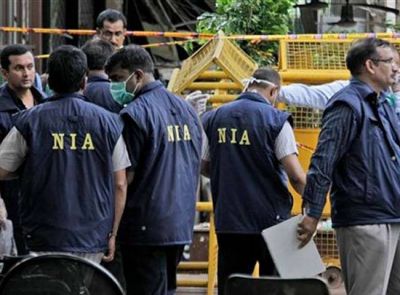
niaSources in the NIA said that this was the first time the accused have pleaded guilty in a terror case. Special court judge Muralidhar Pai adjourned the case to Friday, when he will pronounce the quantum of punishment.

The charge was that the youths had planned to assassinate several prominent personalities including BJP leaders and pro-BJP journalists. Later, a couple of the arrested youths had got clean chit in the case. Some of the accused are still absconding, according to the NIA. The arrest spree started on August 29, 2012 when a team of the Central Crime Branch of the Bengaluru City police nabbed two bike-borne youths in Basaveshwaranagar police limits.

The convicted are: Syed Tanzeem Ahmed of Ben galuru, Dr Imran Ahmed of Bengaluru, Dr Nayeem Siddiqui of Davanagere, Ubaid Ur Rehman of Hyderabad, Shoaib Ahmed Mirza alias Chotu of Hubballi, Abdul Hakeem Jamdar of Hubballi, Riyaz Ahmed Byahatti of Hubballi, Zafar Iqbal Sholapur of Hubb alli, Moha mmed Sa diq Lashkar of Hubballi, Mehaboob Bagalkot of Hubballi, Baba alias Mehboob Bagalkot and Wahid Hussain alias Saahil.

Public prosecutor Arjun Ambalapatta said, the conviction was made mainly under IPC sections 120B (criminal conspiracy), 153A (promoting enmity between different groups on grounds of religion), 307 (attempt to murder) and Section 38 of the Unlawful Activities Prevention Act and Arms Act, and Section 3 read with 25 of the Arms Act, 1959. The sections invoked entail prison terms of up to 10 years.

Police said the suspects were linked to Lashkar-e-Taiba and Harkat-ul-Jehad-al-Islami, and were being directed by handlers in Saudi Arabia to eliminate prominent personalities, including a newspaper editor, a newspaper columnist who is now a BJP MP representing Mysuru-Kodagu constituency, and right-wing leaders.

The case was later transferred to the National Investigation Agency. Six months after the arrests, NIA released two of the suspects, saying there was no prosecutable evidence against them, while a court released on bail a third suspect after the agency failed to file a chargesheet within the stipulated six months of the arrest.

Pleaded guilty in the hope of early release'

The Federation of Muslim NGOs has regretted that the 13 accused pleaded guilty because they were unable to bear the torture of remaining in prison.

"It is a sad reflection of the way investigations are being conducted in terror-related cases. Hundreds of witnesses are cited and a chargesheet running into several thousand pages is filed. The trial takes several years to complete. The draconian Unlawful Activities Prohibition Act ensures no bail is granted and the accused, even if innocent, have to spend several years in jail," read the statement.

"We further call upon the government to ensure the trials are expedited and the Act is amended to ensure bail is granted when proof is not convincing .... Call upon to form an independent review committee comprising a HC judge ... to review the evidence collected before granting sanction for prosecution to ensure innocents are not harassed," read the statement.

"Police say they have ample material evidence against our children. They have been in jail for too long now and have not got bail. Instead of dragging the case, our children agreed to plead guilty as they have already spent four years in jail, and undergo punishment. At least now they can look at an early release after they complete their terms," a family member said, on condition of anonymity.

Only 32 Of 260 gave evidence

The 13 accused stood motionless as NIA special court judge Muralidhar Pai held them guilty, while some of their family members let out exclamations of disappointment.

Around 10.30am Thursday, the men were brought in police vans, each accompanied by a policeman, as they walked to court hall 54 on the third floor of the City Civil Court complex. The judge said he would pronounce the judgment by 3pm. The men were taken out for lunch in the van and brought back to the hall by 2.30pm.

The 13 accused had been denied bail and were in jail during the course of the trial, where only 32 of the 260 witnesses turned up to give evidence.

Comments

Bopanna
 - 
Friday, 16 Sep 2016

\Educated Muslim youth \" ?
Madrassa education ????? Get ready to go meet your 72 virgins"

Bopanna
 - 
Friday, 16 Sep 2016

Terror has only one religion = Islam

Abdullah
 - 
Friday, 16 Sep 2016

The namo naresh who killed baliga was given bail.
The educated Muslim youths who didn't do any crime are convicted.
Wah re wah incredible RSS ruling India.

Deepak D
 - 
Friday, 16 Sep 2016

Who said terror does not have any religion. Anything or nothing can become a terror act if the arrested are Muslims. and any terror act can become nothing if the arrested are Sangh Parivar activists.

observer
 - 
Friday, 16 Sep 2016

Judge Murlidhar Pai a pakka RSS man.

Althaf
 - 
Friday, 16 Sep 2016

really injustice to the youths, how their family must be feeling about the injustice of india.

Nazir
 - 
Friday, 16 Sep 2016

Seriously shameful to our court. hoping of early release they accepted the guilty, for everything we should answer one day, that day will come soon to everyone.

Narain
 - 
Friday, 16 Sep 2016

this terrorists produced by Muslim's NGO's itself, they have to protect them from all the side. in every case this happens. their plan is to take compensation from govt. so they are pushing the case to so many years, in this 60% goes to this NGO's for protecting them, but in this case they failed to protect their children.

Mohan
 - 
Friday, 16 Sep 2016

this Muslim NGO's main job is this only first our court should punish this fellows for arguing against court decision.

Pran Kumar
 - 
Friday, 16 Sep 2016

Why naming Muslim youths? Terror dont have any religion.

Add new comment

  • Coastaldigest.com reserves the right to delete or block any comments.
  • Coastaldigset.com is not responsible for its readers’ comments.
  • Comments that are abusive, incendiary or irrelevant are strictly prohibited.
  • Please use a genuine email ID and provide your name to avoid reject.
News Network
January 6,2020

Bengaluru, Jan 6: There is a wide spread criticism by the Janata Dal(S) and Congress leaders over a proposal to rename Ramanagaram district as New (Nava) Bengaluru, Karnataka Chief Minister CM Yediyurappa said on Monday.

“An unnecessary discussion on renaming Ramanagaram is under way. There is no thought before the government over renaming," The CM accused the Congress and JD(S) leaders of indulging in baseless discussion to mislead the people and to remain relevant. "There is no such agenda before the government. It is a joke that JD(S) and Congress leaders are starting a fight over it.”

The Chief Minister’s clarification came after criticism by former Chief Minister HD Kumaraswamy, who carved out the Ramanagaram district when he was Chief Minister, and former Minister DK Shivakumar whose Kanakapura constituency is in Ramanagaram district, after Deputy Chief Minister CN Ashwath Narayan said Ramanagaram could be renamed as Nava Bengaluru to increase investments prospects.

Comments

Add new comment

  • Coastaldigest.com reserves the right to delete or block any comments.
  • Coastaldigset.com is not responsible for its readers’ comments.
  • Comments that are abusive, incendiary or irrelevant are strictly prohibited.
  • Please use a genuine email ID and provide your name to avoid reject.
News Network
April 4,2020

New Delhi, Apr 4: The Supreme Court on Friday urged Karnataka and Kerala to amicably resolve their issues concerning a border blockade that has choked the free flow of vehicles carrying essential items and patients in the midst of the COVID-19 outbreak.

Karnataka, which imposed the blockade, justified that its border was sealed to “combat the spread of the pandemic by preventing the movement of people from the bordering districts of Kerala to Karnataka”.

The State had moved the Supreme Court, challenging a Kerala High Court order on April 1 to open the border. Kerala has countered that patients from the State cannot be denied access to health care. Besides, the blockade has severely affected the supply of essential items, from medicines to food, to Kerala.

On Friday, a Supreme Court Bench of Justices L. Nageswara Rao and Deepak Gupta urged the States to not confront each other in the midst of an unprecedented public health crisis. Instead, it asked the Chief Secretaries of both States to sit with the Union Health Secretary and iron out a solution. Meanwhile, the apex court urged Kerala not to take any precipitative action based on the High Court order.

The court issued notice to Kerala on the appeal filed by Karnataka, represented by advocate Shubhranshu Padhi. It listed the case for further hearing on April 7.

Karnataka, in its appeal against the High Court order, said the blockade was put in place in the interest of public health. The situation regarding Coronavirus was “really dire”, it said. It warned that opening the blockade would cause a law and order issue as its local population wanted the border to remain sealed.

Karnataka argued that Kerala was the “worst-affected” State in the country with nearly 194 coronavirus cases. In this, Kasaragod, adjoining Karnataka, was the “worst affected” district of Kerala with over a 100 positive cases.

MP’s plea

The court also separately considered a writ petition by Kasaragod MP Rajmohan Unnithan for an order to forthwith open the State border.

The parliamentarian, represented by advocates Haris Beeran and Pallavi Pratap, urged the court to issue an ex-parte stay on the operation of the blockade imposed by Karnataka with its border States.

Mr. Unnithan said Karnataka’s blockade was “ill-planned and dangerous” and had led to loss of lives. Two patients from Kerala, in need of urgent medical care, died after their ambulances were denied entry at the border by the Karnataka authorities. 

Comments

Add new comment

  • Coastaldigest.com reserves the right to delete or block any comments.
  • Coastaldigset.com is not responsible for its readers’ comments.
  • Comments that are abusive, incendiary or irrelevant are strictly prohibited.
  • Please use a genuine email ID and provide your name to avoid reject.
News Network
July 17,2020

Bengaluru, Jul 17: The Karnataka State Board of AUQAF has ordered that management committees at Muslim Khabarastans, shall not refuse burial to Muslims died due to COVID-19.

"...in exercise the powers conferred under Waqf Act 1995, it is hereby ordered that management Committees/Muthawallies/Administrators responsible for the management of Muslim Khabarastans in the state of Karnataka irrespective of registered or unregistered in the Waqf, shall not refuse the burial of Muslims died due to COVID-19 pandemic," read an order from the Karnataka State Board of AUQAF on Thursday.

"They shall co-operate with all the Nodal Officers designated for this purpose regarding the decent burial. Non co-operation or refusal on the part of the management will be construed as an insult committed to the deceased. Any violation of the above order will attract the punitive provision of Indian Penal Code and removal from the management as per the provisions of the Waqf Act 1995," the order read.

It further said that the Waqf Officers, District Wakf Advisory Committees of the state, shall ensure the adherence of this order, and circulate the same to all the Khabarastan managements, registered or unregistered in the state.

"No further deliberation in this regard is solicited except compliance of the order in letter and spirit. Any dereliction in this regard will be viewed seriously," it read.

Giving a background on the issue of burial of COVID-19 deceased, the order read, "It is observed that, number of deaths are being occurred in various Districts of Karnataka, due to COVID-19 pandemic and it is reported that, some of the management committees of Khabarastan, are not cooperating to bury the dead bodies of COVID-19."

"A decent burial is a right of the dead person" as per the law of the land and the Islamic jurisprudence. It is needless to emphasize the importance of burial of Muslim dead bodies in Shariah. The dead body of a Muslim is treated with the utmost respect by the Ummah, joining in the funeral (Tadfeen), participating in the Namaz-e-Janaza and the burial are considered as Farz-e-Kifaya in Muslim law. According to the tradition of Islam, the person who participates in the funeral is entitled to Mountain sized reward (Sawaab)," the order read.

As per the order, the board, in its earlier circular had also cautioned the management of Waqf institutions and Khabarastan which were reluctant to allow the decent burial in the Khabarastan would be punished under the provisions of Indian Penal Code and the punitive provisions of the Waqf Act 1995 as well.

"The District Magistrates and the Superintendent of Police in the districts have been requested to prosecute the erring management committees who are responsible for non co-operation in this regard. Hence, the following order," it added.

Comments

Add new comment

  • Coastaldigest.com reserves the right to delete or block any comments.
  • Coastaldigset.com is not responsible for its readers’ comments.
  • Comments that are abusive, incendiary or irrelevant are strictly prohibited.
  • Please use a genuine email ID and provide your name to avoid reject.