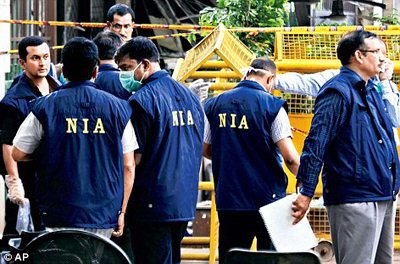
NIA raids 14 places in Kashmir, 8 in Delhi in connection with terror funding

June 3, 2017

New Delhi, Jun 3: The National Intelligence Agency on Saturday raided 14 places in Kashmir and 8 in Delhi in connection with reports of terror funding in the Valley. “Raids are being conducted at 8 locations in Delhi-Haryana and 14 locations in Kashmir,” NIA sources told news agency.nia2

The agency had earlier registered a Preliminary Enquiry into the case which was later converted into regular case (RC) last evening.

“NIA raids also underway against hawala operators, and at separatist leaders' house, office and commercial locations,” sources said. Around eight hawala dealers and traders in the national capital were also raided, they added.

The agency started searches in the wee hours of Saturday at the houses of second-rung separatist leaders in the Valley, according to news agency.

Aides and kins of separatist leader Syed Ali Shah Geelani were among those whose houses were raided by the agency on Friday, including Altaf Fantoosh, his the son-in-law.

Businessman Zahoor Watali, Shahid-ul-Islam, leader of Awami Action Committee, Naaem Khan and Hurriat leader Raja Kalwal in Srinagar, were also among those whose were houses were raided by the agency, as per news agencies. Two places in Sonepat in Haryana were also being searched by the NIA teams.

The agency seized nearly Rs 1.5 crore from various locations in the Kashmir Valley, besides documents which were being scrutinised, officials said.

While no separatist leader from the Valley has been named in the FIR registered by the NIA, organisations like the Hurriyat Conference (factions led by Geelani and Mirwaiz Umer Farooq), Hizbul Mujahideen, Dukhtaran-e-Milat and Lashker-e-Taiba besides Pakistan-based chief of Jamaat-ul Dawah Hafeez Saeed have been mentioned.

The raids were carried out following the questioning of three separatists leaders Nayeem Khan, Farooq Ahmed and Gazi Javed Baba who were allegedly receiving funds from 2008 Mumbai terror attacks mastermind and LeT chief Hafiz Saeed.

The separatists were allegedly being asked to carry out subversive activities in Valley. including stone pelting at armed forces, damaging public property and burning schools and other government establishments.

Comments

Add new comment

  • Coastaldigest.com reserves the right to delete or block any comments.
  • Coastaldigset.com is not responsible for its readers’ comments.
  • Comments that are abusive, incendiary or irrelevant are strictly prohibited.
  • Please use a genuine email ID and provide your name to avoid reject.
News Network
June 18,2020

New Delhi, Jun 18: The border clash between Indian and Chinese soldiers in Ladakh broke the brittle quiet – and also the sense of security for anxious Chinese nationals in India who fear a backlash with anti-Chinese sentiment spiralling in the country.

With the high altitude violent face-off in eastern Ladakh’s Galwan Valley spurring hashtags such as “Boycott China” and “Teach Lesson to China” and leading to street protests, the undercurrents of tension were evident.

Wary of being identified, some said they had been reassured by their friends but were still apprehensive for themselves and their families.

"They (Chinese families) don''t want to speak to the media. They are not going out and are worried about their security and well being. Their families are also worried back home," Mohammed Saqib, secretary general of the India China Economic & Cultural Council, told PTI.

He added that his Chinese friends in India been calling him since they heard news about Monday night’s clashes in which 20 Indian soldiers were killed -- the worst military confrontation in five decades -- and expressed concern over growing anti-China sentiments.

A Chinese national from Beijing working in Gurgaon for a Chinese mobile firm initially refused to talk, saying he did not want to speak to the media and later shared his thoughts only on condition of anonymity.

"There is talk of border standoff and tensions, but we know Indians are very warm people and that is why I have told my family that all is fine here and they should not worry," he said.

Another Chinese national working in Gurgaon said he and his family are feeling the stress amid the spiralling conflict between India and China, but many friends have been reassuring him.

"They (Chinese in India) are under a lot of stress naturally. Such a conflict puts a lot of stress as they could bear the brunt and the same applies to Indians in China," B R Deepak, professor at the Centre for Chinese and South East Asian Studies of the Jawaharlal Nehru University said.

He said it was unfortunate that the border standoff derailed the commemorative programmes aimed at strengthening ties at a time the two countries were gearing to celebrate 70 years of establishment of diplomatic ties.

Experts also feel the border clash is likely to have a significant negative impact on the economic and people to people ties.

There are scores of Chinese in India working in various Chinese firms and also those who are studying in universities like JNU.

About 3,000 Chinese people, doing business or studying in big cities in India, were stranded in India at the start of the COVID-19 crisis, and about half of them returned to China before the lockdown began on March 25.

The Chinese Embassy in New Delhi announced on May 25 that they will arrange for flights to take back students, tourists and businesspersons to five Chinese cities, including Shanghai and Guangzhou.

"It will impact the psychology of the Chinese here. There are 2,000 Chinese firms in various sectors in India which are going to be impacted," Deepak said.

Future investments from the Chinese side could also be impacted, he said.

Moreover, as far as people-to-people contacts are concerned, the number of Chinese students choosing India as a preferred destination is likely to go down, Deepak said.

Alka Acharya, another China expert, said there are two kinds of impacts of such an incident -- short term and medium term.

Usually after the initial nationalistic reaction in the short term things tend to normalise in the medium term, but with such a border clash happening for the first time in decades clearly the resonance would be much more in both India and China, said Acharya, professor at the Centre for East Asian Studies, School of International Studies, in JNU.

“Due to the impact of the COVID-19 crisis on the economy, whether India can take a hardline in terms of economics towards China, is a tricky question,” she said.

In the immediate context, there may be a dip in economic ties with calls for boycott of Chinese goods and services, Acharya said.

The manner in which this crisis is resolved will affect how ties will be affected in the medium term, she said.

The headlines have added to the anxiety.

A group of ex-armymen gathered near the Chinese embassy to protest the killing of 20 Indian Army personnel in Ladakh’s Galwan Valley. And another group of around 10 protesters belonging to the Swadeshi Jagaran Manch protested near the Teen Murti roundabout in Central Delhi.

The anti-China sentiment prevalent among the common public is also finding a reflection in government policy with sources saying the Department of Telecom (DoT) is set to ask state-owned Bharat Sanchar Nigam Ltd (BSNL) not to use Chinese telecom gear in its 4G upgradation.

Trade bodies like CAIT are also calling for a boycott of Chinese products.

And Chinese handset maker Oppo cancelled the livestream launch of its flagship 5G smartphone in the country amid protests.

Monday night’s clashes between the Chinese and Indian troops in Galwan Valley significantly escalated the already volatile border standoff between the two countries.

The casualties on the Chinese side are not yet known. However, government sources, citing an American intelligence report, claimed the total number of soldiers killed and seriously wounded could be 35.


Comments

Add new comment

  • Coastaldigest.com reserves the right to delete or block any comments.
  • Coastaldigset.com is not responsible for its readers’ comments.
  • Comments that are abusive, incendiary or irrelevant are strictly prohibited.
  • Please use a genuine email ID and provide your name to avoid reject.
News Network
January 31,2020

New Delhi, Jan 31: Substantial competition and low tariff rates by telecom operators since 2016 have led to a financial stress in the sector, the Economic Survey said on Friday.

The data price in the country came down by over 99 per cent during 2016-2019, making it among the lowest tariff in the world, according to the survey.

"Since 2016, the sector has witnessed substantial competition and price cutting by the telecom service providers (TSPs), creating financial stress in the sector. As a result, the sector is experiencing consolidation. While some operators have filed for bankruptcy, others have merged, in their quest to improve viability," the survey report said.

In April-June 2019, the price of data was Rs 7.7 per gigabyte (GB) as compared to Rs 200 per GB in June 2016, it added.

"The Average Revenue Per User (ARPU) for GSM based mobile services has also gone down substantially from Rs 126 in June 2016 to Rs 74.30 in June 2019," the survey said.

The tariff war started in the market with entry of new telecom operator Reliance Jio in September 2016.

"BSNL and MTNL are also affected by the tariff war that has impacted their cash flow resulting in mounting losses," the survey said.

The financial health of the public sector telecom firms plummeted to a level where they have been finding hard to pay employees salaries in time.

The government has drawn up a plan to revive these PSUs which is still in works.

The revival plan consists of several measures, including reduction of staff cost through voluntary retirement scheme, allotment of spectrum for 4G services, monetisation of land and building, tower and fibre assets of BSNL and MTNL, debt restructuring through sovereign guarantee bonds and ''in-principle'' approval for merger of BSNL and MTNL.

The survey said that the wireless telephony now constitutes 98.27 per cent of all subscriptions whereas share of landline telephones now stands at only 1.73 per cent where market share is dominated by private sector players.

"The overall tele-density in India stands at 90.45 per cent, the rural tele-density being 57.35 per cent and urban teledensity being 160.71 per cent at the end of September 2019. The private sector dominates with a share of 88.81 per cent (106.06 crore connections) at the end of September, 2019 while the share of public sector was 11.19 per cent (13.36 crore connections)," the survey said.

The lower price of data has also lead in surge of broadband connections and average consumption of the internet.

Total broadband connections increased by about ten times, from 6.1 crore in 2014 to 59.46 crore in June 2019, the survey said.

The number of internet subscribers (both broadband and narrowband put together) stood at 66.53 crore at the end of June 2019 as compared to 25.16 crore in 2014.

The number of mobile internet subscribers was 64.36 lakh at the end of June 2019 while the number of wireline internet subscribers was 2.17 crore.

"India is now the global leader in monthly data consumption, with average consumption per subscriber per month increasing 157 times from 62 MB in 2014 to 9.8 GB in June 2019. The cost of data has also reduced substantially, enabling affordable internet access for millions of citizens," the survey said.

Comments

Add new comment

  • Coastaldigest.com reserves the right to delete or block any comments.
  • Coastaldigset.com is not responsible for its readers’ comments.
  • Comments that are abusive, incendiary or irrelevant are strictly prohibited.
  • Please use a genuine email ID and provide your name to avoid reject.
News Network
June 24,2020

New Delhi, Jun 24: Union Civil Aviation Minister Hardeep Singh Puri on Tuesday said that nearly 1,25,000 Indians have returned from different countries under the Vande Bharat Mission.

He informed that 6,037 people returned to India from overseas on June 23.

"Vande Bharat continues to be a mission of hope and happiness for stranded and distressed Indians around the world. So far, nearly 125K Indians have come back on these evacuation flights and nearly 43K have flown out of India. Today (on Tuesday) 6,037 people returned from different countries," Puri said in a tweet.

As many as 2,50,087 Indian nationals stranded abroad have been repatriated since the beginning of Vande Bharat Mission last month, the Ministry of External Affairs (MEA) said last week.

The Vande Bharat Mission, which started from May 7 to evacuate Indians stranded abroad due to coronavirus pandemic, is in its third phase.
The recent phase commenced on June 11.

Under the third phase, India would have 550 flights including 191 feeder flights.

Comments

Add new comment

  • Coastaldigest.com reserves the right to delete or block any comments.
  • Coastaldigset.com is not responsible for its readers’ comments.
  • Comments that are abusive, incendiary or irrelevant are strictly prohibited.
  • Please use a genuine email ID and provide your name to avoid reject.