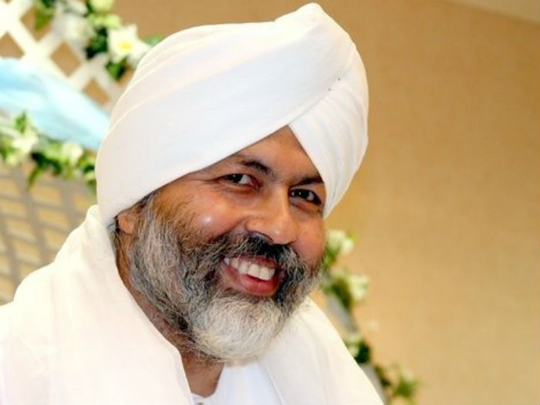
Nirankari sect head Baba Hardev Singh killed in Canada accident: reports

May 13, 2016

New Delhi, May 13: Indian spiritual leader and Nirankari sect head Baba Hardev Singh was reportedly killed in a car accident in Canada on Friday.

Narsingh copy

BJP leader Shahnawaz Hussain confirmed the development on Twitter.

Baba Hardev Singh was the chief priest of the spiritual organization Sant Nirankari Mission. He was born to the previous Satguru of Sant Nirankari Mission, Gurbachan Singh and his wife Kulwant Kaur.

The Sant Nirankari Movement or Universal Brotherhood Movement, which was started by Baba Buta Singh in early 19th century, believes in the importance of a living leader. Sikhism, on the other hand, believed in the Sikh scriptures as their final guru. It was this difference that caused the Sant Nirankari movement, which separated from mainstream Sikhism in 1929.

Satguru Gurbachan Singh was assassinated by fundamentalist Sikhs belonging to Akhand Kirtani Jatha who were wary of the growing power of the Nirankari Mission.

After the assassination, Baba Hardev Singh succeeded his father as the Satguru of the mission and continued to provide teachings to the believers.

The mission has grown to be a global entity with over 2000 centres around the world.

Comments

Sanjay kumar
 - 
Thursday, 19 Jul 2018

In reply to by Sadhu Maharaj

Interesting how the first leader was his grand father and then his father and then him, after his death, his wife and then his daughter. Is this the first ‘family’ of spirituality? Seems more like a family business. 

Sadhu Maharaj
 - 
Friday, 13 May 2016

Deeply saddened to learn the demise of Baba Hardev Singh ji. Baba Hardev Singh's demise is a huge loss to the Nirankari Mission.

Ram charan
 - 
Friday, 13 May 2016

Saddened to hear about the demise of #nirankari Baba. Hardev Singh. RIP

Priyanka Chopra
 - 
Friday, 13 May 2016

Deeply pained by the untimely death of the Nirankari Baba Hardev Singh Ji Maharaj

Umanath Kotian
 - 
Friday, 13 May 2016

Singh's demise is a huge loss to the Nirankari society. May God give his followers the strength to bear the pain of his death.

Add new comment

  • Coastaldigest.com reserves the right to delete or block any comments.
  • Coastaldigset.com is not responsible for its readers’ comments.
  • Comments that are abusive, incendiary or irrelevant are strictly prohibited.
  • Please use a genuine email ID and provide your name to avoid reject.
News Network
February 26,2020

Feb 26: China’s massive travel restrictions, house-to-house checks, huge isolation wards and lockdowns of entire cities bought the world valuable time to prepare for the global spread of the new virus.

But with troubling outbreaks now emerging in Italy, South Korea and Iran, and U.S. health officials warning Tuesday it’s inevitable it will spread more widely in America, the question is: Did the world use that time wisely and is it ready for a potential pandemic?

“It’s not so much a question of if this will happen anymore, but rather more a question of exactly when this will happen — and how many people in this country will have severe illness,” said Dr. Nancy Messonnier of the U.S. Centers for Disease Control and Prevention.

Some countries are putting price caps on face masks to combat price gouging, while others are using loudspeakers on trucks to keep residents informed. In the United States and many other nations, public health officials are turning to guidelines written for pandemic flu and discussing the possibility of school closures, telecommuting and canceling events.

Countries could be doing even more: training hundreds of workers to trace the virus’ spread from person to person and planning to commandeer entire hospital wards or even entire hospitals, said Dr. Bruce Aylward, the World Health Organization’s envoy to China, briefing reporters Tuesday about lessons learned by the recently returned team of international scientists he led.

“Time is everything in this disease,” Aylward said. “Days make a difference with a disease like this.”

The U.S. National Institutes of Health’s infectious disease chief, Dr. Anthony Fauci, said the world is “teetering very, very close” to a pandemic. He credits China’s response for giving other nations some breathing room.

China locked down tens of millions of its citizens and other nations imposed travel restrictions, reducing the number of people who needed health checks or quarantines outside the Asian country.

It “gave us time to really brush off our pandemic preparedness plans and get ready for the kinds of things we have to do,” Fauci said. “And we’ve actually been quite successful because the travel-related cases, we’ve been able to identify, to isolate” and to track down those they came in contact with.

With no vaccine or medicine available yet, preparations are focused on what’s called “social distancing” — limiting opportunities for people to gather and spread the virus.

That played out in Italy this week. With cases climbing, authorities cut short the popular Venice Carnival and closed down Milan’s La Scala opera house. In Japan, Prime Minister Shinzo Abe called on companies to allow employees to work from home, while the Tokyo Marathon has been restricted to elite runners and other public events have been canceled.

Is the rest of the world ready?

In Africa, three-quarters of countries have a flu pandemic plan, but most are outdated, according to authors of a modeling study published last week in The Lancet medical journal. The slightly better news is that the African nations most connected to China by air travel — Egypt, Algeria and South Africa — also have the most prepared health systems on the continent.

Elsewhere, Thailand said it would establish special clinics to examine people with flu-like symptoms to detect infections early. Sri Lanka and Laos imposed price ceilings for face masks, while India restricted the export of personal protective equipment.

India’s health ministry has been framing step-by-step instructions to deal with sustained transmissions that will be circulated to the 250,000 village councils that are the most basic unit of the country’s sprawling administration.

Vietnam is using music videos on social media to reach the public. In Malaysia, loudspeakers on trucks blare information through the streets.

In Europe, portable pods set up at United Kingdom hospitals will be used to assess people suspected of infection while keeping them apart from others. France developed a quick test for the virus and has shared it with poorer nations. German authorities are stressing “sneezing etiquette” and Russia is screening people at airports, railway stations and those riding public transportation.

In the U.S., hospitals and emergency workers for years have practiced for a possible deadly, fast-spreading flu. Those drills helped the first hospitals to treat U.S. patients suffering from COVID-19, the disease caused by the virus.

Other hospitals are paying attention. The CDC has been talking to the American Hospital Association, which in turn communicates coronavirus news daily to its nearly 5,000 member hospitals. Hospitals are reviewing infection control measures, considering using telemedicine to keep potentially infectious patients from making unnecessary trips to the hospital and conserving dwindling supplies of masks and gloves.

What’s more, the CDC has held 17 different calls reaching more than 11,000 companies and organizations, including stadiums, universities, faith leaders, retailers and large corporations. U.S. health authorities are talking to city, county and state health departments about being ready to cancel mass gathering events, close schools and take other steps.

The CDC’s Messonnier said Tuesday she had contacted her children’s school district to ask about plans for using internet-based education should schools need to close temporarily, as some did in 2009 during an outbreak of H1N1 flu. She encouraged American parents to do the same, and to ask their employers whether they’ll be able to work from home.

“We want to make sure the American public is prepared,” Messonnier said.

How prepared are U.S. hospitals?

“It depends on caseload and location. I would suspect most hospitals are prepared to handle one to two cases, but if there is ongoing local transmission with many cases, most are likely not prepared just yet for a surge of patients and the ‘worried well,’” Dr. Jennifer Lighter, a pediatric infectious diseases specialist at NYU Langone in New York, said in an email.

In the U.S., a vaccine candidate is inching closer to first-step safety studies in people, as Moderna Inc. has delivered test doses to Fauci’s NIH institute. Some other companies say they have candidates that could begin testing in a few months. Still, even if those first safety studies show no red flags, specialists believe it would take at least a year to have something ready for widespread use. That’s longer than it took in 2009, during the H1N1 flu pandemic — because that time around, scientists only had to adjust regular flu vaccines, not start from scratch.

The head of the World Health Organization, Tedros Adhanom Ghebreyesus, said the U.N. health agency’s team in China found the fatality rate between 2% and 4% in the hard-hit city of Wuhan, the virus’ epicenter, and 0.7% elsewhere.

The world is “simply not ready,” said the WHO’s Aylward. “It can get ready very fast, but the big shift has to be in the mindset.”

Aylward advised other countries to do “really practical things” now to get ready.

Among them: Do you have hundreds of workers lined up and trained to trace the contacts of infected patients, or will you be training them after a cluster pops up?

Can you take over entire hospital wards, or even entire hospitals, to isolate patients?

Are hospitals buying ventilators and checking oxygen supplies?

Countries must improve testing capacity — and instructions so health workers know which travelers should be tested as the number of affected countries rises, said Johns Hopkins University emergency response specialist Lauren Sauer. She pointed to how Canada diagnosed the first traveler from Iran arriving there with COVID-19, before many other countries even considered adding Iran to the at-risk list.

If the disease does spread globally, everyone is likely to feel it, said Nancy Foster, a vice president of the American Hospital Association. Even those who aren’t ill may need to help friends and family in isolation or have their own health appointments delayed.

“There will be a lot of people affected even if they never become ill themselves,” she said.

Comments

Add new comment

  • Coastaldigest.com reserves the right to delete or block any comments.
  • Coastaldigset.com is not responsible for its readers’ comments.
  • Comments that are abusive, incendiary or irrelevant are strictly prohibited.
  • Please use a genuine email ID and provide your name to avoid reject.
News Network
February 18,2020

Beijing, Feb 18: A hospital director at the epicentre of China's virus epidemic died on Tuesday, state media said, the latest medical worker to fall victim to the new coronavirus spreading across the country.

The COVID-19 virus, which is believed to have originated in Wuhan late last year, has infected more than 72,000 people and killed nearly 1,900.

Liu Zhiming, the director of Wuchang Hospital in Wuhan, died Tuesday morning after "all-out rescue efforts failed," state broadcaster CCTV reported.

China said last week that six medical workers had died from the virus, while 1,716 have been infected.

Liu's death was initially reported by Chinese media and bloggers shortly after midnight on Tuesday -- but the stories were later deleted and replaced with reports that doctors were still trying to save him.

After initial reports of his death were denied, the hospital told AFP on Tuesday morning that doctors were giving him life-saving treatment.

Liu's death has echoes of that of Wuhan ophthalmologist Li Wenliang, who had been punished by authorities for sounding the alarm about the virus in late December.

Li's death prompted a national outpouring of grief as well as anger against the authorities, who were accused of mishandling the crisis.

People took to social media to mourn Liu on Tuesday, with many users on the Twitter-like Weibo platform drawing critical comparisons between Liu's death and Li's.

In both cases their deaths were initially reported in state media posts -- later deleted -- and their deaths denied, before being finally confirmed again.

"Has everyone forgotten what happened to Li Wenliang? They forcefully attempted resuscitation after he died," one Weibo commenter wrote.

Another commenter said, Liu "already died last night, (but) some people are addicted to torturing corpses".

A hashtag about Liu's death had 29 million views by Tuesday afternoon.

Doctors in Wuhan face shortages of masks and protective bodysuits, with some even wearing makeshift hazmat suits and continuing to work despite showing respiratory symptoms, health workers have told AFP.

Hubei province and its capital Wuhan have been the hardest hit by the virus, accounting for nearly 1,800 of the deaths from the virus so far.

Comments

Add new comment

  • Coastaldigest.com reserves the right to delete or block any comments.
  • Coastaldigset.com is not responsible for its readers’ comments.
  • Comments that are abusive, incendiary or irrelevant are strictly prohibited.
  • Please use a genuine email ID and provide your name to avoid reject.
Agencies
June 10,2020

Houston, Jun 10: George Floyd was fondly remembered Tuesday as “Big Floyd” — a father and brother, athlete and neighborhood mentor, and now a catalyst for change — at a funeral for the black man whose death has sparked a global reckoning over police brutality and racial prejudice.

More than 500 mourners wearing masks against the coronavirus packed a Houston church a little more than two weeks after Floyd was pinned to the pavement by a white Minneapolis police officer who put a knee on his neck for what prosecutors said was 8 minutes and 46 seconds.

Cellphone video of the encounter, including Floyd’s pleas of “I can’t breathe,” ignited protests and scattered violence across the U.S. and around the world, turning the 46-year-old Floyd — a man who in life was little known beyond the public housing project where he was raised in Houston’s Third Ward — into a worldwide symbol of injustice.

“Third Ward, Cuney Homes, that’s where he was born at,” Floyd’s brother, Rodney, told mourners at the Fountain of Praise church. “But everybody is going to remember him around the world. He is going to change the world.”

The funeral capped six days of mourning for Floyd in three cities: Raeford, North Carolina, near where he was born; Houston, where he grew up; and Minneapolis, where he died. The memorials have drawn the families of other black victims whose names have become familiar in the debate over race and justice — among them, Eric Garner, Michael Brown, Ahmaud Arbery and Trayvon Martin.

After the service, Floyd’s golden casket was taken by hearse to the cemetery in the Houston suburb of Pearland to be entombed next to his mother, for whom he cried out as he lay dying. A mile from the graveyard, the casket was transferred to a glass-sided carriage drawn by a pair of white horses. A brass band played as his casket was taken inside the mausoleum.

Hundreds of people, some chanting, “Say his name, George Floyd,” gathered along the procession route and outside the cemetery entrance in the mid-90s heat.

“I don’t want to see any black man, any man, but most definitely not a black man sitting on the ground in the hands of bad police,” said Marcus Brooks, 47, who set up a tent with other graduates of Jack Yates High School, Floyd’s alma mater.

In the past two weeks, amid the furor over Floyd’s death, sweeping and previously unthinkable things have taken place: Confederate statues have been toppled, and many cities are debating overhauling, dismantling or cutting funding for police departments. Authorities in some places have barred police from using chokeholds or are otherwise rethinking policies on the use of force.

Dozens of Floyd’s family members, most dressed in white, took part in the four-hour service. Grammy-winning singer Ne-Yo was among those who sang.

The mourners included actors Jamie Foxx and Channing Tatum, J.J. Watt of the NFL’s Houston Texans, rapper Trae tha Truth, Rep. Sheila Jackson Lee, Houston Police Chief Art Acevedo and Houston Mayor Sylvester Turner, who brought the crowd to its feet when he announced he will sign an executive order banning chokeholds in the city.

“I know you have a lot of questions that no child should have to ask, questions that too many black children have had to ask for generations: Why? Why is Daddy gone?” former Vice President Joe Biden, the Democratic presidential candidate, said, addressing Floyd’s 6-year-old daughter in a video eulogy played at the service. “Now is the time for racial justice. That’s the answer we must give to our children when they ask why.”

Biden made no mention of his opponent in November. But other speakers took swipes at President Donald Trump, who has ignored demands to address racial bias and has called on authorities to crack down hard on lawlessness.

“The president talks about bringing in the military, but he did not say one word about 8 minutes and 46 seconds of police murder of George Floyd,” said the Rev. Al Sharpton, the civil rights activist. “He challenged China on human rights. But what about the human right of George Floyd?”

Most of the pews were full, with relatively little space between people.

“So much for social distancing today,” the Rev. Remus Wright told mourners, gently but firmly instructing those attending to wear face masks.

Texas has no limit on how many people can gather in places of worship during the pandemic, though Republican Gov. Greg Abbott has encouraged churches to follow federal health guidelines.

Although the church service was private, at least 50 people gathered outside to pay their respects.

“There’s a real big change going on, and everybody, especially black, right now should be a part of that,” said Kersey Biagase, who traveled more than three hours from Port Barre, Louisiana, with his girlfriend, Brandy Pickney. They wore T-shirts printed with Floyd’s name and “I Can’t Breathe.”

Floyd served nearly five years in prison for robbery with a deadly weapon before becoming a mentor and a church outreach volunteer in Houston. He moved to Minnesota several years ago through a program that tried to change men’s lives by helping them find work in new settings.

At the time of his death, Floyd was out of work as a bouncer at a Minneapolis club that had closed because of the coronavirus outbreak. He was seized by police after being accused of passing a counterfeit $20 bill at a convenience store.

Four Minneapolis officers were arrested in his death: Derek Chauvin, 44, was charged with second-degree murder. J. Alexander Kueng, Thomas Lane and Tou Thao were charged with aiding and abetting. All four could get up to 40 years in prison.

Some of the mostly peaceful demonstrations that erupted after Floyd’s death were marked by bursts of arson, assaults, vandalism and smash-and-grab raids on businesses, with more than 10,000 people arrested. But protests in recent days have been overwhelmingly peaceful.

Comments

Add new comment

  • Coastaldigest.com reserves the right to delete or block any comments.
  • Coastaldigset.com is not responsible for its readers’ comments.
  • Comments that are abusive, incendiary or irrelevant are strictly prohibited.
  • Please use a genuine email ID and provide your name to avoid reject.