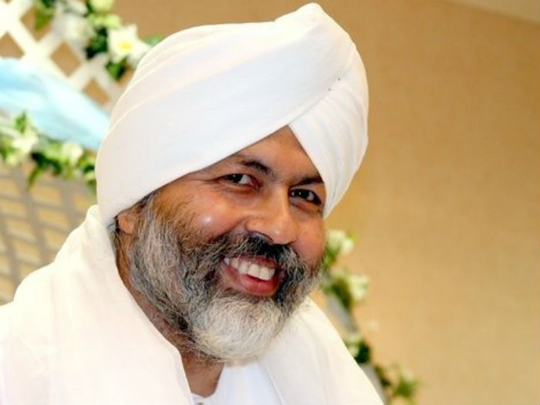
Nirankari sect head Baba Hardev Singh killed in Canada accident: reports

May 13, 2016

New Delhi, May 13: Indian spiritual leader and Nirankari sect head Baba Hardev Singh was reportedly killed in a car accident in Canada on Friday.

Narsingh copy

BJP leader Shahnawaz Hussain confirmed the development on Twitter.

Baba Hardev Singh was the chief priest of the spiritual organization Sant Nirankari Mission. He was born to the previous Satguru of Sant Nirankari Mission, Gurbachan Singh and his wife Kulwant Kaur.

The Sant Nirankari Movement or Universal Brotherhood Movement, which was started by Baba Buta Singh in early 19th century, believes in the importance of a living leader. Sikhism, on the other hand, believed in the Sikh scriptures as their final guru. It was this difference that caused the Sant Nirankari movement, which separated from mainstream Sikhism in 1929.

Satguru Gurbachan Singh was assassinated by fundamentalist Sikhs belonging to Akhand Kirtani Jatha who were wary of the growing power of the Nirankari Mission.

After the assassination, Baba Hardev Singh succeeded his father as the Satguru of the mission and continued to provide teachings to the believers.

The mission has grown to be a global entity with over 2000 centres around the world.

Comments

Sanjay kumar
 - 
Thursday, 19 Jul 2018

In reply to by Sadhu Maharaj

Interesting how the first leader was his grand father and then his father and then him, after his death, his wife and then his daughter. Is this the first ‘family’ of spirituality? Seems more like a family business. 

Sadhu Maharaj
 - 
Friday, 13 May 2016

Deeply saddened to learn the demise of Baba Hardev Singh ji. Baba Hardev Singh's demise is a huge loss to the Nirankari Mission.

Ram charan
 - 
Friday, 13 May 2016

Saddened to hear about the demise of #nirankari Baba. Hardev Singh. RIP

Priyanka Chopra
 - 
Friday, 13 May 2016

Deeply pained by the untimely death of the Nirankari Baba Hardev Singh Ji Maharaj

Umanath Kotian
 - 
Friday, 13 May 2016

Singh's demise is a huge loss to the Nirankari society. May God give his followers the strength to bear the pain of his death.

Add new comment

  • Coastaldigest.com reserves the right to delete or block any comments.
  • Coastaldigset.com is not responsible for its readers’ comments.
  • Comments that are abusive, incendiary or irrelevant are strictly prohibited.
  • Please use a genuine email ID and provide your name to avoid reject.
Agencies
February 12,2020

London, Feb 12: Fugitive liquor baron Vijay Mallya returned to the courtroom here on Wednesday, the second day of hearing at the UK High Court, where the former billionaire has appealed against the extradition decision of Westminster Magistrates Court in December 2018.

On being asked about his expectations from the lengthy appeals process against the extradition order as today is the last day for Mallya to present his defence, the embattled former Kingfisher Airlines boss replied, "I have no clue. You see. I'll also see it. Let's not get into a speculative game."

When asked on what would happen if Mallya loses the case and has to return to India, the liquor baron responded: "We do have arguments."

The UK High Court, on Tuesday, had also heard Mallya's appeal against the Westminster Magistrates' Court order extraditing him to India to face alleged fraud and money laundering charges amounting to Rs 9,000 crore.

Mallya was present in the court along with his counsel Clare Montgomery during the hearing. Officials from Enforcement Directorate (ED) and Central Bureau of Investigation (CBI) along with counsel Mark Summers representing the Indian government were also present.

When the judge asked if there was a timeline in the case, Clare said," This is a very dense case," involving multiple individuals and organisations and that not everything had been taken into account by the magistrate Emma Arbuthnot in her ruling against Mallya.

Montgomery contended that the magistrate's ruling had been riddled with "multiple errors". She also brought into question the admissibility of documents submitted by the Indian government - including witness statements and emails that proved crucial in the ruling by judge Arbuthnot, who found "clear evidence of misapplication of loan funds" and that there was a prima facie case of fraud against Mallya.

As she had done throughout the trial, Montgomery continued to assert that Mallya had not acted in a fraudulent manner or run a pyramid and that the collapse of Kingfisher Airlines was, in fact, the failure of a business in difficult economic circumstances.

She also reiterated concerns about the conduct of the Central Bureau of Investigation (CBI) in bringing charges against Mallya, claiming that the tycoon had been made a scapegoat.

Montgomery also stated that the Indian government had presented the loan taken out by Kingfisher Airlines, not as a simple business loan but was part of a larger and elaborate attempt at defrauding the banks by Mallya and Kingfisher Airlines management.

This, Montgomery contended, was but one example of a wider misinterpretation of the case by judge Arbuthnot.

The High Court justices reprimanded Montgomery for concentrating on the evidence - in essence rehashing the case presented at the lower court - rather than the apparent "mistakes" made by judge Arbuthnot in her ruling.

Mallya remains on bail of £650,000 as he has done throughout this legal process.

The Crown Prosecution Service which is representing the Government of India will present its case for the extradition of Mallya on Wednesday.

The 63-year-old businessman fled India in March 2016 and has been living in the UK since then.

Comments

Add new comment

  • Coastaldigest.com reserves the right to delete or block any comments.
  • Coastaldigset.com is not responsible for its readers’ comments.
  • Comments that are abusive, incendiary or irrelevant are strictly prohibited.
  • Please use a genuine email ID and provide your name to avoid reject.
News Network
April 13,2020

Manila, Apr 13: The Asian Development Bank (ADB) on Monday tripled the size of its response to novel coronavirus disease (COVID-19) pandemic to 20 billion dollars and approved measures to streamline its operations for quicker and more flexible delivery of assistance.

The package expands ADB's 6.5 billion dollars initial response announced on March 18, adding 13.5 billion dollars in resources to help ADB's developing member countries counter the severe macroeconomic and health impacts caused by COVID-19.

The 20 billion dollar package includes about 2.5 billion dollars in concessional and grant resources.

"This pandemic threatens to severely set back economic, social, and development gains in Asia and the Pacific, reverse progress on poverty reduction and throw economies into recession," said ADB President Masatsugu Asakawa.

"Our expanded and comprehensive package of assistance, made possible with the strong support of our board, will be delivered more quickly, flexibly and forcefully to the governments and the private sector in our developing member countries to help them address the urgent challenges in tackling the pandemic and economic downturn," he said in a statement.

ADB's most recent assessment released on April 3 estimates the global impact of the pandemic at between 2.3 and 4.8 per cent of gross domestic product. Regional growth is forecast to decline from 5.2 per cent last year to 2.2 per cent in 2020.

The new package includes the establishment of a COVID-19 pandemic response option under ADB's countercyclical support facility.

Up to 13 billion dollars will be provided through this new option to help governments of developing member countries implement effective countercyclical expenditure programs to mitigate impacts of the COVID-19 pandemic, with a particular focus on the poor and the vulnerable.

Grant resources will continue to be deployed quickly for providing medical and personal protective equipment and supplies from expanded procurement sources.

Some 2 billion dollars from the 20 billion dollar package will be made available for the private sector. Loans and guarantees will be provided to financial institutions to rejuvenate trade and supply chains.

Enhanced microfinance loan and guarantee support and a facility to help liquidity-starved small and medium-sized enterprises, including those run by female entrepreneurs, will be implemented alongside direct financing of companies responding to or impacted by COVID-19.

The response package includes a number of adjustments to policies and business processes that will allow ADB to respond more rapidly and flexibly to the crisis. These include measures to streamline internal business processes, widen the eligibility and scope of various support facilities and make the terms and conditions of lending more tailored.

All support under the expanded package will be provided in close collaboration with international organisations, including the International Monetary Fund, World Bank Group, World Health Organisation, UNICEF, other UN agencies and the broader global community.

Comments

Add new comment

  • Coastaldigest.com reserves the right to delete or block any comments.
  • Coastaldigset.com is not responsible for its readers’ comments.
  • Comments that are abusive, incendiary or irrelevant are strictly prohibited.
  • Please use a genuine email ID and provide your name to avoid reject.
News Network
June 4,2020

Jun 4: A malaria drug President Donald Trump took to try to prevent COVID-19 proved ineffective for that in the first large, high-quality study to test it in people in close contact with someone with the disease.

Results published Wednesday by the New England Journal of Medicine show that hydroxychloroquine was no better than placebo pills at preventing illness from the coronavirus.

The drug did not seem to cause serious harm, though -- about 40% on it had side effects, mostly mild stomach problems.

 “We were disappointed. We would have liked for this to work,” said the study leader, Dr. David Boulware, an infectious disease specialist at the University of Minnesota.

“But our objective was to answer the question and to conduct a high-quality study,” because the evidence on the drug so far has been inconclusive, he said.

Hydroxychloroquine and a similar drug, chloroquine, have been the subject of much debate since Trump started promoting them in March.

Hydroxychloroquine has long been used for malaria, lupus, and rheumatoid arthritis, but no large studies have shown it or chloroquine to be safe or effective for much sicker patients with coronavirus, and some studies have suggested the drugs may do harm.

Trump took a two-week course of hydroxychloroquine, along with zinc and Vitamin D, after two staffers tested positive for COVID-19, and had no ill effects, according to results of his latest physical released by his doctor Wednesday.

Federal regulators have warned against hydroxychloroquine's use except in hospitals and formal studies because of the risk of side effects, especially heart rhythm problems.

Boulware's study involved 821 people in the United States and Canada living with someone diagnosed with COVID-19 or at high risk of getting it because of their job -- doctors, nurses, ambulance workers who had significant exposure to a sick patient while not wearing full protective gear.

They were randomly assigned to get either the nutrient folate as a placebo or hydroxychloroquine for five days, starting within four days of their exposure. Neither they nor others involved in the research knew who was getting which pills.

After 14 days in the study, 12 per cent on the drug developed COVID-19 symptoms versus 14 per cent in the placebo group, but the difference is so small it could have occurred by chance, Boulware said.

“There's basically no effect. It does not prevent infection,” he said of the drug. Even if it were to give some slim advantage, “we'd want a much larger effect” to justify its use and risk of side effects for preventing illness, he said.

Results were no different among a subgroup of participants who were taking zinc or vitamin C, which some people believe might help make hydroxychloroquine more effective or fight the coronavirus.

There are some big caveats: The study enrolled people through the Internet and social media, relying on them to report their own symptoms rather than having them tracked in a formal way by doctors.

Participants were not all tested for the coronavirus but were diagnosed as COVID-19 cases based on symptoms in many cases. And not all took their medicines as directed.

The results “are more provocative than definitive,” and the drug may yet have prevention benefits if tried sooner or in a different way, Dr. Myron Cohen of the University of North Carolina at Chapel Hill wrote in a commentary in the journal.

Others were glad to see a study that had a comparison group and good scientific methods after so many weaker reports on hydroxychloroquine.

“This fits with everything else we've seen so far which suggests that it's not beneficial," said Dr. Peter Bach, director of a health policy center at Memorial Sloan Kettering Cancer Center in New York.

This study was in younger relatively healthy people, but the results “would make me very discouraged about trying to use this in older people” who are most vulnerable to serious illness from the coronavirus, Bach said.

“If it does work, it doesn't work very well.” Dr. Dan Culver, a lung specialist at the Cleveland Clinic, said there's still a chance that giving the drug sooner than four days after someone's exposure to the virus may help prevent illness.

But the study “takes 'home run' off the table” as far as hopes for the drug, he said.

The study was mostly funded by David Baszucki, founder of Roblox, a California-based game software company, and other private donors and the Minnesota university.

Boulware also is leading a study testing hydroxychloroquine for treating COVID-19. The study is finished and results are being analyzed now.

On Tuesday, the journal Lancet posted an “expression of concern” about a study it published earlier this month of nearly 15,000 COVID-19 patients on the malaria drugs that tied their use to a higher risk of dying in the hospital or developing a heartbeat problem.

Scientists have raised serious questions about the database used for that study, and its authors have launched an independent audit.

That work had a big impact: the World Health Organization suspended use of hydroxychloroquine in a study it is leading, and French officials stopped the drug's use in hospitals. On Wednesday, the WHO said experts who reviewed safety information decided that its study could resume.


Comments

Add new comment

  • Coastaldigest.com reserves the right to delete or block any comments.
  • Coastaldigset.com is not responsible for its readers’ comments.
  • Comments that are abusive, incendiary or irrelevant are strictly prohibited.
  • Please use a genuine email ID and provide your name to avoid reject.