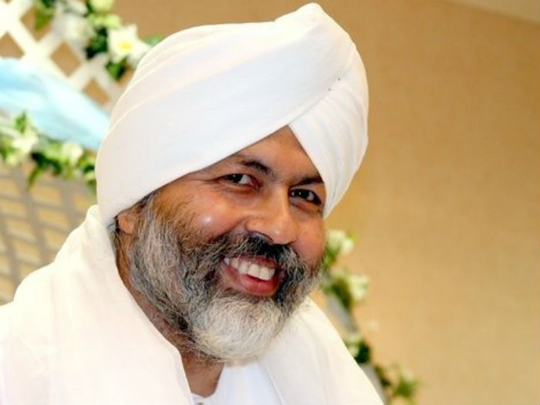
Nirankari sect head Baba Hardev Singh killed in Canada accident: reports

May 13, 2016

New Delhi, May 13: Indian spiritual leader and Nirankari sect head Baba Hardev Singh was reportedly killed in a car accident in Canada on Friday.

Narsingh copy

BJP leader Shahnawaz Hussain confirmed the development on Twitter.

Baba Hardev Singh was the chief priest of the spiritual organization Sant Nirankari Mission. He was born to the previous Satguru of Sant Nirankari Mission, Gurbachan Singh and his wife Kulwant Kaur.

The Sant Nirankari Movement or Universal Brotherhood Movement, which was started by Baba Buta Singh in early 19th century, believes in the importance of a living leader. Sikhism, on the other hand, believed in the Sikh scriptures as their final guru. It was this difference that caused the Sant Nirankari movement, which separated from mainstream Sikhism in 1929.

Satguru Gurbachan Singh was assassinated by fundamentalist Sikhs belonging to Akhand Kirtani Jatha who were wary of the growing power of the Nirankari Mission.

After the assassination, Baba Hardev Singh succeeded his father as the Satguru of the mission and continued to provide teachings to the believers.

The mission has grown to be a global entity with over 2000 centres around the world.

Comments

Sanjay kumar
 - 
Thursday, 19 Jul 2018

In reply to by Sadhu Maharaj

Interesting how the first leader was his grand father and then his father and then him, after his death, his wife and then his daughter. Is this the first ‘family’ of spirituality? Seems more like a family business. 

Sadhu Maharaj
 - 
Friday, 13 May 2016

Deeply saddened to learn the demise of Baba Hardev Singh ji. Baba Hardev Singh's demise is a huge loss to the Nirankari Mission.

Ram charan
 - 
Friday, 13 May 2016

Saddened to hear about the demise of #nirankari Baba. Hardev Singh. RIP

Priyanka Chopra
 - 
Friday, 13 May 2016

Deeply pained by the untimely death of the Nirankari Baba Hardev Singh Ji Maharaj

Umanath Kotian
 - 
Friday, 13 May 2016

Singh's demise is a huge loss to the Nirankari society. May God give his followers the strength to bear the pain of his death.

Add new comment

  • Coastaldigest.com reserves the right to delete or block any comments.
  • Coastaldigset.com is not responsible for its readers’ comments.
  • Comments that are abusive, incendiary or irrelevant are strictly prohibited.
  • Please use a genuine email ID and provide your name to avoid reject.
News Network
April 28,2020

Washington, Apr 28: After nearly three weeks in an intensive care unit in Los Angeles, doctors treating 41-year-old Broadway actor Nick Cordero for COVID-19 were forced to amputate his right leg.

The flow of blood had been impeded by a blood clot: yet another dangerous complication of the disease that has been bubbling up in frontline reports from China, Europe and the United States.

To be sure, so-called "thrombotic events" occur for a variety of reasons among intensive care patients, but the rates among COVID-19 patients are far higher than would be otherwise expected.

"I have had 40-year-olds in my ICU who have clots in their fingers that look like they'll lose the finger, but there's no other reason to lose the finger than the virus," Shari Brosnahan, a critical care doctor at NYU Langone said.

One of these patients is suffering from a lack of blood flow to both feet and both hands, and she predicts an amputation may be necessary, or the blood vessels may get so damaged that an extremity could drop off by itself.

Blood clots aren't just dangerous for our limbs, but can make their way to the lungs, heart or brain, where they may cause lethal pulmonary embolisms, heart attacks, and strokes.

A recent paper from the Netherlands in the journal Thrombosis Research found that 31 percent of 184 patients suffered thrombotic complications, a figure that the researchers called "remarkably high" -- even if extreme consequences like amputation are rare.

Behnood Bikdeli, a doctor at New York-Presbyterian Hospital, assembled an international consortium of experts to study the issue. Their findings were published in the Journal of The American College of Cardiology.

The experts found the risks were so great that COVID-19 patients "may need to receive blood thinners, preventively, prophylactically," even before imaging tests are ordered, said Bikdeli.

What exactly is causing it? The reasons aren't fully understood, but he offered several possible explanations.

People with severe forms of COVID-19 often have underlying medical conditions like heart or lung disease -- which are themselves linked to higher rates of clotting.

Next, being in intensive care makes a person likelier to develop a clot because they are staying still for so long. That's why for example people are encouraged to stretch and move around on long haul flights.

It's also now clear the COVID-19 illness is associated with an abnormal immune reaction called "cytokine storm" -- and some research has indicated this too is linked to higher rates of clotting.

There could also be something about the virus itself that is causing coagulation, which has some precedent in other viral illnesses.

A paper in the journal The Lancet last week showed that the virus can infect the inner cell layer of organs and of blood vessels, called the endothelium. This, in theory, could interfere with the clotting process.

According to Brosnahan, while thinners like Heparin are effective in some patients, they don't work for all patients because the clots are at times too small.

"There are too many microclots," she said. "We're not sure exactly where they are."

Autopsies have in fact shown some people's lungs filled with hundreds of microclots.

The arrival of a new mystery however helps solve a slightly older one.

Cecilia Mirant-Borde, an intensive care doctor at a military veterans hospital in Manhattan, told AFP that lungs filled with microclots helped explain why ventilators work poorly for patients with low blood oxygen.

Earlier in the pandemic doctors were treating these patients according to protocols developed for acute respiratory distress syndrome, sometimes known as "wet lung."

But in some cases, "it's not because the lungs are occupied with water" -- rather, it's that the microclotting is blocking circulation and blood is leaving the lungs with less oxygen than it should.

It has just been a little under five months since the virus emerged in Wuhan, China, and researchers are learning more about its impact every day.

"While we react surprised, we shouldn't be as surprised as we were. Viruses tend to do weird things," said Brosnahan.

While the dizzying array of complications may seem daunting, "it's possible there'll be one or a couple of unifying mechanisms that describe how this damage happens," she said.

"It's possible it's all the same thing, and that there'll be the same solution."

Comments

Add new comment

  • Coastaldigest.com reserves the right to delete or block any comments.
  • Coastaldigset.com is not responsible for its readers’ comments.
  • Comments that are abusive, incendiary or irrelevant are strictly prohibited.
  • Please use a genuine email ID and provide your name to avoid reject.
Agencies
April 2,2020
Thailand's controversial king has created a category of his own with his idea of self-isolation.
 
According to reports, King Maha Vajiralongkorn, also known as Rama X, has hired out an entire luxury hotel in Germany, where he has been 'self-isolating' with 20 women.
 
The luxury hotel, the Grand Hotel Sonnenbichl, is in the Alpine resort town of Garmisch-Partenkirchen.
 
The 67-year-old king is self-isolating with his entourage that includes a 'harem' of 20 concubines and several servants, reported Bild.
 
However, it is unclear if his four wives are currently living in the same hotel.

Comments

Add new comment

  • Coastaldigest.com reserves the right to delete or block any comments.
  • Coastaldigset.com is not responsible for its readers’ comments.
  • Comments that are abusive, incendiary or irrelevant are strictly prohibited.
  • Please use a genuine email ID and provide your name to avoid reject.
News Network
May 12,2020

May 12: Gunmen stormed a hospital on Tuesday in an ongoing attack in the Afghan capital Kabul, as a suicide blast killed 15 people at a funeral in the country's restive east.

Special forces rescued 80 people including mothers and babies from the Kabul hospital after three gunmen launched a morning assault, killing at least four people, the interior ministry said in a statement.

Heavily armed forces were seen carrying babies wrapped in blankets away from the scene, as the clearance operation continued.

The facility, which has a large maternity ward, is located in the west of the city, home to the capital's minority Shiite Hazara community -- a frequent target of Sunni militants from the Islamic State group.

The flare-up in violence comes as Afghanistan grapples with myriad crises including a rise in militant operations across the country and a surge in coronavirus infections.

A paediatrician who fled the hospital told AFP he heard a loud explosion at the entrance of the building.

"The hospital was full of patients and doctors, there was total panic inside," he said, asking not to be named.

The maternity services at the hospital are supported by humanitarian organisation Doctors Without Borders (MSF).

"Hospitals and health workers must not be attacked. We call on all sides to stop attacking hospitals and health workers," said deputy health minister in the city, Waheed Majroh.

Around an hour later, a suicide bomber killed at least 15 people at the funeral of a local police commander in the country's eastern Nangarhar province, according to provincial spokesman Ataullah Khogyani.

The attacker detonated his explosives in the middle of the ceremony.

Zaher Adel, spokesman for the government hospital in Jalalabad, earlier said 12 bodies had arrived from the blast site and more than 50 people were being treated for injuries.

Amir Mohammad, who was wounded in the blast, said thousands of people had gathered for the funeral, an event which often draws huge crowds in Afghanistan.

The violence comes just a day after four roadside bombs exploded in a northern district of Kabul, wounding four civilians including a child.

The bombings were later claimed by the Islamic State group, according to the SITE intelligence group.

They were just the latest in a string of IS attacks on the capital.

In March, at least 25 people were killed by a gunman at a Sikh temple in Kabul, which was later claimed by the group.

IS is also responsible for an infamous attack in March 2017 on one of the country's largest hospitals, when gunmen disguised as doctors stormed the Kabul building and killed dozens.

In recent months, the jihadist group has suffered mounting setbacks after being hunted by US and Afghan forces as well as Taliban offensives targeting their fighters, but it still retains the ability to launch major assaults on urban centres.

The Taliban have largely refrained from launching large attacks on Afghan cities since February when they signed a landmark withdrawal deal with the US meant to pave the way for peace talks with the Kabul government.

Under the agreement, the Taliban promised not to target forces from the US-led coalition, but made no such pledge toward Afghan troops and have stepped up attacks in the provinces.

The Taliban have denied involvement in both of Tuesday's attacks.

Comments

Add new comment

  • Coastaldigest.com reserves the right to delete or block any comments.
  • Coastaldigset.com is not responsible for its readers’ comments.
  • Comments that are abusive, incendiary or irrelevant are strictly prohibited.
  • Please use a genuine email ID and provide your name to avoid reject.