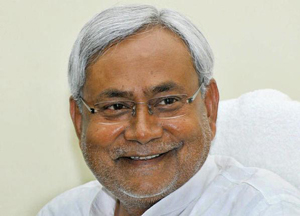
Nitish to skip opposition meet on VP pick

Agencies
July 10, 2017

Patna, Jul 10: Bihar Chief Minister Nitish Kumar cancelled today's public interface event and the subsequent press conference on health grounds, triggering speculation that he is intended to skip the big meet of opposition on Vice President pick. It is also speculated that he is avoiding the media in view of the recent CBI raids on the family of alliance partner Lalu Prasad.

nitishNeither Kumar, nor his party, the JD(U), has commented so far on Friday's CBI raids in four cities in connection with a corruption case, in which Lalu Prasad, his wife Rabri Devi and son Tejashwi are among the accused.

"The Lok Samvad programme, which was scheduled for tomorrow, stands cancelled due to an indisposition of Chief Minister Nitish Kumar," said an official release.

It said the JD(U) chief was down with fever.

Lok Samvad is a public interface programme of Kumar held every Monday. It is aimed at collecting the feedback of the people on the implementation of the development schemes and gather new ideas to strengthen 'sushasan' (good governance).

After the Lok Samvad programme, the chief minister holds a press conference.

While Kumar has maintained a studied silence on the issue of raids on Lalu's family, another ally Congress has expressed solidarity with the RJD chief and accused the central BJP government of "misusing" the official machinery.

Comments

Ahmed Ali K
 - 
Wednesday, 12 Jul 2017

Joke of the millennium
Prohibitory order in Dakshina Kannada??
Q- for whom?
A - Minorities only

Add new comment

  • Coastaldigest.com reserves the right to delete or block any comments.
  • Coastaldigset.com is not responsible for its readers’ comments.
  • Comments that are abusive, incendiary or irrelevant are strictly prohibited.
  • Please use a genuine email ID and provide your name to avoid reject.
News Network
January 19,2020

Chennai, Jan 19: Amid ongoing nationwide protests against Citizenship (Amendment) Act, 2019, finance minister Nirmala Sitharaman on Sunday said that as many as 2838 people from Pakistan were given citizenship during the last six years.

"In the last six years, as many as 2838 Pakistani refugees, 914 Afghan refugees, 172 Bangladeshi refugees including Muslims have been given Indian citizenship. From 1964 to 2008, more than 4,00,000 Tamils (from Sri Lanka) have been given Indian citizenship," Sitharaman said at 'Programme on Citizenship (Amendment) Act, 2019' event here.

She added, "Till 2014, over 566 Muslims from Pakistan, Bangladesh and Afghanistan were given Indian citizenship. During 2016-18 under Modi government, around 1595 Pakistani migrants and 391 Afghanistani Muslims were given Indian citizenship."

The minister, further, said, "It was also during the same period in 2016, that Adnan Sami was given Indian citizenship, this is an example."    

Sitharaman added that people who came from East Pakistan have been settled at various camps in the country.

"They are still there and it's been 50-60 years now. If you visit these camps, your heart will cry. The situation is the same with Sri Lankan refugees who continue to live in camps. They're barred from getting basic facilities," she said.

Asserting that the government is not snatching away anyone's citizenship, the BJP leader said: "This Citizenship (Amendment) Act is an attempt to provide people with a better life. We are not snatching away anyone's citizenship, we are only providing them that."

"The National Population Register (NPR) will be updated every 10 years and is not involved with the National Register of Citizens (NRC). Some are involved in raising false allegations and triggering people unnecessarily without any base," she added.

Comments

indian
 - 
Monday, 20 Jan 2020

Hello Madam,

What Are you ?? Are you a Finance Minister or External Affairs Minister ??

when someone asked about the economy which well related to your ministry you won't even open your mouth, 

but now you are talking about a matter which is not at all your business...

WellWisher
 - 
Sunday, 19 Jan 2020

What a pefect  figure  given by our short time  finance minister. Hope  she wil feed them from her person income wthout ONION.

Fairman
 - 
Sunday, 19 Jan 2020

Stupid, dont know even what they talk.


It is not snatching anybody's nationality. You dont have right to do it.


The subject is not snatching,    the subject is disccimination while giving nationality.


Add new comment

  • Coastaldigest.com reserves the right to delete or block any comments.
  • Coastaldigset.com is not responsible for its readers’ comments.
  • Comments that are abusive, incendiary or irrelevant are strictly prohibited.
  • Please use a genuine email ID and provide your name to avoid reject.
Agencies
July 23,2020

Expressing concern over the ban imposed on TikTok by the government of India, Facebook CEO Mark Zuckerberg has reportedly called the development in the south Asian country “worrisome”.

TikTok was amongst the 59 Chinese apps that were banned in India but why it hogs the maximum limelight because TikTok had the second-largest user base in India with over 200 million users.

As per The Verge writer Casey Newton, Zuckerberg was worried about TikTok’s India ban. Although it soon cashed into the opportunity and released a TikTok clone “Reels”, the government’s reason behind banning the app in India wasn’t received well by Mark Zuckerberg. 

He had said that if India can ban a platform with over 200 million users in India without citing concrete reasons, it can also ban Facebook if something goes amiss on the security and privacy front.

Why Mark finds it particularly worrisome because Facebook is already involved in a lot tussle with the governments across the world involving national security concerns. 

“Facebook already faces fights around the world from governments on both the left and the right related to issues that fit under the broad umbrella of national security: election interference, influence campaigns, hate speech, and even just plain-old democratic speech. Zuckerberg knows that the leap from banning TikTok on national security grounds to banning Facebook on national security grounds is more of a short hop,” the report by Casey read.

Facebook till now has not faced any kind of issue in India but considering the debacle with the other governments, it is not entirely wrong to worry about its future in India if any national security issue arises. Back in 2016, Facebook’s Free Basics service, which means a free but restricted internet service, was banned in India by the telecom regulators. 

The TRAI had said that the Free Basic services were banned in India because it violated the principles of net neutrality. With Free Basics services, Facebook had planned to bring more unconnected users online. But since 2016, there has been no major tussle between the Indian government and Zuckerberg due to national security issues.

Comments

Add new comment

  • Coastaldigest.com reserves the right to delete or block any comments.
  • Coastaldigset.com is not responsible for its readers’ comments.
  • Comments that are abusive, incendiary or irrelevant are strictly prohibited.
  • Please use a genuine email ID and provide your name to avoid reject.
News Network
January 23,2020

Mumbai, Jan 23: Rashmi Sahijwala never expected to start working at the age of 59, let alone join India’s gig economy—now she is part of an army of housewives turning their homes into “cloud kitchens” to feed time-starved millennials.

Asia’s third-largest economy is battling a slowdown so sharp it is creating a drag on global growth, the International Monetary Fund said Monday, but there are some bright spots.

The gig economy, aided by cheap mobile data and abundant labour, has flourished in India, opening up new markets across the vast nation.

Although Indian women have long battled for access to education and employment opportunities, the biggest hurdle for many is convincing conservative families to let them leave home.

But new apps like Curryful, Homefoodi, and Nanighar are tapping the skills of housewives to slice, dice and prepare meals for hungry urbanites from the comfort of their homes.

The so-called cloud kitchens—restaurants that have no physical presence and a delivery-only model—are rising in popularity as there is a boom in food delivery apps such as Swiggy and Zomato.

“We want to be the Uber of home-cooked food,” said Ben Mathew, who launched Curryful in 2018, convinced that housewives were a huge untapped resource.

His company—which employs five people for the app’s daily operations—works with 52 women and three men, and the 31-year-old web entrepreneur hopes to get one million female chefs on-board by 2022.

“We usually train them in processes of sanitisation, cooking, prep time and packaging... and then launch them on the platform,” Mathew told news agency.

One of the first housewives to join Curryful in November 2018 shortly after its launch, Sahijwala was initially apprehensive, despite having four decades of experience in the kitchen.

But backed by her children, including her son who gave her regular feedback about her proposed dishes, she took the plunge.

Since then, she’s undergone a crash course in how to run a business, from creating weekly menus to buying supplies from wholesale markets to cut costs.

The learning curve was steep and Sahijwala switched from cooking everything from scratch to preparing curries and batters for breads in advance to save time and limit leftovers.

She even bought a massive freezer to store fruits and vegetables despite her husband’s reservations about the cost.

“I told him that I am a professional now,” she told news agency.

‘Internet restaurants’

Kallol Banerjee, co-founder of Rebel Foods which runs 301 cloud kitchens backing up 2,200 “internet restaurants”, was among the first entrepreneurs to embrace the concept in 2012.

“We could do more brands from one kitchen and cater to different customer requirements at multiple price points,” Banerjee told AFP.

The chefs buy the ingredients, supply the cookware and pay the utility bills.

The apps—which make their money through charging commission, such as more than 18 percent per order for Curryful—offer training and supply the chefs with containers and bags to pack the food in.

Curryful chef Chand Vyas, 55, spent years trying to set up a lunch delivery business but finally gave up after failing to compete with dabbawalas, Mumbai’s famously efficient food porters.

Today Vyas works seven hours a day, five days a week in her kitchen, serving up a bevy of Indian vegetarian staples, from street food favourites to lentils and rice according to the app’s weekly set menus.

“I don’t understand marketing or how to run a business but I know how to cook. So, the current partnership helps me focus on just that while Curryful takes care of the rest,” Vyas told AFP.

She pockets up to $150 (Rs 10,000 approx) a month after accounting for the commissions and costs, but hopes to earn more as the orders increase.

In contrast, a chef at a bricks-and-mortar restaurant takes home a monthly wage of between $300 (Rs 20,000 approx) and $1,000 (Rs 70,000) approx for working six days a week.

With India’s cloud kitchen sector expected to reach $1.05 billion by 2023, according to data platform Inc42, other companies are also keen to get a slice of the action.

Swiggy, for example, has invested 2.5 billion rupees ($35.3 million) in opening 1,000 cloud kitchens across the nation.

Back in her Mumbai kitchen, Sahijwala is elated to have embarked on a career at an age when her contemporaries are eyeing retirement.

Over the past year, she has seen her profit grow to $200 (Rs 15,000 approx) a month, but more importantly, she said, “My passion has finally found an outlet.

“I am just glad life has given me this chance.”

Comments

Add new comment

  • Coastaldigest.com reserves the right to delete or block any comments.
  • Coastaldigset.com is not responsible for its readers’ comments.
  • Comments that are abusive, incendiary or irrelevant are strictly prohibited.
  • Please use a genuine email ID and provide your name to avoid reject.