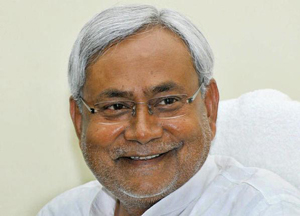
Nitish to skip opposition meet on VP pick

Agencies
July 10, 2017

Patna, Jul 10: Bihar Chief Minister Nitish Kumar cancelled today's public interface event and the subsequent press conference on health grounds, triggering speculation that he is intended to skip the big meet of opposition on Vice President pick. It is also speculated that he is avoiding the media in view of the recent CBI raids on the family of alliance partner Lalu Prasad.

nitishNeither Kumar, nor his party, the JD(U), has commented so far on Friday's CBI raids in four cities in connection with a corruption case, in which Lalu Prasad, his wife Rabri Devi and son Tejashwi are among the accused.

"The Lok Samvad programme, which was scheduled for tomorrow, stands cancelled due to an indisposition of Chief Minister Nitish Kumar," said an official release.

It said the JD(U) chief was down with fever.

Lok Samvad is a public interface programme of Kumar held every Monday. It is aimed at collecting the feedback of the people on the implementation of the development schemes and gather new ideas to strengthen 'sushasan' (good governance).

After the Lok Samvad programme, the chief minister holds a press conference.

While Kumar has maintained a studied silence on the issue of raids on Lalu's family, another ally Congress has expressed solidarity with the RJD chief and accused the central BJP government of "misusing" the official machinery.

Comments

Ahmed Ali K
 - 
Wednesday, 12 Jul 2017

Joke of the millennium
Prohibitory order in Dakshina Kannada??
Q- for whom?
A - Minorities only

Add new comment

  • Coastaldigest.com reserves the right to delete or block any comments.
  • Coastaldigset.com is not responsible for its readers’ comments.
  • Comments that are abusive, incendiary or irrelevant are strictly prohibited.
  • Please use a genuine email ID and provide your name to avoid reject.
Agencies
June 29,2020

From March through May, around 1 crore migrant workers fled India’s megacities, afraid to be unemployed, hungry and far from family during the world’s biggest anti-Covid-19 lockdown.

Now, as Asia’s third-largest economy slowly reopens, the effects of that massive relocation are rippling across the country. Urban industries don’t have enough workers to get back to capacity, and rural states worry that without the flow of remittances from the city, already poor families will be even worse off -- and a bigger strain on state coffers.

Meanwhile, migrant workers aren’t expected to return to the cities as long as the virus is spreading and work is uncertain. States are rolling out stimulus programs, but India’s economy is hurtling for its first contraction in more than 40 years, and without enough jobs, a volatile political climate gets more so.

“This will be a huge economic shock, especially for households of short-term, cyclical migrants, who tend to come from vulnerable, poor and low-caste and tribal backgrounds,” said Varun Aggarwal, a founder of India Migration Now, a research and advocacy group based in Mumbai.

In the first 15 days of India’s lockdown, domestic remittances dropped by 90%, according to Rishi Gupta, chief executive officer of Mumbai-based Fino Paytech Ltd., which operates the country’s biggest payments bank.

By the end of May, remittances were back to around 1750 rupees ($23), about half the pre-Covid average. Gupta’s not sure how soon it’ll fully recover. “Migrants are in no hurry to come back,” Gupta said. “They’re saying that they’re not thinking of going back at all.”

If workers stay in their home states long term, policymakers will have more than remittances to worry about. If consumption falls and the new surplus of labor drives wages down, Agarwal said, “there will also be a second-order shock to the local economy. Overall, not looking good.”

India announced a $277 billion stimulus package in May and followed it up with a $7 billion program aimed at creating jobs for 125 days for migrants in villages across 116 districts. Separately, local authorities are also looking for solutions.

Officials in Bihar have identified 2,500 acres of land that could be made available to investors, said Sushil Modi, deputy chief minister of Bihar, a state in east India. “We can use this crisis as an opportunity to speed up reforms,” he said.

The investors haven’t materialised yet, and in the meanwhile, state governments are relying on the national cash-for-work program that guarantees 100 days worth of wages per household.

Skilled workers don’t want to do manual labor offered through the program, and even if they did, says Amitabh Kundu of RIS, many think of it as beneath their station. “There will be an increase in social tensions,” he predicts. “Caste may again start playing a role. It’s absolute chaos.”

For skilled workers, initiatives vary:

* Uttar Pradesh, which received 3.2 million people, is compiling lists of skilled workers who need employment and trying to place them with local manufacturing and real estate industry associations. So far, the government says, it’s placed 300,000 people with construction and real estate firms.

* Bihar has placed returners in state-run infrastructure projects and hired others to stitch uniforms and make furniture for government-run schools, even as they waited in quarantine centres, said Pratyay Amrit, head of the state’s disaster management department.

* The eastern state of Odisha announced an urban wage employment program aimed at putting as many as 450,000 day labourers to work through September. Some 25,000 people have been employed, so far, under the scheme, G. Mathivathanan, principal secretary for housing and urban development said.

Attracting Investments

It’s not clear any of this will be enough to make a dent, says Ravi Srivastava, professor at New Delhi-based Institute of Human Development, adding that the states don’t have much of a track record on economic development.

“It was the failure of these states to improve governance and put development plans in place that led to the out-migration in the first place,” he said.

But officials and workers’ rights advocates see opportunity. Uttar Pradesh has established liaisons to encourage companies from the US, Japan and South Korea to establish manufacturing in the state. There and in Madhya Pradesh and Rajasthan, the government has made labour laws more friendly to employers, making it easier to hire and fire workers.

Modi, the minister from Bihar, said the migration may also give workers--historically a disenfranchised group--new power, particularly as urban centres struggle. “The way industries treated workers during the lockdown -- didn’t pay them, the living conditions were poor -- now these industries will realize the value of this force,” Modi said.

“In the days to come, labour will emerge as a force that can’t be ignored anymore,” he added. “That’s the new normal. We will work out how to ensure dignity, rights to our people who are going to work in other states.”

Bihar is due for elections by November, a vote that could be an early test of the mass migration’s political consequences. The state is currently governed by a coalition that includes Prime Minister Narendra Modi’s Bharatiya Janata Party. Amitabh Kundu, a fellow at the Research and Information System for Developing Countries, a New Delhi-based government think-tank, said migrant workers are likely to be angry voters.

“Chief ministers are telling these migrants that they will not have to go back for work,” he said. “But their capacity to do something miraculous in the next four to five months is doubtful. If they can retain even one-fourth of the migrants, I would call it a success.”


Comments

Add new comment

  • Coastaldigest.com reserves the right to delete or block any comments.
  • Coastaldigset.com is not responsible for its readers’ comments.
  • Comments that are abusive, incendiary or irrelevant are strictly prohibited.
  • Please use a genuine email ID and provide your name to avoid reject.
Agencies
April 14,2020

Mumbai, Apr 14: The Shiv Sena and NCP said Prime Minister Narendra Modis address to the nation on Tuesday lacked substance as he did not suggest ways to strengthen the economy or a relief package for the poor and those worst hit by the lockdown.

Shiv Sena spokesperson Manisha Kayande also took a dig at the prime minister, saying he thankfully did not give any activity to people this time like clanging utensils or lighting lamps.

Modi on Tuesday announced that the lockdown across the country will be extended till May 3, saying the measure has produced a significant outcome in containing the infection.

He said implementation of the lockdown will be strictly ensured in its second phase and detailed guidelines will be brought out on Wednesday to ensure that outbreak does not spread to new areas.

Some relaxations may be allowed after April 20 in places where there are no hotspots, he said.

Kayande said Modi could have announced extension of the lockdown on Wednesday itself along with the new guidelines, instead of declaring it separately.

"He could have elaborated steps to be taken to tackle the coronavirus, relaxing restrictions on movements in different areas (depending upon threat posed by the disease)," she said.

"His speech normally is more of a rhetoric than substance. Thankfully, he did not give any other event to the people like lighting up lamps or clanging utensils. There was nothing substantial (in the address), the only takeaway was that the lockdown has been extended, she added.

Maharashtra Minister and NCP national spokesman Nawab Malik noted that Modi talked about helping the poor.

"But, he could have announced a package on behalf of the central government to help the poor, those working in the unorganised sector who are the worst hit due to the lockdown.

There was no mention of it anywhere," Malik said.

Another NCP spokesman Mahesh Tapase said it was expected that the prime minister would address the economic concerns being faced by the country.

"The least to expect was the announcement of a slew of measures to kick-start the economy in a phased manner as and when the restrictions are lifted, he added.

Tapase said the employers and employees wanted to know from the government how recession and unemployment will be tackled in the time to come.

"Access to capital for business, especially for MSMEs and agriculture, is a big concern. Supply and logistics is the cornerstone of economic activity which has come to a virtual standstill," he said.

The 2020-21 fiscal looks grim and hence, the right stimulus from the government coupled with a renewed zeal by the industry will only bring the economy back on track, he suggested.

Comments

Add new comment

  • Coastaldigest.com reserves the right to delete or block any comments.
  • Coastaldigset.com is not responsible for its readers’ comments.
  • Comments that are abusive, incendiary or irrelevant are strictly prohibited.
  • Please use a genuine email ID and provide your name to avoid reject.
News Network
February 28,2020

Feb 28: Market benchmark Sensex plummeted over 1,100 points, wiping off over Rs 5 lakh crore investor wealth, in opening session on Friday amid a massive selloff in global equities as rising coronavirus cases outside China stoked fears of a pandemic that could dent world growth.

The 30-share index sank 1,100.27 points, or 2.77 per cent, to 38,645.39, while the NSE Nifty cracked 329.50 points, or 2.83 per cent, to 11,303.80.

All Sensex components were trading in the red, led by losses in Tata Steel, Tech Mahindra, Infosys, Mahindra and Mahindra, Bajaj Finance, HCL Tech and Reliance Industries.

In the previous session, the Sensex settled 143.30 points, or 0.36 per cent, lower at 39,745.66, and the Nifty fell 45.20 points or 0.39 per cent to end at 11,633.30.

According to analysts, till last week the market was of the view that coronavirus was going to have minimum impact on global economy as situation in China was being contained. But the increase in the number of new cases is changing the view and investors are worried about an intense slowdown.

Further, incessant selling by foreign investors is also spooking domestic market participants, traders said.

On a net basis, foreign institutional investors sold equities worth Rs 3,127.36 crore on Thursday, data available with stock exchanges showed.

Stock exchanges in Shanghai, Hong Kong, Seoul and Tokyo plunged up to 4 per cent in their morning sessions.

On Wall Street, the Dow Jones Industrial Average dropped 1,190.95 points, its largest one-day point drop in history, bringing its loss for the week to 3,225.77 points, or 11.1 per cent.

The S&P 500 has now plunged 12 per cent from the all-time high it set just a week ago.

World oil prices too tumbled by more than 4 per cent overnight as traders fretted about the impact of spreading coronavirus on crude demand, particularly from key consumer China.

Brent crude oil futures fell another 2.47 per cent to USD 50.45 per barrel early in the day.

The rupee depreciated 28 paise to 71.89 against the US dollar in morning session.

Comments

Add new comment

  • Coastaldigest.com reserves the right to delete or block any comments.
  • Coastaldigset.com is not responsible for its readers’ comments.
  • Comments that are abusive, incendiary or irrelevant are strictly prohibited.
  • Please use a genuine email ID and provide your name to avoid reject.