No ban on day-dreaming: Javadekar on Rahul's prime ministerial aspirations

Agencies
May 22, 2018

Mumbai, May 22: Union minister Prakash Javadekar on Tuesday took a dig at Congress president Rahul Gandhi's remark that he is ready to be the prime minister, saying there is no ban on "day-dreaming".

The Congress has lost 20 states and it is in power only in a couple of states now. "If on that basis, Gandhi is thinking of becoming the prime minister, then there is no ban on day-dreams in this country," Javadekar told a regional television channel, when asked about the Congress chief's remark.

Gandhi had recently said he is ready to become the prime minister if his party emerges as the "biggest" party in the 2019 Lok Sabha polls.

Asked if Gandhi could pose a challenge to Prime Minister Narendra Modi in the parliamentary elections next year, Javadekar said, "A smart tweet or big talk is not politics. It is much more than that."

The BJP had only two MPs in the Lok Sabha in 1984 and it won 282 seats in the 2014 general polls. The Congress was then 400, which reduced to 44, he pointed out.

"There are lessons to be learnt by the Congress from our example," he said.

Asked about the recent political scenario in Karnataka, he said the southern state's governor had invited the BJP by acting within the constitutional framework.

"When we realised that we do not have the sufficient strength, our chief minister (B S Yeddyurappa) stepped down," he added.

On the Punjab National Bank scam involving diamond merchant Nirav Modi, the BJP leader said, "It happened during Congress period but we have arrested more than 13 people in connection with the case. We will seize their properties spread across the country."

On the BJP's slogan of 'Congress-free India', the minister said it means a country free of "crony-politics, lobbying and passing on benefits only to selected people."

"The bad culture in politics, introduced by the Congress, is what we have been opposing," Javadekar said.

Asked about Rahul Gandhi using a similar slogan of "Modi-mukt Bharat", he claimed that it does not have any appeal among people. "Being so anti-Modi is negative politics which will never be successful in the country."

Despite being a nationwide party, if the Congress was going to say it will only oppose (Prime Minister) Narendra Modi, then it is negative politics, he said.

Javadekar exuded confidence that the BJP will not only win the 2019 general elections, but its performance will also be better than earlier in West Bengal, Odisha, Tamil Nadu and Kerala. "We will also retain our current base in the country."

To a query on how the Centre was going to check the black money and if any opposition leader from Maharashtra would face the heat, he said the Benami Property Transaction Act is going to be implemented from June onwards.

"You will see many leaders of the Congress, the NCP and many more will face its heat. The properties and bungalows purchased in the name of some servants or non-existing person, all are going to be confiscated," he said.

Highlighting the government's achievements and lauding its Swachh Bharat Abhiyan, Javadekar said seven crore houses in the country got toilets.

"I have seen that women in Uttar Pradesh and Bihar have given their toilets the name of 'izzat ghar' as earlier it was embarrassing for them to go out in public," he said.

There are some 400 schemes in the country having an outlay of Rs 3.25 lakh crore, which directly gets deposited into the bank accounts, he said.

"The then prime minister, Rajiv Gandhi, had once said that if he sends Rs 100 to the people, only Rs 15 would reach actually. It was the Congress in power, from the Centre to village, and leaders were siphoning off money. We have stopped it," Javadekar said.

Comments

Mr Frank
 - 
Tuesday, 22 May 2018

Yes Modiji has got excellent experience of that in karnataka and it applies more to Modiji than Rahul for 2019.

Add new comment

  • Coastaldigest.com reserves the right to delete or block any comments.
  • Coastaldigset.com is not responsible for its readers’ comments.
  • Comments that are abusive, incendiary or irrelevant are strictly prohibited.
  • Please use a genuine email ID and provide your name to avoid reject.
News Network
January 13,2020

Jan 13: For the first time in years, the government of India’s Prime Minister Narendra Modi is playing defense. Protests have sprung up across the country against an amendment to India’s laws — which came into effect on Friday — that makes it easier for members of some religions to become citizens of India. The government claims this is simply an attempt to protect religious minorities in the Muslim-majority countries that border India; but protesters see it as the first step toward a formal repudiation of India’s constitutionally guaranteed secularism — and one that must be resisted.

Modi was re-elected prime minister last year with an enhanced majority; his hold over the country’s politics is absolute. The formal opposition is weak, discredited and disorganized. Yet, somehow, the anti-Citizenship Act protests have taken hold. No political party is behind them; they are generally arranged by student unions, neighborhood associations and the like.

Yet this aspect of their character is precisely what will worry Modi and his right-hand man, Home Minister Amit Shah. They know how to mock and delegitimize opposition parties with ruthless efficiency. Yet creating a narrative that paints large, flag-waving crowds as traitors is not quite that easy.

For that is how these protests look: large groups of young people, many carrying witty signs and the national flag. They meet and read the preamble to India’s Constitution, into which the promise of secularism was written in the 1970’s.

They carry photographs of the Constitution’s drafter, the Columbia University-trained economist and lawyer B. R. Ambedkar. These are not the mobs the government wanted. They hoped for angry Muslims rampaging through the streets of India’s cities, whom they could point to and say: “See? We must protect you from them.” But, in spite of sometimes brutal repression, the protests have largely been nonviolent.

One, in Shaheen Bagh in a Muslim-dominated sector of New Delhi, began simply as a set of local women in a square, armed with hot tea and blankets against the chill Delhi winter. It has now become the focal point of a very different sort of resistance than what the government expected. Nothing could cure the delusions of India’s Hindu middle class, trained to see India’s Muslims as dangerous threats, as effectively as a group of otherwise clearly apolitical women sipping sweet tea and sharing their fears and food with anyone who will listen.

Modi was re-elected less than a year ago; what could have changed in India since then? Not much, I suspect, in most places that voted for him and his party — particularly the vast rural hinterland of northern India. But urban India was also possibly never quite as content as electoral results suggested. India’s growth dipped below 5% in recent quarters; demand has crashed, and uncertainty about the future is widespread. Worse, the government’s response to the protests was clearly ill-judged. University campuses were attacked, in one case by the police and later by masked men almost certainly connected to the ruling party.

Protesters were harassed and detained with little cause. The courts seemed uninterested. And, slowly, anger began to grow on social media — not just on Twitter, but also on Instagram, previously the preserve of pretty bowls of salad. Instagram is the one social medium over which Modi’s party does not have a stranglehold; and it is where these protests, with their photogenic signs and flags, have found a natural home. As a result, people across urban India who would never previously have gone to a demonstration or a political rally have been slowly politicized.

India is, in fact, becoming more like a normal democracy. “Normal,” that is, for the 2020’s. Liberal democracies across the world are politically divided, often between more liberal urban centers and coasts, and angrier, “left-behind” hinterlands. Modi’s political secret was that he was that rare populist who could unite both the hopeful cities and the resentful countryside. Yet this once magic formula seems to have become ineffective. Five of India’s six largest cities are not ruled by Modi’s Bharatiya Janata Party in any case — the financial hub of Mumbai changed hands recently. The BJP has set its sights on winning state elections in Delhi in a few weeks. Which way the capital’s voters will go is uncertain. But that itself is revealing — last year, Modi swept all seven parliamentary seats in Delhi.

In the end, the Citizenship Amendment Act is now law, the BJP might manage to win Delhi, and the protests might die down as the days get unmanageably hot and state repression increases. But urban India has put Modi on notice. His days of being India’s unifier are over: From now on, like all the other populists, he will have to keep one eye on the streets of his country’s cities.

Comments

Add new comment

  • Coastaldigest.com reserves the right to delete or block any comments.
  • Coastaldigset.com is not responsible for its readers’ comments.
  • Comments that are abusive, incendiary or irrelevant are strictly prohibited.
  • Please use a genuine email ID and provide your name to avoid reject.
News Network
June 17,2020

New Delhi, Jun 17: Police Surender Jeet Kaur, Assistant Commissioner of Delhi Police Surender Jeet Kaur, has held herself responsible for the death of her husband Charan Jeet Singh, who succumbed to Covid at a hospital in Delhi.

“My husband didn’t step out of the house when the lockdown started, but I went out daily because of my job… I will never be able to forgive myself,” Kaur on Tuesday, a day after losing her husband.

54-year-old Singh, a resident of Lajpat Nagar and a businessman, is survived by his wife and their 26-year-old son who lives in Canada.

Kaur, 57, ACP (Crimes Against Women) in the South-East district of the Delhi Police, is also ACP (Covid Cell) of the district. On May 20, five days after Kaur tested positive for the virus, her husband Singh tested positive, followed by the ACP’s 80-year-old father on May 24.

All of them had symptoms and while Kaur and Singh were admitted to Indraprastha Apollo hospital, her father was admitted to Max hospital in Saket. On May 26, Kaur returned home after recovering from the virus.

Kaur said, “I last spoke to my husband on May 22 night, when we were both admitted in the hospital in different wards. The doctor called me and said that my husband needs to be put on ventilator support. I had a video call with my husband. He was breathless and told me that his oxygen level was dropping. He showed me the monitor, the doctors in the room, and then said he was having trouble speaking and that he would send me WhatsApp messages.”

A day after he passed away, Kaur recalled the messages that Singh sent her just before being put on ventilator support. “He started sending me details of our finances, accounts… I told him to stop and asked him why he was telling me all this. He said I needed to know… Maybe he feared he wouldn’t come back. I prayed every day, at temples, mosques, churches and gurdwaras for him. I am devastated that he’s gone. We were to move to Canada to live with our son in 2023 after my retirement. We had so many plans.”

Kaur’s brother Maninder Ahluwalia said the hospital tried plasma therapy but Singh didn’t respond to the treatment. “He had diabetes and high BP, but those were always under control. We were hopeful,” he said.

The couple’s son joined on video call from Canada to watch his father’s last journey from the ambulance to the entrance of the crematorium. “My son couldn’t attend his father’s last rites because there are no flights… It’s so unfortunate,” said Kaur.

Friends and family remember Singh as a “jolly, disciplined and brave man”, while Kaur said he was the “perfect partner”. She said, “When I was an SHO-rank officer, I would work for 36 hours straight some days, and he would handle the house and our son who was growing up. I would miss family functions and important occasions but he would always go and make up for my absence. I was able to do this job for decades because of his support.”

On Tuesday afternoon, Singh was cremated in the presence of close family and members of the police fraternity. “The DCP and the Joint CP called me daily to enquire about my husband, other police officers too. I am grateful for their support. They didn’t let me feel alone for a single day,” said Kaur.

Comments

Add new comment

  • Coastaldigest.com reserves the right to delete or block any comments.
  • Coastaldigset.com is not responsible for its readers’ comments.
  • Comments that are abusive, incendiary or irrelevant are strictly prohibited.
  • Please use a genuine email ID and provide your name to avoid reject.
coastaldigest.com news network
August 7,2020


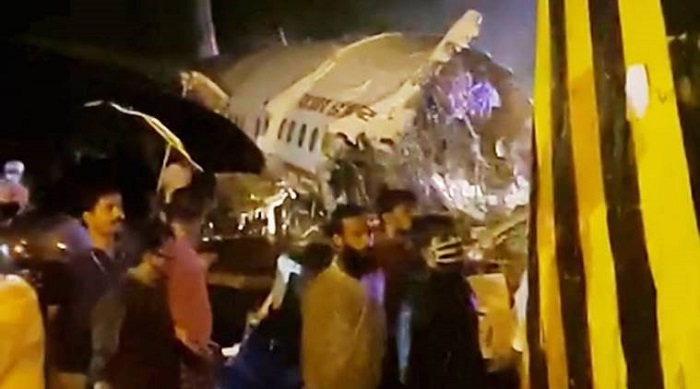
Kozhikode: An Air India Express flight from Dubai with 190 people on board overshot the Kozhikode tabletop runway on landing there today. The Boeing 737 “fell off” the runway into the valley, broke into two causing death and devastation. 

According to reports, around 20 people were dead including two pilots.

An Air India spokesperson said: “Air India Express flight IX 1344 operated by Boeing 737 aircraft from Dubai to Calicut overshot the runway at Kozhikode at 7.41 pm Friday. No fire reported at the time of landing. There are 174 passengers, 10 infants, two pilots and five cabin crew on board. Rescue operations are on and passengers are being taken to hospital for medical care. We will soon share the update in this regard.”

The Directorate General of Civil Aviation (DGCA) is probing this accident. “Prima facie, the aircraft landed beyond the touchdown point and fell into a valley. It has broken into two. We suspect some casualties. More information is awaited,” said a senior DGCA official.

Taking to twitter, defence minister Rajnath Singh wrote: “Devastating news from Kozhikode, Kerala. I am deeply anguished by the loss of lives due to an accident carrying several passengers on Air India flight. In this hour of grief, my thoughts are with the bereaved families. I pray for the speedy recovery of the injured.”

Foreign minister S Jaishankar tweeted: “Deeply distressed to hear about the Air India Express tragedy at Kozhikode. Prayers are with the bereaved families and those injured. We are ascertaining further details.”

While, senior BJP leader from Kerala K J Alphons tweeted: “Second tragedy of the day in Kerala: Air India Express skids off the run way at Kozhikode, front portion splits , pilot dies and lots of passengers injured . All passengers evacuated. Very lucky the aircraft didn’t catch fire.”

More details are awaited.

Watch video | Air India flight from Dubai skids off runway in Kerala, splits into two pic.twitter.com/qgGxEEG2e3

— coastaldigest.com (@coastaldigest) August 7, 2020

Comments

Add new comment

  • Coastaldigest.com reserves the right to delete or block any comments.
  • Coastaldigset.com is not responsible for its readers’ comments.
  • Comments that are abusive, incendiary or irrelevant are strictly prohibited.
  • Please use a genuine email ID and provide your name to avoid reject.