


No evidence for seer’s allegation against singer Premalatha: CID

[email protected] (CD Network)
February 22, 2017

Karwar, Feb 22: Central Investigation Department (CID) has given clean chit to singer Premalatha and her husband Divakar in connection with alleged blackmail case filed by Sri Ramachandrapura Mutt and its Seer Raghaveshwara Bharathi Swami.
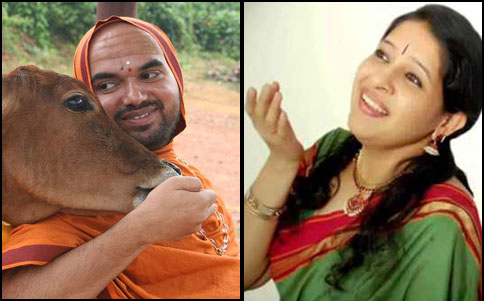
1seerlathaOn Wednesday, the CID team submitted ‘B’ report to the Honnavara JMFC court stating that there was no solid evidence to prove the allegations made against Premalatha and her husband by the seer.

Premalatha had earlier filed a complaint against the seer accusing him of sexually exploiting her for many times in the mutt.

In his complaint to Honnavar police in August, 2014, the seer had claimed that Premalatha and Divakar had demanded Rs 2 crore to "not to lodge rape complaint against him".

Following the complaint filed at Honnavar police station in 2014, after an enquiry by the police department, the state government had transferred the case to CID for further investigation.

Background

It could be recalled here that last year a local court had given clean chit to the same seer in the rape case filed against him by Premalatha.

Prior to that the CID charge sheet in the case (164/2014) registered with the Girinagar police station in Bengaluru, had established that the seer has sexually abused the singer repeatedly during the Rama Katha discourses across the country since 2011.

The vital evidence in the case claimed by the CID was the Forensic Science Laboratory (FSL) report. The CID stated that the FSL report confirmed that the DNA sample found on the material evidence matched with the DNA of the seer. The charge sheet also stated that the seer repeatedly threatened the victim of incurring divine displeasure (if she did not comply). Hence, section 508 of IPC was also included.

The court had taken cognisance of the charge sheet and had summoned the accused. Before the stage of Hearing Before Charge (HBC), the seer had filed a discharge application. The CID objected stating that since the charges against the accused were serious, only a trial would unearth the facts. The court, however, discharged him of all the offences.

The victim had stated that after the Rama Katha programme at Gokarna in Uttara Kannada, in September 2011, the seer had made the first sexual advances at her.

Later, during the Rama Katha discourses held at Jodhpur in Rajasthan in October 2011, the seer had called her to his private room and given her some prasadam. The victim stated that the sexual abuse had taken place in Kolkata, Mumbai and in nine districts of Karnataka. The victim was a prominent singer in the Rama Katha programmes and the seer was also present during these programmes. The CID had conducted mahazar and recorded the statements of witnesses at all the places stated by the victim.

In July 2014, a woman by name Deepika, who participated in Rama Katha discourses, filed a complaint with the Honnavar police saying she got threatening calls asking her not to participate in the discourse.

In August 2014, Mutt staffer Raghavendra Madhyasta filed a complaint with the Puttur town police stating he got threat calls asking him not to support the seer.

In August 2014, one Chandrashekhar of Ramachandrapura Mutt filed a complaint with the Honnavar police against the victim in FIR number 164/2014 and her husband of blackmailing the seer for Rs 3 crore. The couple was arrested by Honnavar police and kept in judicial custody.

In August 2014, victim's daughter filed a complaint with the Girinagar (Bengaluru) police stating the seer had sexually abused her mother. The CID filed a charge sheet against the seer; the court (on Thursday) discharged the seer.

In August 2014, victim's brother-in-law Shyamprasad Shastry committed suicide by shooting himself at his residence in Puttur, Dakshina Kannada district. Shastry’s wife Sandhya Lakshmi filed a complaint stating that her husband was threatened by the mutt staff to ask the victim to withdraw the rape case against the seer.

Comments

S. Sultan
 - 
Thursday, 23 Feb 2017

Still do we need such a KAPATA SWAMY?????????

Why is he yet not stripped, naked, garlanded, processioned.

The society does not need such swamy.

Add new comment

  • Coastaldigest.com reserves the right to delete or block any comments.
  • Coastaldigset.com is not responsible for its readers’ comments.
  • Comments that are abusive, incendiary or irrelevant are strictly prohibited.
  • Please use a genuine email ID and provide your name to avoid reject.
News Network
July 28,2020

Hounde, Jul 28: Coronavirus and its restrictions are pushing already hungry communities over the edge, killing an estimated 10,000 more young children a month as meager farms are cut off from markets and villages are isolated from food and medical aid, the United Nations warned Monday.

In the call to action shared with The Associated Press ahead of publication, four UN agencies warned that growing malnutrition would have long-term consequences, transforming individual tragedies into a generational catastrophe.

Hunger is already stalking Haboue Solange Boue, an infant from Burkina Faso who lost half her former body weight of 5.5 pounds (2.5 kilograms) in just a month. Coronavirus restrictions closed the markets, and her family sold fewer vegetables. Her mother was too malnourished to nurse.

“My child,” Danssanin Lanizou whispered, choking back tears as she unwrapped a blanket to reveal her baby's protruding ribs.

More than 550,000 additional children each month are being struck by what is called wasting, according to the UN — malnutrition that manifests in spindly limbs and distended bellies. Over a year, that's up 6.7 million from last year's total of 47 million. Wasting and stunting can permanently damage children physically and mentally.

“The food security effects of the COVID crisis are going to reflect many years from now,” said Dr. Francesco Branca, the WHO head of nutrition. “There is going to be a societal effect.”

From Latin America to South Asia to sub-Saharan Africa, more poor families than ever are staring down a future without enough food.

In April, World Food Program head David Beasley warned that the coronavirus economy would cause global famines “of biblical proportions” this year. There are different stages of what is known as food insecurity; famine is officially declared when, along with other measures, 30% of the population suffers from wasting.

The World Food Program estimated in February that one Venezuelan in three was already going hungry, as inflation rendered salaries nearly worthless and forced millions to flee abroad. Then the virus arrived.

“Every day we receive a malnourished child,” said Dr. Francisco Nieto, who works in a hospital in the border state of Tachira.

In May, Nieto recalled, after two months of quarantine, 18-month-old twins arrived with bodies bloated from malnutrition. The children's mother was jobless and living with her own mother. She told the doctor she fed them only a simple drink made with boiled bananas.

“Not even a cracker? Some chicken?” he asked.

“Nothing,” the children's grandmother responded. By the time the doctor saw them, it was too late: One boy died eight days later.

The leaders of four international agencies — the World Health Organization, UNICEF, the World Food Program and the Food and Agriculture Organization — have called for at least dollar 2.4 billion immediately to address global hunger.

But even more than lack of money, restrictions on movement have prevented families from seeking treatment, said Victor Aguayo, the head of UNICEF's nutrition program.

“By having schools closed, by having primary health care services disrupted, by having nutritional programs dysfunctional, we are also creating harm,” Aguayo said. He cited as an example the near-global suspension of Vitamin A supplements, which are a crucial way to bolster developing immune systems.

In Afghanistan, movement restrictions prevent families from bringing their malnourished children to hospitals for food and aid just when they need it most. The Indira Gandhi hospital in the capital, Kabul, has seen only three or four malnourished children, said specialist Nematullah Amiri. Last year, there were 10 times as many.

Because the children don't come in, there's no way to know for certain the scale of the problem, but a recent study by Johns Hopkins University indicated an additional 13,000 Afghans younger than 5 could die.

Afghanistan is now in a red zone of hunger, with severe childhood malnutrition spiking from 690,000 in January to 780,000 — a 13% increase, according to UNICEF.

In Yemen, restrictions on movement have blocked aid distribution, along with the stalling of salaries and price hikes. The Arab world's poorest country is suffering further from a fall in remittances and a drop in funding from humanitarian agencies.

Yemen is now on the brink of famine, according to the Famine Early Warning Systems Network, which uses surveys, satellite data and weather mapping to pinpoint places most in need.

Some of the worst hunger still occurs in sub-Saharan Africa. In Sudan, 9.6 million people live from one meal to the next — a 65% increase from the same time last year.

Lockdowns across Sudanese provinces, as around the world, have dried up work and incomes for millions. With inflation hitting 136%, prices for basic goods have more than tripled.

“It has never been easy but now we are starving, eating grass, weeds, just plants from the earth,” said Ibrahim Youssef, director of the Kalma camp for internally displaced people in war-ravaged south Darfur.

Adam Haroun, an official in the Krinding camp in west Darfur, recorded nine deaths linked with malnutrition, otherwise a rare occurrence, over the past two months — five newborns and four older adults, he said.

Before the pandemic and lockdown, the Abdullah family ate three meals a day, sometimes with bread, or they'd add butter to porridge. Now they are down to just one meal of “millet porridge” — water mixed with grain. Zakaria Yehia Abdullah, a farmer now at Krinding, said the hunger is showing “in my children's faces.”

“I don't have the basics I need to survive,” said the 67-year-old, who who hasn't worked the fields since April. “That means the 10 people counting on me can't survive either.”

Comments

Add new comment

  • Coastaldigest.com reserves the right to delete or block any comments.
  • Coastaldigset.com is not responsible for its readers’ comments.
  • Comments that are abusive, incendiary or irrelevant are strictly prohibited.
  • Please use a genuine email ID and provide your name to avoid reject.
coastaldigest.com news network
June 5,2020

Bengaluru, June 5: Under the leadership of trouble-shooter D K Shivakumar, the Karnataka Congress is planning a political ‘ghar wapsi’ to bring back leaders who quit the party and also rope in those from other parties.

Shivakumar, the Karnataka Pradesh Congress Committee (KPCC) president, has constituted a 12-member committee headed by former minister Allum Veerabhadrappa to liaise to anchor this effort to bring back people into the party fold. 

The committee comprises of former legislators B A Hasanabba, Ajaykumar Sarnaik, Abhaychandra Jain, Satish Sail, Prafulla Madhukar, former MPs R Dhruvanarayan and BN Chandrappa, MLA V Muniyappa, former mayor Sampath Raj, Mahila Congress leader Kripa Alva and former KPCC general secretary V Y Ghorpade. 

This move comes more than a year after over a dozen Congress MLAs defected and joined the BJP, leading to the collapse of the Congress-JD(S) coalition government. Also, several influential leaders quit the party ahead of the Lok Sabha elections last year.

The constitution of this committee also coincides with disgruntlement brewing within the ruling BJP. 

“Many people who left the party and others have applied (to join Congress). Many have met me also. I felt it wouldn't be right for me to make a decision. So, this committee has been constituted,” Shivakumar said. “They will process all applications and send it to the KPCC.” 

According to Shivakumar, any person wanting to join the Congress should accept the party’s leadership and its ideology. “Importantly, they should be first accepted by the cadre. If there's no acceptance from the cadre, then what's the point?” he said.

Comments

Abdullah
 - 
Saturday, 6 Jun 2020

should not vote them even if they return to congress. They are backstabbers of voters.

Add new comment

  • Coastaldigest.com reserves the right to delete or block any comments.
  • Coastaldigset.com is not responsible for its readers’ comments.
  • Comments that are abusive, incendiary or irrelevant are strictly prohibited.
  • Please use a genuine email ID and provide your name to avoid reject.
coastaldigest.com news network
January 21,2020

Mangaluru, Jan 21: The city police arrested the auto driver of the auto-rickshaw allegedly used by the suspect to place the Improvised Explosive Device (IED) at Mangaluru International Airport.

The identity of the auto driver is yet to be ascertained.

The police are currently interrogating the auto driver to obtain details about the suspect, according to reports.

The IED recovered from a bag at the airport was defused in an open field by the personnel of the bomb disposal squad yesterday.

The visuals of the suspect have also been shared by the police for his identification. 

Comments

Add new comment

  • Coastaldigest.com reserves the right to delete or block any comments.
  • Coastaldigset.com is not responsible for its readers’ comments.
  • Comments that are abusive, incendiary or irrelevant are strictly prohibited.
  • Please use a genuine email ID and provide your name to avoid reject.