No other government honoured Ambedkar as we did: PM Modi

Agencies
April 4, 2018

New Delhi, Apr 4: Hitting out at political parties for politicising the legacy of B R Ambedkar, Prime Minister Narendra Modi on Wednesday said no regime had honoured the Dalit icon like his government had.

The prime minister said his government had given Ambedkar his rightful place by completing projects conceived in his memory.

The 26, Alipur Road house where Ambedkar died would be dedicated to the nation on April 13 on the eve of his birth anniversary, Modi said.

He was addressing a gathering at the inauguration of the Western Court annexe meant to provide accommodation to MPs.

Lamenting that everyone had dragged Ambedkar's name for political gains, Modi said it was his government that completed the Ambedkar international centre though the idea was conceived when Atal Bihari Vajpayee was prime minister.

The previous UPA government had dragged its feet on the project for years, Modi said.

The PM's remarks come soon after widespread protests over a Supreme Court verdict putting in place safeguards to prevent misuse of a law to prevent atrocities of SCs and STs.

Comments

wellwisher
 - 
Thursday, 5 Apr 2018

Paise aur taktha ke liye kuch bhi karega a sanghi rss sevak. Now thier lab test is with MP state and just fooling the people. Major post all are filled wiht their so called brahmins. No chance to any other hindu castes.

People awake and think about our future. To ask and pray with the creator  GOD there is no middle man or any supporter.  Every one can pray directly with the creator god.


These baba etc all are  fake and nothing logic or they are the agent of creator.

Ganesh
 - 
Wednesday, 4 Apr 2018

Feku said the "truth"

- you should mention that -

during his rule only more dalits got killed by saffron people.

- more attack on dalits during your rule.

more ambedkar's statue beheaded during your rule in yogi's UP.

and still counting the 'honourings'


So.. I think this is too much of honour for Ambedkar from you dear feku


Add new comment

  • Coastaldigest.com reserves the right to delete or block any comments.
  • Coastaldigset.com is not responsible for its readers’ comments.
  • Comments that are abusive, incendiary or irrelevant are strictly prohibited.
  • Please use a genuine email ID and provide your name to avoid reject.
News Network
January 7,2020

New Delhi, Jan 7: When a reign of terror was unleashed by "masked goons" in the Jawaharlal Nehru University (JNU) on Sunday, Delhi Police registered two cases against varsity students union president Aishe Ghosh, who was badly injured in the attack, within a span of five minutes.

The registration of cases on two separate complaints against Ghosh and other students filed by JNU security department on January 3 and January 4 were registered on Sunday night when the violence was on, triggering questions about the motive behind the timing.

While the FIRs against Ghosh and others were registered between 8.44 pm and 8.49 pm after the JNUSU president was admitted to AIIMS, an FIR on the Sunday violence was registered on Monday at 5.36 am against unknown persons. The Sunday violence case has been transferred to Crime Branch for further investigations.

Questions are being raised over the registration of FIRs on Sunday while the complaints were filed on the previous days. Students allege that it was an afterthought from the police and authorities, as a nationwide outrage erupted as soon as the violence was reported.

Delhi Police is under attack for not coming to the aid of students targeted by the mob of ABVP activists armed with iron rods and sticks who went on a rampage on the campus. While no single person in the Sunday violence was arrested, the police are also accused of being a "mute spectator" by allowing the rioters to leave the campus without being arrested.

In its complaints, the JNU Security Department has alleged that Ghosh and others entered into a verbal and physical scuffle with security guards, including women, when officials tried to open the Centre for Information System (CIS) that was blocked by students protesting against the fee hike and registration process.

While the January 3 complaint claims that the students switched off the power supply to the CIS and evicted staff forcefully, the January 4 complaint alleged that they damaged the information system.

They also claimed the students damaged the servers, made it dysfunctional, severely damaged optic fibre cables and broke the biometric system in the CIS. The complaint also cited a Supreme Court order that prevented any protest within 100 metres of Administration Block and claimed the students violated the direction.

The FIR filed on Sunday violence on the basis of the statement of Inspector Anand Yadav said that the first phase of violence was reported at 3.45 pm when "40-50 unidentified" people who had "covered their faces" attacked students in Periyar Hostel and the situation was brought under control.

However at around 7 pm, "50-60 people with rods in their hands" targeted students in Sabarmati Hostel in which students were attacked and public property destroyed.

The FIR said that students were injured but skipped the mention of the attack on teachers, who were injured. At least two faculty members Sucharita Sen and Ameet Parameswaran were taken to AIIMS while several other teachers suffered minor injuries.

Comments

Add new comment

  • Coastaldigest.com reserves the right to delete or block any comments.
  • Coastaldigset.com is not responsible for its readers’ comments.
  • Comments that are abusive, incendiary or irrelevant are strictly prohibited.
  • Please use a genuine email ID and provide your name to avoid reject.
News Network
April 21,2020

New Delhi, Apr 21: The historic rout in oil markets that sent US crude prices plummeting to as much as minus USD 40 a barrel is unlikely to translate into any big reduction in petrol and diesel prices in India as domestic pricing is based on different benchmark, and refineries are already filled up to brim and cannot buy US crude just yet.

With storage capacity already overflowing amid coronavirus-induced demand collapse, traders rushed to to get rid of unwanted stocks triggering the collapse of US West Texas Intermediate (WTI) crude for May delivery.

Indian Oil Corp (IOC) Chairman Sanjiv Singh said the collapse was triggered by traders unable to take deliveries of crude they had previously booked because of a demand collapse. And so they paid the seller to keep oil in their storage.

"If you look at June futures, it is trading in positive territory... around USD 20 per barrel," he said.

Low oil prices may seem good in short-term but in the long run it will hurt the oil economy as producers will have no surplus to invest in exploration and production which will lead to a drop in production, he said.

He did not comment on retail fuel prices that have been static since March 16.

Oil companies have not changed rates despite a fall in international prices as they first adjusted them against the increase that was warranted from a Rs 3 per litre hike in excise duty and close to Re 1 per litre additional cost of switching over to cleaner BS-VI grade fuel from April 1.

Petrol in Delhi is priced at Rs 69.59 a litre and diesel comes for Rs 62.29 per litre.

"The negative price has no direct impact on India or Indian oil prices, as this has taken place due to crude oil produced and traded within the US. India's prices are driven partly by another benchmark, the Brent, which is still trading at USD 25/barrel. Therefore, the retail price of fuels in India are unlikely to fall," said Amit Bhandari, Fellow, Energy and Environment Studies, Gateway House.

Also, Indian refineries are already overflowing as fuel demand has evaporated due to the unprecedented nationwide lockdown imposed to curb spread of COVID-19. So, they can't rush to buy US crude.

The refineries have already cut operating rate to half because the fuel they produce has not been sold yet.

India imports 4 million barrels/day (1.4 billion barrels/year) of oil. The country has been benefitting from the falling prices of oil for the last five years, when oil dropped from a peak of USD 110/barrel to USD 50-60/barrel last year, enabling India to invest in public service programmes.

"However, the additional USD 30 fall of this week is good for India - but there is also a downside. If oil prices are too low, the economies of oil-rich gulf countries will be hurt, threatening the job prospects of the 8 million Indians working in the Gulf countries. India is the largest recipient of foreign remittances due to these workers – very low oil prices will hurt this cash stream," Bhandari said.

He said the negative price of oil shows how much oil oversupply exists in international markets today. "Global oil consumption has fallen due to the COVID-19 pandemic that traders are willing to pay customers to get rid of the barrels they can't store. The world does not have enough storage capacity, and dumping the oil is an environmental crime."

The first half of April saw Brent crude oil prices plummet 63.6 per cent to USD 26.9 per barrel. Prices of Western Texas Intermediate (WTI), the American oil, had also fallen similarly by 63.1 per cent.

But on April 20, WTI prices turned rapidly negative because traders on the Nymex exchange rushed to offload their May futures positions a day before expiry of contracts (on April 21).

Such WTI futures are traded on the Nymex exchange with contracts settled in physical crude oil. Problem is, those who had gone long are unable to find storage facilities for the oil and had to liquidate their contracts before expiry. This caused the plunge in WTI prices.

Contrast to this, June WTI Nymex futures prices is hovering around USD 21, while Brent for June delivery is at USD 25.

Miren Lodha, Director, CRISIL Research said the demand for crude oil was declining already because of economic slowdown when the COVID-19 pandemic-driven lockdowns crushed it further.

Consequently, oil demand is expected to contract by 8-10 million barrels per day (mbpd) in 2020 assuming demand recovery begins from the third quarter of the year, he said, adding if recovery doesn't happen by then, further demand destruction could occur.

On the supply side, producers reining in output following a strategic deal between OPEC members, Russia and the US.

Under this agreement, OPEC+ would reduce oil production by 9.7 mbpd for May and June, but gradually ease the curb to 7.7 mbpd between July and December 2020, and to 5.8 mbpd till April 2022 to stabilise prices.

"This is expected to reduce some surplus in the market by the end of 2020," Lodha said.

Crude oil demand is expected to decline by over 20 mbpd in April alone. Typically, monthly global demand is about 100 mbpd. Given this scenario, supply curbs would have limited influence.

Consequently, Brent oil prices is expected to be in the USD 25-30 range for the second quarter while increasing marginally in the last 2 quarters of 2020.

"The gigantic inventory build-ups and lack of storage facilities would also put pressure on prices," he said, adding overall Brent could average USD 30-35 in 2020, with a strong downward bias.


Comments

Add new comment

  • Coastaldigest.com reserves the right to delete or block any comments.
  • Coastaldigset.com is not responsible for its readers’ comments.
  • Comments that are abusive, incendiary or irrelevant are strictly prohibited.
  • Please use a genuine email ID and provide your name to avoid reject.
Agencies
August 8,2020

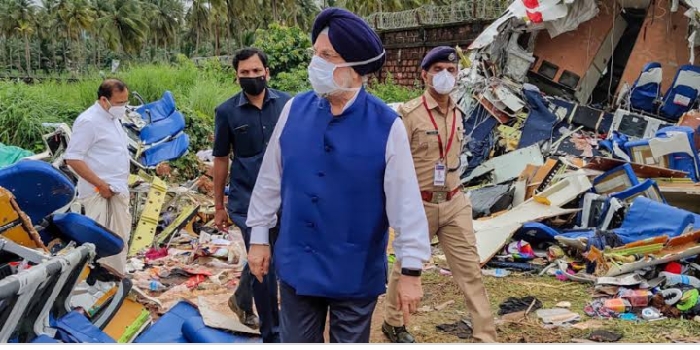
The Civil Aviation Ministry announced an initial assistance of Rs 10 lakh to the dependents of the deceased in the Kozhikode AIE plane crash, while the Kerala government also announced a compensation of Rs 10 lakh each.

Minister of Civil Aviation, Hardeep Singh Puri, who visited the mishap spot on Saturday, said that a detailed probe is already on and the pilot and co-pilot were highly experienced.

He also announced a compensation of Rs 2 lakh each to the injured and Rs. 50,000 each to those who suffered minor injuries. The other normal compensations would be decided in due course.

Puri said that Captain Deepak Vasant Sathe, aged 59, who commandeered the AIE flight, had a flying experience of 10,848 hours, while co-pilot Akhilesh Kumar, aged 32, had a flying experience of 1,723 hours.

"Deepak was one of the most distinguished and experienced pilots. He had a commanding experience of 6,662 hours and was commander of B-737 aircraft for 4,244 hours. He had also operated to Kozhikode international airport 27 times. He joined AIE in 2013 and prior to that he served with the IAF and HAL. He was a figher pilot and a recipient of prestigious sword of honour and a gold medalist," said Puri.

Puri said that even as the flight slipped down to around 35 feet, a major disaster was averted due to timely rescue operations. Local people played an exemplary role and the fire brigade's timely action of cutting the plane body and rescuing the passengers minimised the casualties, he said.

Chief Minister Pinarayi Vijayan also said that the local people and all rescue and relief agencies did a well co-ordinated job. The state government would also meet the entire treatment expenses of the injured.

Till Saturday afternoon, the total number of deaths was 18. While 149 were still in hospitals, 23 were discharged.

Comments

Add new comment

  • Coastaldigest.com reserves the right to delete or block any comments.
  • Coastaldigset.com is not responsible for its readers’ comments.
  • Comments that are abusive, incendiary or irrelevant are strictly prohibited.
  • Please use a genuine email ID and provide your name to avoid reject.