



No proof against Dr Zakir Naik; security agencies asked to probe deeper

[email protected] (CD Network)
September 1, 2016

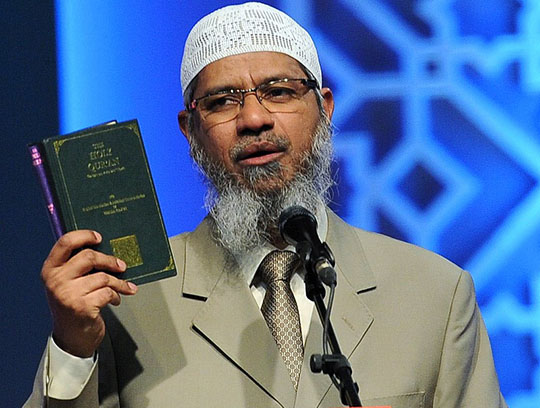
Mangaluru, Sep 1: Even after two months of rigorous investigation the security agencies have not found any solid evidence against Islamic preacher Dr Zakir Naik, who is accused by a section of media of inspiring terrorists and violating foreign funding norms.
zn

No violations

Highly placed sources said that the Islamic Research Foundation, the NGO run by Dr Naik, has almost come out clean on foreign donations received. In its reply submitted before the home ministry last week, Dr Naik's NGO has given details of funds reportedly received in 2014 from Dubai with an explanation on expenditure, a senior MHA official said on the condition of anonymity.

The NGO has received nearly Rs 93 lakh from Dubai in 2014. Naik's spokesperson Arif Malik said: "In 2014-15, MHA carried out inspection of our accounts and foreign donation utilisation and after three weeks of exhaustive investigations gave us a clean chit.

Still the NGO is facing the threat of ban under Unlawful Activities Prevention Act (UAPA) after solicitor-general Ranjit Kumar wrote to the Ministry of Home Affairs asking it to take action against the televangelist.

Probe to be intensified

Meanwhile, the security agencies have been asked to analyse Dr Naik's speeches in a more comprehensive manner and conduct a more exhaustive probe before any decision is taken on whether to gag him and ban his NGO, Islamic Research Foundation (IRF), as an unlawful association.

The development comes with the Law Ministry advising the Ministry of Home Affairs (MHA), which has jurisdiction over security agencies, that not enough evidence is on record to proceed against Naik.

“We have been advised to analyse a larger number of speeches delivered by Naik to arrive at a clearer picture of whether he is liable for any action. While several of his speeches have already been analysed, we will now have to go through as many of his speeches as is possible – not all his speeches might be easily available,” a source in the MHA said.

The process could take weeks, or even months, as it is “extremely laborious”. The source said, “Videos of Naik's speeches available in the public domain will have to be authenticated to prove they are not doctored in any way, and then they will have to be carefully transcribed.”

Terror allegations

Meanwhile, security agencies have claimed that nearly 55 terror accused, arrested from across the country over the past decade, have reportedly been influenced by Dr Naik, or at least they have watched Dr Naik's speeches. These terror accused include those who were picked up as far back as 2005. However the agencies have failed to produce any proof for their claims.

Dr Naik's lawyer has refuted these allegations and said that if his speeches are seen in their full context, no one would conclude that he had inspired people to commit acts of terror. Those leveling allegations against Naik might have relied upon doctored speeches available on the Internet, and not on the entire speech, his lawyer had earlier said.

Comments

ali
 - 
Saturday, 3 Sep 2016

I hope many will convert to Islam after hearing his speeches.

Government should allow entire nation to hear his speeches and take decisions.

muthhu
 - 
Thursday, 1 Sep 2016

this will be another blow to BJP led MODI personality ...this is to divert Bhakths away from Babri masjid issue and corruption ,,,,

O bhakthon jaan lo

Abdul Latif
 - 
Thursday, 1 Sep 2016

Al Hamdulillahi Rubil Al Alameen.....

HAQ
 - 
Thursday, 1 Sep 2016

Honey trap ! Why only muslim media reporting with headlines.. Zakir naik news
Jangal main more nacha
Kisne dekha !

mohammed
 - 
Thursday, 1 Sep 2016

Al Hamduillha Truth all ways win

Azeez Sompady
 - 
Thursday, 1 Sep 2016

whoever, goes deeper and deeper on islamic speech will embrace Islam.

MSS
 - 
Thursday, 1 Sep 2016

Do any type of investigation, as long as it is fair and honest, there is no problem.
We know Dr. Naik and his NGO. Even many common Non-Muslims specially educated Hindus know him.

If anybody tries to harm deliberately such innocent great personality, definitely they are spreading communal disharmony and it will be very costlier to them.

Be sincere and be fair.

SK
 - 
Thursday, 1 Sep 2016

Naren, even if your hypocrite brothers investigate thousands and thousands of files , you will not get any thing out of it..... Truth always wins, Insha Allah

abdullah
 - 
Thursday, 1 Sep 2016

everyone knows Dr. Zakeer naik did not do any wrong. why this RSS people want him to implicate in wrong case?

Let police go and find real goondas and babas in politics who are looting India and killing indians, Kidnapping Girls, and carrying out bomb blasts

UNLOCK
 - 
Thursday, 1 Sep 2016

Surely U go deeper and deeper and deeper and will dig your own grave... U will not find any link to terrorist...
Understand the TRUTH and PONDER on what Dr. Zakir naik conveys...

Rikaz
 - 
Thursday, 1 Sep 2016

Chaddis should understand that Zakir Naik brings white money to our economy.....never ever utilized it for any illegal purpose....probe team got babaji's tullu....wasted tax payers money for this probe.....

Add new comment

  • Coastaldigest.com reserves the right to delete or block any comments.
  • Coastaldigset.com is not responsible for its readers’ comments.
  • Comments that are abusive, incendiary or irrelevant are strictly prohibited.
  • Please use a genuine email ID and provide your name to avoid reject.
Ram Puniyani
February 10,2020

Noam Chomsky is one of the leading peace workers in the world. In the wake of America’s attack on Vietnam, he brought out his classic formulation, ‘manufacturing consent’. The phrase explains the state manipulating public opinion to have the public approve of it policies—in this case, the attack of the American state on Vietnam, which was then struggling to free itself from French colonial rule.

In India, we are witness to manufactured hate against religious minorities. This hatred serves to enhance polarisation in society, which undermines India’s democracy and Constitution and promotes support for a Hindu nation. Hate is being manufactured through multiple mechanisms. For example, it manifests in violence against religious minorities. Some recent ghastly expressions of this manufactured hate was the massive communal violence witnessed in Mumbai (1992-93), Gujarat (2002), Kandhamal (2008) and Muzaffarnagar (2013). Its other manifestation was in the form of lynching of those accused of having killed a cow or consumed beef. A parallel phenomenon is the brutal flogging, often to death, of Dalits who deal with animal carcasses or leather.

Yet another form of this was seen when Shambhulal Regar, indoctrinated by the propaganda of Hindu nationalists, burned alive Afrazul Khan and shot the video of the heinous act. For his brutality, he was praised by many. Regar was incited into the act by the propaganda around love jihad. Lately, we have the same phenomenon of manufactured hate taking on even more dastardly proportions as youth related to Hindu nationalist organisations have been caught using pistols, while police authorities look on.

Anurag Thakur, a BJP minster in the central government recently incited a crowd in Delhi to complete his chant of what should happen to ‘traitors of the country...” with a “they should be shot”. Just two days later, a youth brought a pistol to the site of a protest at Jamia Millia Islamia university and shouted “take Azaadi!” and fired it. One bullet hit a student of Jamia. This happened on 30 January, the day Nathuram Godse had shot Mahatma Gandhi in 1948. A few days later, another youth fired near the site of protests against the CAA and NRC at Shaheen Bagh. Soon after, he said that in India, “only Hindus will rule”.

What is very obvious is that the shootings by those associated with Hindu nationalist organisations are the culmination of a long campaign of spreading hate against religious minorities in India in general and against Muslims in particular. The present phase is the outcome of a long and sustained hate campaign, the beginning of which lies in nationalism in the name of religion; Muslim nationalism and Hindu nationalism. This sectarian nationalism picked up the communal view of history and the communal historiography which the British introduced in order to pursue their ‘divide and rule’ policy.

In India what became part of “social common sense” was that Muslim kings had destroyed Hindu temples, that Islam was spread by force, and that it is a foreign religion, and so on. Campaigns, such as the one for a temple dedicated to the Hindu god Rama to be built at the site where the Babri masjid once stood, further deepened the idea of a Muslim as a “temple-destroyer”. Aurangzeb, Tipu Sultan and other Muslim kings were tarnished as the ones who spread Islam by force in the subcontinent. The tragic Partition, which was primarily due to British policies, and was well-supported by communal streams also, was entirely attributed to Muslims. The Kashmir conflict, which is the outcome of regional, ethnic and other historical issues, coupled with the American policy of supporting Pakistan’s ambitions of regional hegemony, (which also fostered the birth of Al-Qaeda), was also attributed to the Muslims.

With recurring incidents of communal violence, these falsehoods went on going deeper into the social thinking. Violence itself led to ghettoisation of Muslims and further broke inter-community social bonds. On the one hand, a ghettoised community is cut off from others and on the other hand the victims come to be presented as culprits. The percolation of this hate through word-of-mouth propaganda, media and re-writing of school curricula, had a strong impact on social attitudes towards the minorities.

In the last couple of decades, the process of manufacturing hate has been intensified by the social media platforms which are being cleverly used by the communal forces. Swati Chaturvedi’s book, I Am a Troll: Inside the Secret World of the BJP’s Digital Army, tells us how the BJP used social media to spread hate. Whatapp University became the source of understanding for large sections of society and hate for the ‘Other’, went up by leaps and bounds. To add on to this process, the phenomenon of fake news was shrewdly deployed to intensify divisiveness.

Currently, the Shaheen Bagh movement is a big uniting force for the country; but it is being demonised as a gathering of ‘anti-nationals’. Another BJP leader has said that these protesters will indulge in crimes like rape. This has intensified the prevalent hate.

While there is a general dominance of hate, the likes of Shambhulal Regar and the Jamia shooter do get taken in by the incitement and act out the violence that is constantly hinted at. The deeper issue involved is the prevalence of hate, misconceptions and biases, which have become the part of social thinking.

These misconceptions are undoing the amity between different religious communities which was built during the freedom movement. They are undoing the fraternity which emerged with the process of India as a nation in the making. The processes which brought these communities together broadly drew from Gandhi, Bhagat Singh and Ambedkar. It is these values which need to be rooted again in the society. The communal forces have resorted to false propaganda against the minorities, and that needs to be undone with sincerity.

Combating those foundational misconceptions which create hatred is a massive task which needs to be taken up by the social organisations and political parties which have faith in the Indian Constitution and values of freedom movement. It needs to be done right away as a priority issue in with a focus on cultivating Indian fraternity yet again.

Comments

Add new comment

  • Coastaldigest.com reserves the right to delete or block any comments.
  • Coastaldigset.com is not responsible for its readers’ comments.
  • Comments that are abusive, incendiary or irrelevant are strictly prohibited.
  • Please use a genuine email ID and provide your name to avoid reject.
News Network
March 15,2020

While it makes perfect sense for IT employees to work from remote locations via video conferencing and collaboration tools seamlessly - especially in the case of tech giants like Google or Microsoft -- workers from the non-IT companies and small and medium enterprises (SMBs) are the worst-hit in India as most of them have little or no clue about how these messaging and collaboration tools work amid the coronavirus pandemic.

Small companies -- from corporate to education verticals -- are scrambling to get their act together as new coronavirus threat has reached their premises, prompting them to send employees home who have age-old laptops, poor network and connectivity with no UPS backups and little knowledge about how to handle group chat and collaboration software like Zoom, Google Hangouts Meet, Microsoft Teams and Flock etc.

Instead of halting operations, however, businesses can choose to shift towards remote working methods with teaching non-IT staff on how to use the latest digital software to connect and work, say industry experts.

The training will take some time and may hamper productivity in the short run but is a win-win situation for the non-tech companies in the long run, in case any such global emergency arises in the future.

According to a latest report by Gartner, 54 per cent of HR leaders have cited that poor technology and/or infrastructure for remote working is the biggest barrier to effective remote working.

Sandy Shen, Senior Director Analyst, Gartner, says that with COVID-19 disrupting the business landscape, CIOs should relook at the digital fulfillment of market demand.

"The value of digital channels, products and operations is immediately obvious to companies everywhere right now. This is a wake-up call for organisations that have placed too much focus on daily operational needs at the expense of investing in digital business and long-term resilience," warned Shen.

Businesses that can shift technology capacity and investments to digital platforms will mitigate the impact of the outbreak and keep their companies running smoothly now, and over the long term.

"Videoconferencing, messaging, collaboration tools and document sharing are just a few examples of technologies that facilitate remote work. Additional bandwidth and network capacity may also be needed, given the increasing number of users and volume of communications," informed Shen.

The IT industry's apex body Nasscom has asked the government to relax norms for a month to allow work-from-home for technology and back-office employees as a measure to deal with the spread of Covid-19 in India.

Networking giant Cisco said that it has seen "significant growth" in the usage of its web conferencing and video-conferencing service Webex in India.

According to Muneer Ahmad, Business Head, ViewSonic India, due to COVID-19 pandemic, the corporate and educational sector is severely getting affected in the country.

"ViewSonic IFP has a cloud-based software which help teachers and corporates to connect through video conferencing to multiple people at the same time and can split the screen into six screens. It can also connect with various tools like Skype, Cisco WebEx, Zoom, Google Hangouts and GoToMeeting," Ahmad told IANS.

Co-working sector has also taken a hit and the industry is looking at several measures to tackle it -- from ensuring supply of juices rich in Vitamin C to supply of disinfectants and giving work from home facilities.

"The scheduled visits of the clients at our co-working offices have been postponed. Few of our clients have cancelled their outstation meetings and have now started audio/video conferencing for virtual meetings," said Nakul Mathur, MD, Avanta India.

According to reports, India has approximately 1,000 co-working locations (as of September 2019) and is the second-largest market for the co-working industry after China.

As India's first licensed B2B Virtual Network Operator, CloudConnect Communications offers a collaborative platform that allows companies to overcome the COVID-19 threat while maintaining seamless business continuity and optimum employee productivity.

"We offer a secure, robust, reliable, scalable and trackable mobile-first unified communication infrastructure that aids remote teleworking so that businesses can continue operating even under any unforeseen circumstances," said Gokul Tandon, Executive Chairman, CloudConnect Communications.

Comments

Add new comment

  • Coastaldigest.com reserves the right to delete or block any comments.
  • Coastaldigset.com is not responsible for its readers’ comments.
  • Comments that are abusive, incendiary or irrelevant are strictly prohibited.
  • Please use a genuine email ID and provide your name to avoid reject.
News Network
February 26,2020

Mangaluru, Feb 26: Mangaluru Smart City Limited (MSCL) Managing Director Mohammed Nazir on Wednesday said that 13 Schools in eight wards, here, will be upgraded under the Area Based Development (ABD) of the Smart City Mission (SCM).

Mr. Nazir, in a statement, said that the Schools selected include Government Higher Primary School Car Street, Bastigarden, Neereshwalya, Hoigebazar Lower Primary School, Government Practicing HS, Balmatta Primary School, Balmatta Secondary School, Bunder Higher Primary School (Urdu), Bunder Government High School (Urdu) and Bolara East Government Primary School.

These Smart Schools will have IT-enabled interactive teaching and learning tools, computer labs and open reading plazas.

Comments

Add new comment

  • Coastaldigest.com reserves the right to delete or block any comments.
  • Coastaldigset.com is not responsible for its readers’ comments.
  • Comments that are abusive, incendiary or irrelevant are strictly prohibited.
  • Please use a genuine email ID and provide your name to avoid reject.