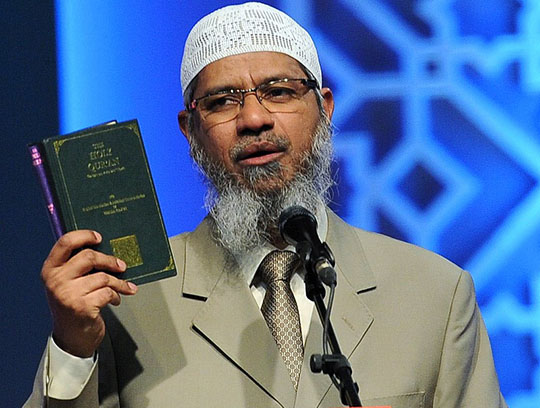
No proof against Dr Zakir Naik; security agencies asked to probe deeper

[email protected] (CD Network)
September 1, 2016

Mangaluru, Sep 1: Even after two months of rigorous investigation the security agencies have not found any solid evidence against Islamic preacher Dr Zakir Naik, who is accused by a section of media of inspiring terrorists and violating foreign funding norms.

zn

No violations

Highly placed sources said that the Islamic Research Foundation, the NGO run by Dr Naik, has almost come out clean on foreign donations received. In its reply submitted before the home ministry last week, Dr Naik's NGO has given details of funds reportedly received in 2014 from Dubai with an explanation on expenditure, a senior MHA official said on the condition of anonymity.

The NGO has received nearly Rs 93 lakh from Dubai in 2014. Naik's spokesperson Arif Malik said: "In 2014-15, MHA carried out inspection of our accounts and foreign donation utilisation and after three weeks of exhaustive investigations gave us a clean chit.

Still the NGO is facing the threat of ban under Unlawful Activities Prevention Act (UAPA) after solicitor-general Ranjit Kumar wrote to the Ministry of Home Affairs asking it to take action against the televangelist.

Probe to be intensified

Meanwhile, the security agencies have been asked to analyse Dr Naik's speeches in a more comprehensive manner and conduct a more exhaustive probe before any decision is taken on whether to gag him and ban his NGO, Islamic Research Foundation (IRF), as an unlawful association.

The development comes with the Law Ministry advising the Ministry of Home Affairs (MHA), which has jurisdiction over security agencies, that not enough evidence is on record to proceed against Naik.

“We have been advised to analyse a larger number of speeches delivered by Naik to arrive at a clearer picture of whether he is liable for any action. While several of his speeches have already been analysed, we will now have to go through as many of his speeches as is possible – not all his speeches might be easily available,” a source in the MHA said.

The process could take weeks, or even months, as it is “extremely laborious”. The source said, “Videos of Naik's speeches available in the public domain will have to be authenticated to prove they are not doctored in any way, and then they will have to be carefully transcribed.”

Terror allegations

Meanwhile, security agencies have claimed that nearly 55 terror accused, arrested from across the country over the past decade, have reportedly been influenced by Dr Naik, or at least they have watched Dr Naik's speeches. These terror accused include those who were picked up as far back as 2005. However the agencies have failed to produce any proof for their claims.

Dr Naik's lawyer has refuted these allegations and said that if his speeches are seen in their full context, no one would conclude that he had inspired people to commit acts of terror. Those leveling allegations against Naik might have relied upon doctored speeches available on the Internet, and not on the entire speech, his lawyer had earlier said.

Comments

ali
 - 
Saturday, 3 Sep 2016

I hope many will convert to Islam after hearing his speeches.

Government should allow entire nation to hear his speeches and take decisions.

muthhu
 - 
Thursday, 1 Sep 2016

this will be another blow to BJP led MODI personality ...this is to divert Bhakths away from Babri masjid issue and corruption ,,,,

O bhakthon jaan lo

Abdul Latif
 - 
Thursday, 1 Sep 2016

Al Hamdulillahi Rubil Al Alameen.....

HAQ
 - 
Thursday, 1 Sep 2016

Honey trap ! Why only muslim media reporting with headlines.. Zakir naik news
Jangal main more nacha
Kisne dekha !

mohammed
 - 
Thursday, 1 Sep 2016

Al Hamduillha Truth all ways win

Azeez Sompady
 - 
Thursday, 1 Sep 2016

whoever, goes deeper and deeper on islamic speech will embrace Islam.

MSS
 - 
Thursday, 1 Sep 2016

Do any type of investigation, as long as it is fair and honest, there is no problem.
We know Dr. Naik and his NGO. Even many common Non-Muslims specially educated Hindus know him.

If anybody tries to harm deliberately such innocent great personality, definitely they are spreading communal disharmony and it will be very costlier to them.

Be sincere and be fair.

SK
 - 
Thursday, 1 Sep 2016

Naren, even if your hypocrite brothers investigate thousands and thousands of files , you will not get any thing out of it..... Truth always wins, Insha Allah

abdullah
 - 
Thursday, 1 Sep 2016

everyone knows Dr. Zakeer naik did not do any wrong. why this RSS people want him to implicate in wrong case?

Let police go and find real goondas and babas in politics who are looting India and killing indians, Kidnapping Girls, and carrying out bomb blasts

UNLOCK
 - 
Thursday, 1 Sep 2016

Surely U go deeper and deeper and deeper and will dig your own grave... U will not find any link to terrorist...
Understand the TRUTH and PONDER on what Dr. Zakir naik conveys...

Rikaz
 - 
Thursday, 1 Sep 2016

Chaddis should understand that Zakir Naik brings white money to our economy.....never ever utilized it for any illegal purpose....probe team got babaji's tullu....wasted tax payers money for this probe.....

Add new comment

  • Coastaldigest.com reserves the right to delete or block any comments.
  • Coastaldigset.com is not responsible for its readers’ comments.
  • Comments that are abusive, incendiary or irrelevant are strictly prohibited.
  • Please use a genuine email ID and provide your name to avoid reject.
News Network
February 6,2020

Kalaburagi, Feb 6: The State government will take steps to ensure that Kannada as a language is taught in all private schools, Chief Minister B.S. Yediyurappa announced today at the 85th Akhila Bharata Kannada Sahitya Sammelana in Kalaburagi.

This comes in the wake of the demand by some Kannada activists for making Kannada medium compulsory in all schools in the State. Sammelana president H.S. Venkatesh Murthy, who spoke after the Chief Minister, also made this demand.

The Chief Minister said “We are committed to putting in place a series of steps to see that Kannada is taught in all schools, aided and private, as a language. Kannada should be taught as the first or second language. We will also take steps to strengthen government schools. However, the government alone cannot do much. The community and parents should offer support to make sure that government schools provide quality education to all.”

To inculcate the spirit of scientific inquiry, the State government is setting up mobile planetariums. This will increase the interest of children in space technology and India’s efforts in space exploration.

The government is committed to protecting the interests of the State in Mahadayi and other river water disputes. It will take the border row issue, based on the Mahajan Commission report pending in the Supreme Court, to its logical end.

The government will also address backwardness and related issues. It will make sure that adequate funds are allocated to the development of Kalyana Karnataka. Among other things, it will establish a hostel for students from Kalaburagi region in Bengaluru. Land has been allotted in Nagarabavi for the hostel that can accommodate around 200 students. The government has decided to celebrate Kalyana Karnataka Utsav once every two years. This will showcase the culture of the region.

“We are working towards forging sentimental and emotional unity of the State other than unity based on language or administration. Our dream is to see that Karnataka remains a homogeneous unit with equality and equal opportunity for all,’’ the Chief Minister added.

Kambar bats for technology

Chandrashekar Kambar, Sahitya Akademi president and former president of the Akhila Bharata Kannada Sahitya Sammelana, favoured effective implementation of technology in administration and for universal use of Kannada in computing and e-governance.

Speaking at the Sammelana inauguration, he said “Several years ago, at the insistence of writer Poornachandra Tejaswi, I appealed to the State government to give a push to Kannada computing. We were convinced that no language can survive without the use of modern technology and use of the language in computers. The Department of Kannada and Culture, headed by then director Manu Baligar, released ₹2 crore for the project. The work began in earnest and teams of technologists came up with software and fonts. Some departments started using Kannada software. But this work has stopped or slowed down at some level. I appeal to Chief Minister B.S. Yediyurappa to continue the work and ensure that computerised Kannada is used at all levels of government and in e-governance.’’

Supports dubbing

Mr. Kambar batted for content dubbing of informative TV channels in Kannada. Channels such as Discovery and History produce good quality content that can be educative and informative. They are very useful for children. These channels are now available in Tamil, Telugu and Hindi and some other Indian languages. But they are not available in Kannada. That is because some people in the film industry are opposing dubbing. Such opposition is not good. Informative channels are our window to the world and allowing dubbing will enhance our knowledge base. There is no merit in not allowing dubbing. I appeal to C.T. Ravi, Minister for Kannada and Culture, to allow dubbing in Kannada, he said.

Mr. Kambar favoured primary education in the mother tongue of the child and urged the State government to introduce universal and compulsory education in Kannada medium in all schools. “This will help preserve our culture. Nothing else can,’’ he said.

He blamed the East India Company administration for inculcating a craze for English education among the people. “The introduction of English education by the British was strongly welcomed by the masses in India as they had been denied the opportunity for education for millenia. The deprived classes and Dalits who had not been exposed to education till then, were excited about the opportunity. However, along with English education, the British were successful in introducing inferiority in our minds. We are yet to escape from this inferiority complex.”

Quoting from Greek mythology, Mr. Kambar said that Hercules had killed his children and relatives in a fit of alcohol-induced rage. “We should not behave like that. We may be very strong, but we should not kill our mother tongue, in our power-induced rage,’’ he said.

Comments

Add new comment

  • Coastaldigest.com reserves the right to delete or block any comments.
  • Coastaldigset.com is not responsible for its readers’ comments.
  • Comments that are abusive, incendiary or irrelevant are strictly prohibited.
  • Please use a genuine email ID and provide your name to avoid reject.
Muhammad Abdullah Javed
May 20,2020

One of the distinguish features of the Noble Quran is that it presents different sorts of classifications. It is quite evident as one of the names of the Quran is Furqan that is it differentiates between things through its unique style of classification. The Quran openly proclaims the difference between right and wrong, truth and falsehood, literate and illiterate, light and darkness and so on. The system of Quranic taxonomy has a pivotal element with regard to ranking of human beings. It classifies them into two groups, one, who is honorable in the sight of their Creator and the second, disliked by Him.

This Quranic approach of classification is quite genuine, void of all sorts of bias. Since humans have no say in their birth, color or region, therefore the Quran doesn’t recognize these parameters to classify two groups of people.

The crux of Quranic taxonomy rests with the human ability which has been equally distributed among all humans. In terms of abilities to perform, barring those tasks performed with exceptional talents, all humans are equal. This is where Quran draws a line and specify who is most honorable in the sight of their Creator, it says:

 O mankind, We created you from one man and one woman, and then divided you into nations and tribes so that you may recognize one another. Indeed, the most honorable among you in the sight of Allah is he who is the most pious of you. Surely, Allah is All-knowing, All-Wise. (Chapter 49, Verse 13).

Criterion of judgement

To be most righteous in the sight of God, one has to be of pious nature. The Quran uses term Taqwa (a sense of distinguishing between right and wrong, piety) to exemplify the pious nature. It further specifies that the source of pious nature - Taqwa is an inherent quality of human beings. Along with the faculties of hearing, seeing and speaking they have been bestowed with (Taqwa) the criterion of distinguishing between virtues and vices, it has been mentioned in the Quran as:

And by the human self and by Him Who balanced it, then inspired it with its wickedness and piety (Chapter 91, Verses 7 & 8).

Good deeds and human nature

With the advent of human race on earth, the equation has been set in simple terms. Humans have to be obedient to their Creator by means of using their intellect, smart enough to use their ability to judge between right and wrong and spend their lives in performing good deeds. For this very reason God has created life and death:

Who created death and life that He may try you to see which of you is best in deeds, and He is All-Mighty as well as All-Forgiving (Chapter 67, Verse 2)

Since life is all about performing good deeds, the ability to perform any good action has been made as natural as recognizing any color with naked eyes. It is within the reach of a person to identify the difference between colors, so is his criterion of judgement that tells what to perform and what to refrain from?

Good actions have been synchronized with human nature whereas evil deeds are quite detrimental, that’s why there is a universal consensus over the conception of virtues and vices. No one can dare to differ with virtues like truth, justice and honesty etc, and no one appreciates vices like falsehood, violations and corruption. With this inherent ability of humans to identify good and bad, the concept of virtues and vices has been described with the same bent of human intellect, there is no philosophical and ideological kind of description to tell what truth and falsehood are, it is as simple as this:

Prophet Muhammad (peace be upon him) said: Give up what is doubtful to you for that which is not doubtful; for truth is peace of mind and falsehood is doubt (Tirmidhi)

Highway of actions

The Quran presents a highway of actions for everyone who believes in it and intend to be most honorable in the sight of the Creator. For each and every day, there is a definite plan of action to go ahead with it to please the Creator. Again, for every week and month, there are clear specifications with regard to individual and collective actions. So no place for claims and reservations, no place for any excuse either, things have been made clear. For a person to be honored, he has to be man of deeds, that’s it. Every person has fair chances of performing better, as the life has been given, criterion of judgement between right and wrong has been given, and plan of action has been provided with. Now one has to energize himself for everyday action and try to set right the intention.

Difference in human efficiencies

No doubt there are differences in human abilities and efficiencies, one may argue about the quality and magnitude of actions. Those who are of high efficiency may perform well and those who are inefficient may not? True, to convince what Quran emphasizes is, God doesn’t look at the magnitude of an action, rather He sees with what intention in what circumstances it has been performed? If any person keep fast in scorching heat for more than 16 hours a day will get high rewards compare to the one who fast less than 10 hours a day at a cold place. Again, if the intention is to please the God, than every action, no matter how small or big it is in its scale, will fetch rich dividends. A poor’s donation of few rupees will be equal in rewards as compare to what a millionaire gets by donating thousands of rupees from his enormous wealth. The act of charity has demanded sacrifice; both of them have sacrificed in accordance with their capacities. Therefore upon asking whose charity is noble in the sight of God, the Prophet Muhammad (pbuh) said: The charity of poor person who tries hard to get few rupees from his hard earn money to donate in the way of God (NasaiBook of Hadith).

The Quranic taxonomy of human is quite justifiable as every human bear testimony to its genuine and unbiased classification through what we term as actions. Therefore the world has to witness a race between men and women to see who can compete with others in order to please their Creator?

Whosoever acts righteously – whether a man or a woman and embraces belief, We will surely grant him a good life; and will surely grant such persons their reward according to the best of their deeds. (Chapter 16, Verse 97)

God-oriented actions, privilege for the Humanity

It’s very unpleasant to notice that in today’s world the parameters like statuses, resources and wealth have been regarded as privilege and honor for both humans and their societies. No doubt they are, but not at the cost of losing the very essence of human nature and sacrificing its interest. Today’s advancements speak of this dark phase where the height of inventions and discoveries touching the skies while the dignity and honor of humans have gone to the lowest of the low. The ever increasing poverty, hunger, untimely deaths, different forms of corruption in the land, violation of human rights are just to remind a few. The presence of rich and poor, highs and lows in the society speaks of disparity of actions, lack of selfless service and hearts void of God’s love and fear.

The beauty of humanity is to remain in the service of God and always stand on the toes to help those who are in need. This God-oriented action enables every doer to be dear to his God as the classification of good and the bad is purely based on the actions performed for the sake of the Creator:

Everyone is assigned a rank according to his deed. Your Lord is not heedless of what they do (Chapter 6, Verse 132).


Muhammad Abdullah Javed is the Director of AJ Academy for Research & Development. He can be reached at [email protected]

Comments

Add new comment

  • Coastaldigest.com reserves the right to delete or block any comments.
  • Coastaldigset.com is not responsible for its readers’ comments.
  • Comments that are abusive, incendiary or irrelevant are strictly prohibited.
  • Please use a genuine email ID and provide your name to avoid reject.
News Network
June 6,2020

New Delhi, Jun 6: With the coronavirus pandemic showing no signs of abating, it seems unlikely that Muslims from India will be able to undertake the Hajj pilgrimage this year.

However, the government will take a final decision on the matter only after Saudi Arabia makes its position on hosting the pilgrimage clear.

A circular issued by the Hajj Committee of India on Friday said only a few weeks are left for the preparatory work in India for Hajj 2020, yet the Saudi authorities have not communicated any further development regarding the pilgrimage.

"In view of the several inquiries received and concerns expressed over uncertainty over Hajj 2020, it has been decided by the Hajj Committee of India that, those pilgrims who desire to cancel their Hajj journey this year, their 100 per cent amount paid so far will be refunded without any deductions," the circular issued by Hajj Committee of India CEO Maqsood Ahmed Khan said.

"Coronavirus cases are increasing in Saudi Arabia and two lakh people have to go from here. We had made preparations, but now there is very little time left. We are waiting for an official word from Saudi Arabia," a top source said.

In response to a question, the source said, "This time, it is unlikely that people will be able to undertake Hajj from India."

Uncertainty has been looming large over this year's Hajj in the wake of the coronavirus pandemic and though Saudi Arabia has not made a decision on whether the annual pilgrimage will be held or not, it did ask Muslims to delay their bookings till there is more clarity.

The bilateral annual Hajj 2020 agreement between India and Saudi Arabia was signed last December. In 2020, a total of 2 lakh Indian Muslims were expected to perform Hajj.

Over 95,000 COVID-19 cases and more than 600 deaths have been reported in Saudi Arabia due to the coronavirus pandemic, according to Johns Hopkins University data.

Some countries have decided not to send their people for Hajj this time. The most prominent among these is Indonesia, the country with the largest Muslim population in the world.

The Hajj 2020 is proposed in the period between late July and early August.

The Hajj is one of the five pillars of Islam which every Muslim is required to complete at least once in their lifetime if they are healthy enough and have the means to do so.

Comments

Add new comment

  • Coastaldigest.com reserves the right to delete or block any comments.
  • Coastaldigset.com is not responsible for its readers’ comments.
  • Comments that are abusive, incendiary or irrelevant are strictly prohibited.
  • Please use a genuine email ID and provide your name to avoid reject.