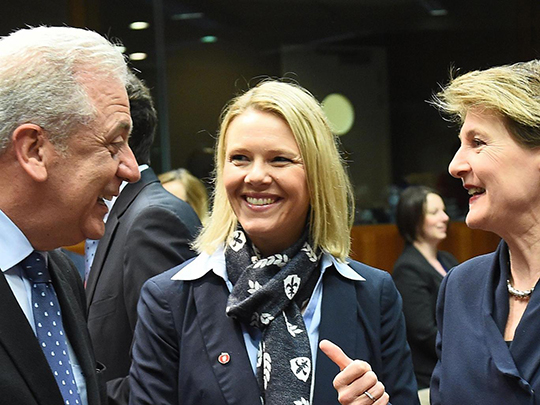
Norway Muslims demand minister's resignation after pork post

October 24, 2016

Norway, Oct 24: Norway's integration minister has been widely mocked and asked to "reconsider her position" after telling the country's Muslims to adapt to the country's culture.

norway

Sylvi Listhaug, from the anti-immigrant Progress Party, caused fury and confusion on Monday when she posted on Facebook on the eve of a national integration conference. “I think those who come to Norway need to adapt to our society,” read the post.

Ms Listhaug has since clarified the comment, which was liked more than 20,000 times, claiming she was misunderstood.

“Here we eat pork, drink alcohol and show our face. You must abide by the values, laws and regulations that are in Norway when you come here.”

The country's coalition government, which includes Ms Listhaug's party and the centre-right Conservative party, has been playing tough with the country's Muslims over the past week.

Ms Listhaug also echoed Prime Minister Erna Solberg who said in an interview that she would not personally employ someone wearing the Islamic niqab face veil.

Ms Listhaug's post however still drew criticism.

Comments

Well Wisher
 - 
Tuesday, 25 Oct 2016

Uncultured people speaking about culture, civilization.... very funny.

Add new comment

  • Coastaldigest.com reserves the right to delete or block any comments.
  • Coastaldigset.com is not responsible for its readers’ comments.
  • Comments that are abusive, incendiary or irrelevant are strictly prohibited.
  • Please use a genuine email ID and provide your name to avoid reject.
News Network
May 14,2020

May 14: The UN’s children agency has warned that an additional 6,000 children could die daily from preventable causes over the next six months as the COVID-19 pandemic weakens the health systems and disrupts routine services, the first time that the number of children dying before their fifth birthday could increase worldwide in decades.

As the coronavirus outbreak enters its fifth month, the UN Children’s Fund (UNICEF) requested USD 1.6 billion to support its humanitarian response for children impacted by the pandemic.

The health crisis is “quickly becoming a child rights crisis. And without urgent action, a further 6,000 under-fives could die each day,” it said.

With a dramatic increase in the costs of supplies, shipment and care, the agency appeal is up from a USD 651.6 million request made in late March – reflecting the devastating socioeconomic consequences of the disease and families’ rising needs.

"Schools are closed, parents are out of work and families are under strain," UNICEF Executive Director Henrietta Fore said on Tuesday.

 “As we reimagine what a post-COVID world would look like, these funds will help us respond to the crisis, recover from its aftermath, and protect children from its knock-on effects.”

The estimate of the 6,000 additional deaths from preventable causes over the next six months is based on an analysis by researchers from the Johns Hopkins Bloomberg School of Public Health, published on Wednesday in the Lancet Global Health Journal.

UNICEF said it was based on the worst of three scenarios analysing 118 low and middle-income countries, estimating that an additional 1.2 million deaths could occur in just the next six months, due to reductions in routine health coverage, and an increase in so-called child wasting.

Around 56,700 more maternal deaths could also occur in just six months, in addition to the 144,000 likely deaths across the same group of countries. The worst case scenario, of children dying before their fifth birthdays, would represent an increase "for the first time in decades,” Fore said.

"We must not let mothers and children become collateral damage in the fight against the virus. And we must not let decades of progress on reducing preventable child and maternal deaths, be lost,” she said.

Access to essential services, like routine immunisation, has already been compromised for hundreds of millions of children and threatens a significant increase in child mortality.

According to a UNICEF analysis, some 77 per cent of children under the age of 18 worldwide are living in one of 132 countries with COVID-19 movement restrictions.

The UN agency also spotlighted that the mental health and psychosocial impact of restricted movement, school closures and subsequent isolation are likely to intensify already high levels of stress, especially for vulnerable youth.

At the same time, they maintained that children living under restricted movement and socio-economic decline are in greater jeopardy of violence and neglect. Girls and women are at increased risk of sexual and gender-based violence.

The UNICEF pointed out that in many cases, refugee, migrant and internally displaced children are experiencing reduced access to protection and services while being increasingly exposed to xenophobia and discrimination.

“We have seen what the pandemic is doing to countries with developed health systems and we are concerned about what it would do to countries with weaker systems and fewer available resources,” Fore said.

In countries suffering from humanitarian crises, UNICEF is working to prevent transmission and mitigate the collateral impacts on children, women and vulnerable populations – with a special focus on access to health, nutrition, water and sanitation, education and protection.

To date, the UN agency said it has received USD 215 million to support its pandemic response, and additional funding will help build upon already-achieved results.

Within its response, UNICEF has reached more than 1.67 billion people with COVID-19 prevention messaging around hand washing and cough and sneeze hygiene; over 12 million with critical water, sanitation and hygiene supplies; and nearly 80 million children with distance or home-based learning.

The UN agency has also shipped to 52 countries, more than 6.6 million gloves, 1.3 million surgical masks, 428,000 N95 respirators and 34,500 COVID-19 diagnostic tests, among other items.

Comments

Add new comment

  • Coastaldigest.com reserves the right to delete or block any comments.
  • Coastaldigset.com is not responsible for its readers’ comments.
  • Comments that are abusive, incendiary or irrelevant are strictly prohibited.
  • Please use a genuine email ID and provide your name to avoid reject.
Agencies
March 1,2020

Washington, Mar 1: The US Federal Communications Commission (FCC) has proposed a fine of over $200 million for all major US mobile carriers for selling the location data of customers to some agencies.

The Federal Communications Commission today proposed fines against the nation's four largest wireless carriers for apparently selling access to their customers' location information without taking reasonable measures to protect against unauthorised access to that information. As a result, T-Mobile faces a proposed fine of more than $91 million, AT&T faces a proposed fine of more than $57 million, Verizon faces a proposed fine of more than $48 million, and Sprint faces a proposed fine of more than $12 million, the FCC said in a statement on Friday.

The Enforcement Bureau of FCC opened this investigation after reports surfaced that a Missouri Sheriff, Cory Hutcheson, used a "location-finding service" operated by Securus, a provider of communications services to correctional facilities, to access the location information of the wireless carriers' customers without their consent between 2014 and 2017.

"American consumers take their wireless phones with them wherever they go. And information about a wireless customer's location is highly personal and sensitive. The FCC has long had clear rules on the books requiring all phone companies to protect their customers' personal information. And since 2007, these companies have been on notice that they must take reasonable precautions to safeguard this data and that the FCC will take strong enforcement action if they don't. Today, we do just that," said FCC Chairman Ajit Pai.

"This FCC will not tolerate phone companies putting Americans' privacy at risk."

The FCC also admonished these carriers for apparently disclosing their customers' location information, without their authorisation, to a third party

The four major US carriers mentioned sold access to their customers' location information to "aggregators," who then resold access to such information to third-party location-based service providers (like Securus).

Although their exact practices varied, each carrier relied heavily on contract-based assurances that the location-based services providers (acting on the carriers' behalf) would obtain consent from the wireless carrier's customer before accessing that customer's location information.

Comments

Add new comment

  • Coastaldigest.com reserves the right to delete or block any comments.
  • Coastaldigset.com is not responsible for its readers’ comments.
  • Comments that are abusive, incendiary or irrelevant are strictly prohibited.
  • Please use a genuine email ID and provide your name to avoid reject.
News Network
January 27,2020

Shanghai, Jan 27: The death toll from a coronavirus outbreak in China rose to 81 on Monday, as the government extended the Lunar New Year holiday and more big businesses shut down or told staff to work from home in an effort to curb the spread.

Chinese Premier Li Keqiang visited the central city of Wuhan, the epicenter of the outbreak, as the government sought to signal it was responding seriously to the crisis.

The total number of confirmed cases in China rose about 30% to 2,744, about half of them in Hubei province, whose capital is Wuhan.

As worries grew around the world, Chinese-ruled Hong Kong, which has had eight confirmed cases, banned entry to people who had visited Hubei in the past 14 days. The ban did not cover Hong Kong residents.

The number of deaths from the flu-like virus in Hubei climbed to 76 from 56, health officials said, with five deaths elsewhere in China, including the southern island province of Hainan, which reported its first fatality on Monday.

While a small number of cases have been confirmed in more than 10 countries, linked to people who traveled from Wuhan, no deaths have been reported elsewhere.

Li is the most senior leader to visit Wuhan since the outbreak began. Clad in a blue protective suit and mask, he inspected efforts to contain the epidemic and spoke to patients and medical staff, the government said.

The government is extending the week-long Lunar New Year holiday by three days to February 2, in a bid to slow the spread of the virus. The Lunar New Year is usually a time for millions of people to travel, but many have had to cancel their plans because of travel curbs over the virus.

Incubation

Wuhan is already in virtual lockdown and severe limits on movement are in place in several other Chinese cities.

The city of 11 million clamped down further on Monday, announcing the suspension of visa and passport services until January 30.

Despite the curbs, the mayor of Wuhan said on Sunday that five million people had left the city for holidays and other reasons.

Images from Wuhan showing hospital corridors packed with people seeking treatment have circulated on social media, along with complaints of soaring prices for essentials such as vegetables.

Chinese leaders have urged transparency in the crisis, after public trust was eroded by the cover-up of the spread of Severe Acute Respiratory Syndrome (SARS), a coronavirus that originated in China and killed nearly 800 people globally in 2002 and 2003.

Much is not known about the newly identified coronavirus, including how easily it spreads and just how dangerous it is. It can cause pneumonia, which has been deadly in some cases.

National Health Commission minister Ma Xiaowei said on Sunday the incubation period could range from one to 14 days, and the virus was infectious during incubation, unlike SARS.

That compares with a World Health Organization (WHO) estimate of two to 10 days for the incubation period.

“Understanding the time when infected patients may transmit the virus to others is critical for control efforts,” the WHO said.

The virus is believed to have originated late last year in a Wuhan market illegally selling wildlife. It has spread to other cities, including Beijing and Shanghai, as well as more than 10 countries including France, Japan and the United States.

‘Overwhelmed’

Australia confirmed its fifth case on Monday involving a woman on the last flight out of Wuhan to Sydney before China’s travel ban.

Health minister Greg Hunt told the Australian Broadcasting Corporation (ABC) authorities aimed to get about 100 Australian children and young people out of Wuhan.

One father of two, Nathan Wang, told the ABC his wife was stuck in Wuhan with the children. “We absolutely want the children to come back, because hospitals in Wuhan are overwhelmed,” he said.

Airports around the world have stepped up screening of passengers from China, although some health experts have questioned its effectiveness.

Last week the WHO stopped short of calling the outbreak a global health emergency, but some health experts question whether China can contain the epidemic.

WHO Director-General Tedros Adhanom Ghebreyesus is due to travel to Beijing to meet officials and health experts.

Australia, France, Italy, Japan and the United States have all said they are working to evacuate citizens from Wuhan.

Some of China’s biggest companies have been affected, with hotpot restaurant chain Haidilao International Holding shutting branches nationwide from Sunday until Friday.

Gaming giant Tencent Holdings Ltd advised staff to work from home until February 7, and e-commerce firm Alibaba removed vendors’ offers of overpriced face masks from its online Taobao marketplace as prices surged.


Comments

Add new comment

  • Coastaldigest.com reserves the right to delete or block any comments.
  • Coastaldigset.com is not responsible for its readers’ comments.
  • Comments that are abusive, incendiary or irrelevant are strictly prohibited.
  • Please use a genuine email ID and provide your name to avoid reject.