Norway Muslims demand minister's resignation after pork post

October 24, 2016

Norway, Oct 24: Norway's integration minister has been widely mocked and asked to "reconsider her position" after telling the country's Muslims to adapt to the country's culture.

norway

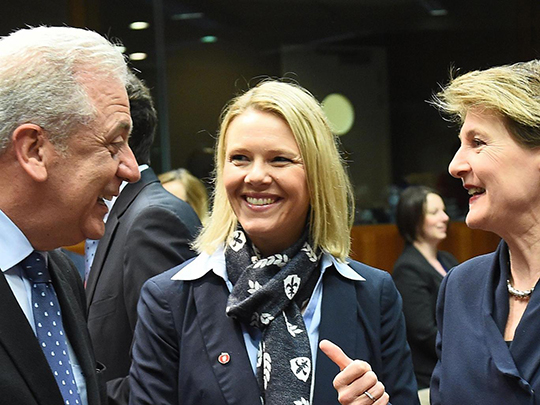
Sylvi Listhaug, from the anti-immigrant Progress Party, caused fury and confusion on Monday when she posted on Facebook on the eve of a national integration conference. “I think those who come to Norway need to adapt to our society,” read the post.

Ms Listhaug has since clarified the comment, which was liked more than 20,000 times, claiming she was misunderstood.

“Here we eat pork, drink alcohol and show our face. You must abide by the values, laws and regulations that are in Norway when you come here.”

The country's coalition government, which includes Ms Listhaug's party and the centre-right Conservative party, has been playing tough with the country's Muslims over the past week.

Ms Listhaug also echoed Prime Minister Erna Solberg who said in an interview that she would not personally employ someone wearing the Islamic niqab face veil.

Ms Listhaug's post however still drew criticism.

Comments

Well Wisher
 - 
Tuesday, 25 Oct 2016

Uncultured people speaking about culture, civilization.... very funny.

Add new comment

  • Coastaldigest.com reserves the right to delete or block any comments.
  • Coastaldigset.com is not responsible for its readers’ comments.
  • Comments that are abusive, incendiary or irrelevant are strictly prohibited.
  • Please use a genuine email ID and provide your name to avoid reject.
Agencies
July 1,2020

The ILO has warned that if another Covid-19 wave hits in the second half of 2020, there would be global working-hour loss of 11.9 percent - equivalent to the loss of 340 million full-time jobs.

According to the 5th edition of International Labour Organisation (ILO) Monitor: Covid-19 and the world of work, the recovery in the global labour market for the rest of the year will be uncertain and incomplete.

The report said that there was a 14 percent drop in global working hours during the second quarter of 2020, equivalent to the loss of 400 million full-time jobs.

The number of working hours lost across the world in the first half of 2020 was significantly worse than previously estimated. The highly uncertain recovery in the second half of the year will not be enough to go back to pre-pandemic levels even in the best scenario, the agency warned.

The baseline model – which assumes a rebound in economic activity in line with existing forecasts, the lifting of workplace restrictions and a recovery in consumption and investment – projects a decrease in working hours of 4.9 percent (equivalent to 140 million full-time jobs) compared to last quarter of 2019.

It says that in the pessimistic scenario, the situation in the second half of 2020 would remain almost as challenging as in the second quarter.

“Even if one assumes better-tailored policy responses – thanks to the lessons learned throughout the first half of the year – there would still be a global working-hour loss of 11.9 per cent at the end of 2020, or 340 million full-time jobs, relative to the fourth quarter of 2019,” it said.

The pessimistic scenario assumes a second pandemic wave and the return of restrictions that would significantly slow recovery. The optimistic scenario assumes that workers’ activities resume quickly, significantly boosting aggregate demand and job creation. With this exceptionally fast recovery, the global loss of working hours would fall to 1.2 per cent (34 million full-time jobs).

The agency said that under the three possible scenarios for recovery in the next six months, “none” sees the global job situation in better shape than it was before lockdown measures began.

“This is why we talk of an uncertain but incomplete recovery even in the best of scenarios for the second half of this year. So there is not going to be a simple or quick recovery,” ILO Director-General Guy Ryder said.

The new figures reflect the worsening situation in many regions over the past weeks, especially in developing economies. Regionally, working time losses for the second quarter were: Americas (18.3 percent), Europe and Central Asia (13.9 percent), Asia and the Pacific (13.5 percent), Arab States (13.2 percent), and Africa (12.1 percent).

The vast majority of the world’s workers (93 per cent) continue to live in countries with some sort of workplace closures, with the Americas experiencing the greatest restrictions.

During the first quarter of the year, an estimated 5.4 percent of global working hours (equivalent to 155 million full-time jobs) were lost relative to the fourth quarter of 2019. Working- hour losses for the second quarter of 2020 relative to the last quarter of 2019 are estimated to reach 14 per cent worldwide (equivalent to 400 million full-time jobs), with the largest reduction (18.3 per cent) occurring in the Americas.

The ILO Monitor also found that women workers have been disproportionately affected by the pandemic, creating a risk that some of the modest progress on gender equality made in recent decades will be lost, and that work-related gender inequality will be exacerbated.

The severe impact of Covid-19 on women workers relates to their over-representation in some of the economic sectors worst affected by the crisis, such as accommodation, food, sales and manufacturing.

Globally, almost 510 million or 40 percent of all employed women work in the four most affected sectors, compared to 36.6 percent of men, it said.

The report said that women also dominate in the domestic work and health and social care work sectors, where they are at greater risk of losing their income and of infection and transmission and are also less likely to have social protection.

The pre-pandemic unequal distribution of unpaid care work has also worsened during the crisis, exacerbated by the closure of schools and care services.

Even as countries have adopted policy measures with unprecedented speed and scope, the ILO Monitor highlights some key challenges ahead, including finding the right balance and sequencing of health, economic and social and policy interventions to produce optimal sustainable labour market outcomes; implementing and sustaining policy interventions at the necessary scale when resources are likely to be increasingly constrained and protecting and promoting the conditions of vulnerable, disadvantaged and hard-hit groups to make labour markets fairer and more equitable.

“The decisions we adopt now will echo in the years to come and beyond 2030. Although countries are at different stages of the pandemic and a lot has been done, we need to redouble our efforts if we want to come out of this crisis in a better shape than when it started,” Ryder said. 

Comments

Add new comment

  • Coastaldigest.com reserves the right to delete or block any comments.
  • Coastaldigset.com is not responsible for its readers’ comments.
  • Comments that are abusive, incendiary or irrelevant are strictly prohibited.
  • Please use a genuine email ID and provide your name to avoid reject.
News Network
June 15,2020

Dubai, Jun 15: The global tally of Covid-19 coronavirus infections crossed the 8 million mark on Monday, with recoveries at 4.13 million, and deaths at nearly 436,000.

As of 11.40am UAE time, there were 3.43 active Covid-19 cases globally, of which 54,460 were serious or critical.

The United States still leads the charts with 2.16 million cases and 117,858 deaths. Behind US, at a distant No 2, is Brazil with 867,882 cases and 43,389 deaths.

Russia, India, the UK, Spain, Italy, Peru, Germany and Iran complete the top 10.

Comments

Add new comment

  • Coastaldigest.com reserves the right to delete or block any comments.
  • Coastaldigset.com is not responsible for its readers’ comments.
  • Comments that are abusive, incendiary or irrelevant are strictly prohibited.
  • Please use a genuine email ID and provide your name to avoid reject.
Agencies
March 28,2020

Canadian researchers are developing a DNA vaccine for SARS-CoV-2, the coronavirus that causes COVID-19 and has currently infected nearly 5,00,000 people worldwide and crippled the global economy.

Entos Pharmaceuticals, a health-care biotechnology company headed by a University of Alberta researchers, develop new therapeutic compounds using the company's proprietary drug-delivery platform and has begun manufacturing vaccine candidates against the novel coronavirus.

"Given the urgency of the situation, we can have a lead candidate vaccine within two months. Once we have that it's a race to get it into clinical trials," said John Lewis, CEO of Entos and a Professor at the University of Alberta in Canada.

Lewis said in comparison to a traditional vaccine, DNA-based vaccines hold several advantages.

Nucleic acids are introduced directly into the patient's own cells, causing them to make pieces of the virus--tricking the immune system into mounting a response without the full virus actually being present, the researcher said.

According to the company, the approach is recognised as being easier to move into large-scale manufacturing, offers improved vaccine stability and works without needing an infectious agent.

In the current absence of a vaccine for COVID-19, several companies around the world are mounting efforts to begin similar work.

The first clinical trial using a DNA-based vaccine developed by Moderna Inc.in the US on March 13.

Their approach allows for antibodies to be made in the human trial volunteers against a specific protein on the surface of the coronavirus that lets the virus enter human cells.

The hope is that the antibodies will stop the interaction.

Though this approach is designed to be effective against COVID-19 specifically, Lewis said Entos is taking a different tack.

The company plans to use plasmid DNA to amplify the production of key coronavirus surface and structural proteins with each injection, with an eye to the bigger picture.

"Many of the structural proteins in the virus are pretty well conserved across all the coronaviruses, including SARS and MERS," said Lewis.

"We're hoping that if we express more of the structural proteins that are common to most coronaviruses, we can inhibit the current COVID-19, and also potentially protect against all coronaviruses both past and future," Lewis added.

To move the project forward quickly, the company is seeking financial support from both provincial and federal levels of government.

"We have the opportunity to save a lot of lives, and I think it's really upon us and governments to find solutions for that," Lewis said.

Comments

Add new comment

  • Coastaldigest.com reserves the right to delete or block any comments.
  • Coastaldigset.com is not responsible for its readers’ comments.
  • Comments that are abusive, incendiary or irrelevant are strictly prohibited.
  • Please use a genuine email ID and provide your name to avoid reject.