Norway Muslims demand minister's resignation after pork post

October 24, 2016

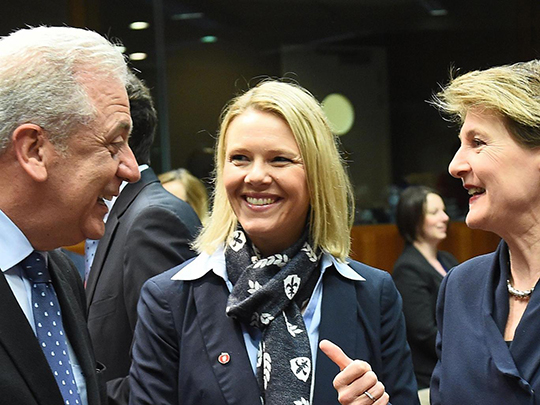
Norway, Oct 24: Norway's integration minister has been widely mocked and asked to "reconsider her position" after telling the country's Muslims to adapt to the country's culture.

norway

Sylvi Listhaug, from the anti-immigrant Progress Party, caused fury and confusion on Monday when she posted on Facebook on the eve of a national integration conference. “I think those who come to Norway need to adapt to our society,” read the post.

Ms Listhaug has since clarified the comment, which was liked more than 20,000 times, claiming she was misunderstood.

“Here we eat pork, drink alcohol and show our face. You must abide by the values, laws and regulations that are in Norway when you come here.”

The country's coalition government, which includes Ms Listhaug's party and the centre-right Conservative party, has been playing tough with the country's Muslims over the past week.

Ms Listhaug also echoed Prime Minister Erna Solberg who said in an interview that she would not personally employ someone wearing the Islamic niqab face veil.

Ms Listhaug's post however still drew criticism.

Comments

Well Wisher
 - 
Tuesday, 25 Oct 2016

Uncultured people speaking about culture, civilization.... very funny.

Add new comment

  • Coastaldigest.com reserves the right to delete or block any comments.
  • Coastaldigset.com is not responsible for its readers’ comments.
  • Comments that are abusive, incendiary or irrelevant are strictly prohibited.
  • Please use a genuine email ID and provide your name to avoid reject.
Agencies
March 24,2020

Beijing, Mar 24:  China reported 78 new confirmed cases, including 74 imported infections, while the death toll from the novel coronavirus increased to 3,277 after seven more fatalities were confirmed from the COVID-19, health officials said on Tuesday.

The overall confirmed cases on the Chinese mainland have reached 81,171 by the end of Monday. This included 3,277 people who died of the disease, 4,735 patients who were still being treated and 73,159 patients discharged after recovery, the National Health Commission (NHC) said on Tuesday.

The NHC said, 78 new confirmed COVID-19 cases were reported on the Chinese mainland on Monday, of which 74 were imported from abroad taking the number of overseas cases to 427.

Also on Monday, seven deaths and 35 new suspected cases were reported on the mainland with all the deaths in Hubei Province.

The total COVID-19 cases in Beijing climbed to 522 with eight deaths prompting local governments of Beijing as well as Shanghai to announce that all overseas arrivals will be subjected to nucleic acid tests to ensure proper detection.

Of the 74 newly imported cases, 31 were reported in Beijing, 14 in Guangdong, nine in Shanghai, five in Fujian, four in Tianjin, three in Jiangsu, two in Zhejiang and Sichuan respectively, and one in Shanxi, Liaoning, Shandong and Chongqing respectively, the NHC said.

Beijing is already diverting all international flights to different cities where the passengers will be quarantined for 14 days before arriving in the city.

The NHC said 132 people were still suspected of being infected with the virus.

Coronavirus epicentre Wuhan has reported one confirmed case after a gap of five days prompting officials to begin to ease restrictions.

Wuhan also reported seven new deaths, bringing the total number of deaths in the city and Hubei province for which Wuhan is the capital to 3,160.

The province also saw 444 patients discharged from hospital after recovery on Monday. Among the 4,200 patients being treated in hospital, 1,203 were still in severe condition and another 336 in critical condition, the local health commission said.

By the end of Monday, 356 confirmed cases, including four deaths have been reported in Hong Kong, which has restricted the entry of foreigners into the city. Also a total of 25 confirmed cases were reported in Macao and 195 in Taiwan including two deaths, state-run Xinhua news agency reporrted.

After days of decline in coronavirus cases, China on Monday said that COVID-19 has effectively been "stemmed" in the country and it started easing severe restrictions imposed on Wuhan's 11 million people who were under lockdown since January 23.

The authorities began relaxing restrictions in Wuhan as it reported no new case for the fifth consecutive day on Monday.

Significantly, the Central Leading Group (CLP), headed by Premier Li Keqiang which is coordinating efforts to contain the virus since January 23, said the virus has been curtailed in the country as well as in Wuhan.

"The meeting noted that the spread of the virus nationwide, particularly in the epicentre of Wuhan, has been effectively stemmed," an official statement said on Monday.

The meeting, however, warned that the risks for sporadic infections and localised outbreaks have not gone away. With the pandemic rampaging across the world, the situation remains complex and challenging.

"Wuhan city and Hubei province should stay focused on medical treatment and community-level containment as the two key priorities. They should continue to treat the severe cases, promptly admit new cases, and advance epidemiological investigations," the meeting said.

In Wuhan, officials said people are allowed to go back to work while restrictions on the public transport are gradually being eased.

The Hubei province and its capital Wuhan with over 56 million people were under lockdown since January 23. The vicious virus broke out in city, reportedly at a live animal market in December last year and became virulent inflicting thousands of people in the city and province catching the government off guard.

As the country saw a surge in imported infections, the Chinese government announced that all international flights scheduled to arrive in Beijing will be redirected to airports in 12 other Chinese cities from Monday.

International passengers flying to Beijing will instead land at airports in 12 cities including Shanghai, Tianjin, Nanjing and Shenyang as their first points of entry, the Civil Aviation Administration of China (CAAC) said in a statement.

On Monday, China said international travellers should "think twice" about choosing Beijing for flight transfer in view of the restrictions.

Starting from Monday, all international flights scheduled to arrive in Beijing will be redirected to airports in 12 other Chinese cities, Liu Haitao, an official with China's National Immigration Administration said.

Passengers would go through entry procedures and quarantine measures at the designated cities' airports before they continue their flights to Beijing, Liu said, urging travellers to reserve enough time for their next flights to make sure that they do not miss their outbound flights.


Comments

Add new comment

  • Coastaldigest.com reserves the right to delete or block any comments.
  • Coastaldigset.com is not responsible for its readers’ comments.
  • Comments that are abusive, incendiary or irrelevant are strictly prohibited.
  • Please use a genuine email ID and provide your name to avoid reject.
Agencies
February 29,2020

Islamabad, Feb 29: A coalition comprising digital media giants Facebook, Google and Twitter (among others) have spoken out against the new regulations approved by the Pakistani government for social media, threatening to suspend services in the country if the rules were not revised, it was reported.

In a letter to Prime Minster Imran Khan earlier this month, the Asia Internet Coalition (AIC) called on his government to revise the new sets of rules and regulations for social media, The News International reported on Friday.

"The rules as currently written would make it extremely difficult for AIC Members to make their services available to Pakistani users and businesses," reads the letter, referring to the Citizens Protection Rules (Against Online Harm).

The new set of regulations makes it compulsory for social media companies to open offices in Islamabad, build data servers to store information and take down content upon identification by authorities.

Failure to comply with the authorities in Pakistan will result in heavy fines and possible termination of services.

It said that the regulations were causing "international companies to re-evaluate their view of the regulatory environment in Pakistan, and their willingness to operate in the country".

Referring to the rules as "vague and arbitrary in nature", the AIC said that it was forcing them to go against established norms of user privacy and freedom of expression.

"We are not against regulation of social media, and we acknowledge that Pakistan already has an extensive legislative framework governing online content. However, these Rules fail to address crucial issues such as internationally recognized rights to individual expression and privacy," The News International quoted the letter as saying.

According to the law, authorities will be able to take action against Pakistanis found guilty of targeting state institutions at home and abroad on social media.

The law will also help the law enforcement authorities obtain access to data of accounts found involved in suspicious activities.

It would be the said authority's prerogative to identify objectionable content to the social media platforms to be taken down.

In case of failure to comply within 15 days, it would have the power to suspend their services or impose a fine worth up to 500 million Pakistani rupees ($3 million).

Comments

Add new comment

  • Coastaldigest.com reserves the right to delete or block any comments.
  • Coastaldigset.com is not responsible for its readers’ comments.
  • Comments that are abusive, incendiary or irrelevant are strictly prohibited.
  • Please use a genuine email ID and provide your name to avoid reject.
News Network
June 20,2020

Sao Paulo, June 20: Brazil’s government confirmed on Friday that the country has risen above 1 million confirmed coronavirus cases, second only to the United States.

The country’s health ministry said that the total now stood at 10,32,913, up more than 50,000 from Thursday. The ministry said the sharp increase was due to corrections of previous days’ underreported numbers.

Brazilian President Jair Bolsonaro still downplays the risks of the virus after nearly 50,000 deaths from COVID-19 in three months, saying the impact of social isolation measures on the economy could be worse than the disease itself.

Specialists believe the actual number of cases in Brazil could be up to seven times higher than the official statistic. Johns Hopkins University says Brazil is performing an average of 14 tests per 1,00,000 people each day, and health experts say that number is up to 20 times less than needed to track the virus.

Official data show a downward trend of the virus in Brazil’s north, including the hard-hit region of the Amazon, a plateau in cases and deaths in the countries’ biggest cities near the Atlantic coast, but a rising curve in the south.

In the Brazilian countryside, which is much less prepared to handle a crisis, the pandemic is clearly growing. Many smaller cities have weaker health care systems and basic sanitation that’s insufficient to prevent contagion.

“There is a lot of regional inequality in our public health system and a shortage of professionals in the interior,” said Miguel Lago, executive director of Brazil’s Institute for Health Policy Studies, which advises public health officials.

That creates many health care deserts, with people going long distances to get attention. When they leave the hospital, the virus can go with them.

The cattle-producing state of Mato Grosso was barely touched by the virus when it hit the nation’s biggest cities in March. Sitting far from the coast, between the Bolivian border and Brazil’s capital of Brasilia, its 33 lakh residents led a mostly normal life until May. But now its people live under lockdown and meat producers have dozens of infected workers.

In Tangará da Serra, a city of 1,03,000 people in Mato Grosso, the mayor decided Friday to forbid the sale of alcoholic drinks for two weeks as an incentive for people to stay home.

Fᢩo Junqueira said the measure was needed after a spike in COVID-19 cases that filled 80% of the city’s 54 intensive care beds. The city has had nearly 300 cases of the disease, plus three fatalities.

In Rondonópolis, only 300 miles away from Tangará da Serra and home to a thriving economy, health authorities closed the local meatpacking industry after 92 cases were confirmed there. The city of 1,44,000 inhabitants counted 21 deaths from the virus and more than 600 cases. The mayor has also decided to limit sales of alcoholic beverages.

Even regions once considered examples of successful efforts against the virus are now struggling.

Porto Alegre, home to about 14 lakh people, had success in slowing the virus’ spread over the last three months. But now its mayor is considering increasing social isolation measures after ICU occupancy in the city jumped to 80% this month.

We were already making projections for schools to come back, Mayor Nelson Marchezan Jr. told The Associated Press. Now the trend is to impose more restrictions. Outside Sao Paulo city, five regions of the state’s countryside will have to close shops starting Monday due to a rise in coronavirus cases. Governor João Doria announced the decision Friday.

Dr. Mike Ryan, the World Health Organization’s executive director, said at a news conference that Brazil needs to increase its efforts to stop the spread of infections.

“The epidemic is still quite severe in Brazil. I believe health workers are working extremely hard and under pressure to be able to deal with the number of cases that they see on a daily basis,” Dr. Ryan said.

“Certainly the rise is not as exponential as it was previously, so there are some signs that the situation is stabilising. But we’ve seen this before in other epidemics in other countries.”

Margareth Dalcolmo, a clinical researcher and professor of respiratory medicine at the state-funded Oswaldo Cruz Foundation in Rio de Janeiro, believes the reopening in major cities and the virus traveling by road into Brazil’s heartland will keep the pressure on the country’s health system.

“The risk in the interior now is very big,” she said. “Our health system just can’t solve the most serious cases of COVID in many places of the countryside.”

Comments

Add new comment

  • Coastaldigest.com reserves the right to delete or block any comments.
  • Coastaldigset.com is not responsible for its readers’ comments.
  • Comments that are abusive, incendiary or irrelevant are strictly prohibited.
  • Please use a genuine email ID and provide your name to avoid reject.