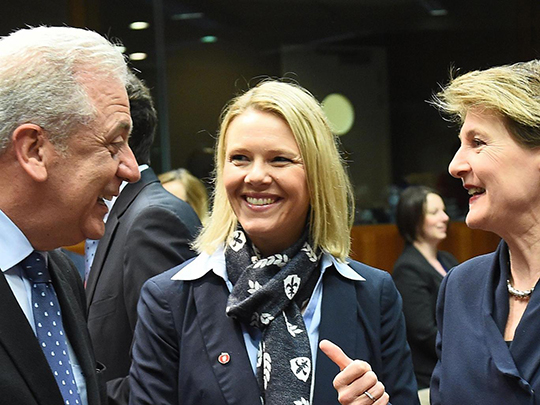
Norway Muslims demand minister's resignation after pork post

October 24, 2016

Norway, Oct 24: Norway's integration minister has been widely mocked and asked to "reconsider her position" after telling the country's Muslims to adapt to the country's culture.

norway

Sylvi Listhaug, from the anti-immigrant Progress Party, caused fury and confusion on Monday when she posted on Facebook on the eve of a national integration conference. “I think those who come to Norway need to adapt to our society,” read the post.

Ms Listhaug has since clarified the comment, which was liked more than 20,000 times, claiming she was misunderstood.

“Here we eat pork, drink alcohol and show our face. You must abide by the values, laws and regulations that are in Norway when you come here.”

The country's coalition government, which includes Ms Listhaug's party and the centre-right Conservative party, has been playing tough with the country's Muslims over the past week.

Ms Listhaug also echoed Prime Minister Erna Solberg who said in an interview that she would not personally employ someone wearing the Islamic niqab face veil.

Ms Listhaug's post however still drew criticism.

Comments

Well Wisher
 - 
Tuesday, 25 Oct 2016

Uncultured people speaking about culture, civilization.... very funny.

Add new comment

  • Coastaldigest.com reserves the right to delete or block any comments.
  • Coastaldigset.com is not responsible for its readers’ comments.
  • Comments that are abusive, incendiary or irrelevant are strictly prohibited.
  • Please use a genuine email ID and provide your name to avoid reject.
News Network
March 4,2020

Beijing/Zurich, Mar 4: China has approved the use of Swiss drugmaker Roche's anti-inflammation drug Actemra for patients who develop severe complications from the coronavirus as it urgently hunts for new ways to combat the deadly infection that is spreading worldwide.

China is hoping that some older drugs could stop severe cytokine release syndrome (CRS), or cytokine storms, an overreaction of the immune system which is considered a major factor behind catastrophic organ failure and death in some coronavirus patients.

Actemra, a biologic drug approved in 2010 in the United States for rheumatoid arthritis (RA), inhibits high Interleukin 6 (IL-6) protein levels that drive some inflammatory diseases.

China's National Health Commission said in treatment guidelines published online on Wednesday that Actemra can now be used to treat coronavirus patients with serious lung damage and high IL-6 levels.

Separately, researchers in the country are testing Actemra, known generically as tocilizumab, in a clinical trial expected to include 188 coronavirus patients and running until May 10.

Roche, which donated 14 million yuan ($2.02 million) worth of Actemra during February, said the trial was initiated independently by a third party with the aim of exploring the efficacy and safety of the drug in coronavirus patients with CRS.

It added that there was currently no published clinical trial data on the drug's safety or efficacy against the virus.

More than 3,000 people have died and 93,000 have been infected by the novel coronavirus thought to have originated in Wuhan, China, before spreading to around 90 countries including the United States, Italy, Switzerland, France and Germany.

The Swiss company, for which China is its No. 2 market behind the United States, also makes diagnostic gear to detect the coronavirus.

Since Actemra's approval a decade ago, it has become a go-to drug against other inflammatory conditions, including cytokine storms in cancer patients receiving cell therapies from Novartis and Gilead Sciences.

In 2012 it helped save the life of a young U.S. girl, the first child to be treated for leukaemia with Novatis' Kymriah, from a post-treatment rush of IL-6.

Priced at between $20-30,000 annually for RA according to SSR Health, Roche's medicine is also used for rare juvenile arthritis and giant cell arteritis, or inflammation of the blood vessels.

Comments

Add new comment

  • Coastaldigest.com reserves the right to delete or block any comments.
  • Coastaldigset.com is not responsible for its readers’ comments.
  • Comments that are abusive, incendiary or irrelevant are strictly prohibited.
  • Please use a genuine email ID and provide your name to avoid reject.
News Network
June 17,2020

Vienna, Jun 17: Austrian police fined a man 500 euros for loudly breaking wind after officers stopped him earlier this month to check his identity.

The police defended the massive fine saying he had deliberately emitted a "massive flatulence," lifting his backside from the bench where he was sitting.

The accused complained of what he called the disproportionate and unjustified fine when he gave his account of the June 5 events on the O24 news website.

In reply to social media commentaries that followed, the police in the Austrian capital justified their reaction on Twitter.

"Of course, nobody is put on the spot if one slips out by accident," the police said.

However, in this case, the police said, the young man had appeared "provocative and uncooperative" in general.

He then "slightly raised himself from the bench, looked at the officers and patently, in a completely deliberate way, emitted a massive flatulence in their immediate proximity."

Comments

Add new comment

  • Coastaldigest.com reserves the right to delete or block any comments.
  • Coastaldigset.com is not responsible for its readers’ comments.
  • Comments that are abusive, incendiary or irrelevant are strictly prohibited.
  • Please use a genuine email ID and provide your name to avoid reject.
News Network
June 9,2020

Washington, Jun 9: When epidemiologists talked about "flattening the curve," they probably didn't mean it this way: the US hit its peak coronavirus caseload in April, but since that time the graph has been on a seemingly unending plateau.

That's unlike several other hard-hit countries which have successfully pushed down their numbers of new cases, including Spain and Italy, which now have bell-shaped curves.

Experts say the prolonged nature of the US epidemic is the result of the cumulative impact of regional outbreaks, as the virus that started out primarily on the coasts and in major cities moves inward.

Layered on top of that are the effects of lifting lockdowns in parts of the country that are experiencing rising cases, as well as a lapse in compliance with social distancing guidelines because of economic hardship, and in some cases a belief that the threat is overstated.

"The US is a large country both in geography and population, and the virus is at very different stages in different parts of the country," Tom Frieden, a former director of the Centers for Disease Control and Prevention told AFP.

The US saw more than 35,000 new cases for several days in April. While that figure has declined, it has still been exceeding 20,000 regularly in recent days.

By contrast, Italy was regularly hitting more than 5,000 cases per day in March but is currently experiencing figures in the low hundreds.

"We did not act quickly and robustly enough to stop the virus spreading initially, and data indicate that it travelled from initial hotspots along major transport routes into other urban and rural areas," added Frieden, now CEO of the non-profit Resolve to Save Lives.

To wit: the East Coast states of New York, New Jersey and Massachusetts accounted for about 50 percent of all cases until about a month or so ago -- but now the geographic footprint of the US epidemic has shifted to the Midwest and southeast, including Florida.

Another key problem, said Jennifer Nuzzo, an epidemiologist at Johns Hopkins, is that the United States is still not doing enough testing, contact tracing and isolation.

After coming late to the testing party -- for reasons ranging from technical issues to regulatory hurdles -- the US has now conducted more COVID-19 tests than any other country.

It even has one of the highest per capita rates per country of 62 per 1,000 people, according to the website ourworldindata.org -- better than Germany (52 per 1,000) and South Korea (20 per 1,000).

But according to Nuzzo, these numbers are misleading, because "the amount of testing that a country should do should be scaled to the size of its epidemic.

"The United States has the largest epidemic in the world so obviously we need to do a lot more testing than any other country."

For Johns Hopkins, the more important metric is the positivity rate -- that is, out of all tests conducted, how many came back positive for COVID-19.

As of June 7, the United States had an average daily positivity rate of 14 percent, well above the World Health Organization guideline of 5 percent over two weeks before social distancing guidelines should be relaxed.

By contrast, Germany, which has tested far fewer people in relation to its population, has a positivity rate of 5 percent.

Even if testing were scaled up, carrying out tests in of itself does very little good without the next steps -- finding out who was exposed and then asking them to isolate.

Here also, too many US states are lagging woefully behind.

Texas, which is experiencing a surge in cases after relaxing its lockdown, is a case in point. The state targeted hiring a modest 4,000 tracers by June, but according to local reports is still more than a thousand shy of even that goal.

Opt-in app based efforts have also been slow to get off the ground.

Then there is the fact that some people are growing tired of lockdowns, while others don't have the economic luxury of being able to stay home for prolonged periods.

The government sent some 160 million Americans a single stimulus check of up to $1,200 back in April but it's not clear whether more will be forthcoming.

Still others, particularly in so-called red states under Republican leadership, have chafed under restrictions and mask-wearing guidelines that they see as an affront to their personal freedom.

"The US is kind of on the extreme of the individual liberty side," Sten Vermund, dean of the Yale School of Public Health, told AFP.

Part of this has to do with mixed messaging from Republican leaders, including President Donald Trump, said Nuzzo.

"We have had at the highest political level an assertion that this is a situation that's been overblown, and that maybe certain protective behaviors are not necessary," she said.

More recently, tens of thousands of people across the country have taken to the streets to protest the killing on an unarmed black man by police, risking coronavirus infection to demonstrate against the public health threat of racialized state violence.


Comments

Add new comment

  • Coastaldigest.com reserves the right to delete or block any comments.
  • Coastaldigset.com is not responsible for its readers’ comments.
  • Comments that are abusive, incendiary or irrelevant are strictly prohibited.
  • Please use a genuine email ID and provide your name to avoid reject.