Norway Muslims demand minister's resignation after pork post

October 24, 2016

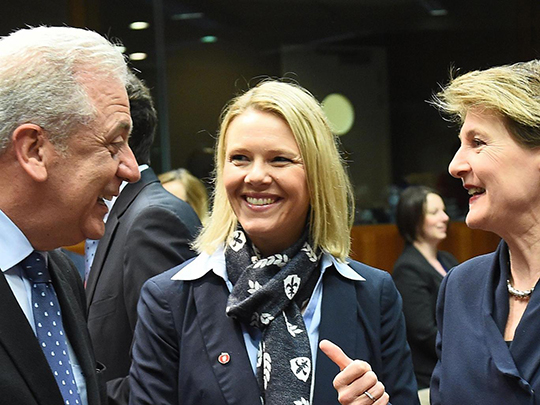
Norway, Oct 24: Norway's integration minister has been widely mocked and asked to "reconsider her position" after telling the country's Muslims to adapt to the country's culture.

norway

Sylvi Listhaug, from the anti-immigrant Progress Party, caused fury and confusion on Monday when she posted on Facebook on the eve of a national integration conference. “I think those who come to Norway need to adapt to our society,” read the post.

Ms Listhaug has since clarified the comment, which was liked more than 20,000 times, claiming she was misunderstood.

“Here we eat pork, drink alcohol and show our face. You must abide by the values, laws and regulations that are in Norway when you come here.”

The country's coalition government, which includes Ms Listhaug's party and the centre-right Conservative party, has been playing tough with the country's Muslims over the past week.

Ms Listhaug also echoed Prime Minister Erna Solberg who said in an interview that she would not personally employ someone wearing the Islamic niqab face veil.

Ms Listhaug's post however still drew criticism.

Comments

Well Wisher
 - 
Tuesday, 25 Oct 2016

Uncultured people speaking about culture, civilization.... very funny.

Add new comment

  • Coastaldigest.com reserves the right to delete or block any comments.
  • Coastaldigset.com is not responsible for its readers’ comments.
  • Comments that are abusive, incendiary or irrelevant are strictly prohibited.
  • Please use a genuine email ID and provide your name to avoid reject.
News Network
April 21,2020

New York, Apr 21: Oil prices plunged below zero on Monday as demand for energy collapses amid the coronavirus pandemic and traders don't want to get stuck owning crude with nowhere to store it.

Stocks were also slipping on Wall Street in afternoon trading, with the S&P 500 down 0.9%, but the market's most dramatic action was by far in oil, where benchmark U.S. crude for May delivery plummeted to negative $3.70 per barrel, as of 2:15 pm. Eastern time.

Much of the drop into negative territory was chalked up to technical reasons — the May delivery contract is close to expiring so it was seeing less trading volume, which can exacerbate swings. But prices for deliveries even further into the future, which were seeing larger trading volumes, also plunged.

Demand for oil has collapsed so much due to the coronavirus pandemic that facilities for storing crude are nearly full.

Tanks could hit their limits within three weeks, according to Chris Midgley, head of analytics at S&P Global Platts.

Benchmark U.S. crude oil for June delivery, which shows a more ”normal” price, fell 14.8% to $21.32 per barrel, as factories and automobiles around the world remain idled. Big oil producers have announced cutbacks in production in hopes of better balancing supplies with demand, but many analysts say it's not enough.

“Basically, bears are out for blood,” analyst Naeem Aslam of Avatrade said in a report. “The steep fall in the price is because of the lack of sufficient demand and lack of storage place given the fact that the production cut has failed to address the supply glut.”

Halliburton swung between gains and sharp losses, even though it reported stronger results for the first three months of 2020 than analysts expected. The oilfield engineering company said that the pandemic has created so much turmoil in the industry that it “cannot reasonably estimate” how long the hit will last. It expects a further decline in revenue and profitability for the rest of 2020, particularly in North America.

Brent crude, the international standard, was down $1.78 to $26.30 per barrel. .

In the stock market, the mild drops ate into some of the big gains made since late March, driven lately by investors looking ahead to parts of the economy possibly reopening as infections level off in hard-hit areas.

Pessimists have called the rally overdone, pointing to the severe economic pain sweeping the world and continued uncertainty about how long it will last.

The Dow Jones Industrial Average was down 364 points, or 1.5%, to 23,887. The Nasdaq was down 0.1%..

More gains from companies that are winners in the new stay-at-home economy helped limit the market's losses Amazon rose 1.4%, and Netflix jumped 3.8% as people shut in at home buy staples and look to fill their time. Clorox likewise rose toward a new record and was up 1% as households and businesses that remain open look to stay clean.

In Tokyo the Nikkei 225 fell 1.1% after Japan reported that its exports fell nearly 12% in March from a year earlier as the pandemic hammered demand in its two biggest markets, the U.S. and China.

The Hang Seng index in Hong Kong lost 0.2%, and South Korea's Kospi fell 0.8%.

European markets were modestly higher The German DAX was up 0.5%, the French CAC 40 was up 0.7% and the FTSE 100 in London gained 0.7%.

In a sign of continued caution in the market, Treasury yields remained extremely low. The yield on the 10-year Treasury slipped to 0.64% from 0.65% late Friday. It started the year near 1.90%. Bond yields drop when their prices rise, and investors tend to buy Treasurys when they're worried about the economy.

Stocks have been on a generally upward swing recently, and the S&P 500 just closed out its first back-to-back weekly gain since the market began selling off in February. Promises of massive aid for the economy and markets by the Federal Reserve and U.S. government ignited the rally, which sent the S&P 500 up as much as 28.5% since a low on March 23.

More recently, countries around the world have tentatively eased up on business-shutdown restrictions put in place to slow the spread of the virus.

But health experts warn the pandemic is far from over and new flareups could ignite if governments rush to allow ”normal” life to return prematurely.

The S&P 500 remains about 15% below its record high in February as millions more U.S. workers file for unemployment every week amid the shutdowns.

Many analysts also warn that a significant part of the recent recovery in stocks is due to the expectation among some investors that the economy will rebound sharply once economic quarantines are lifted. They're essentially predicting that a line chart of the economy will ultimately resemble the letter “V,” with a wild ride down but then a quick pivot to a vigorous recovery.

That may be to optimistic. “We caution that a U-shaped recovery is also quite likely,” where the economy bottoms out and stays at that low level for a while before recovering, strategists at Barclays warned in a recent report.

Without strong testing programs for COVID-19, businesses likely won't feel comfortable bringing back their full workforces for a while.

”With risk assets now overbought, the chance for a correction has increased,” Morgan Stanley strategists wrote in a report.


Comments

Add new comment

  • Coastaldigest.com reserves the right to delete or block any comments.
  • Coastaldigset.com is not responsible for its readers’ comments.
  • Comments that are abusive, incendiary or irrelevant are strictly prohibited.
  • Please use a genuine email ID and provide your name to avoid reject.
Agencies
June 7,2020

Boston, Jun 7: Dozens of scientists doing research funded by Mark Zuckerberg say Facebook should not be letting President Donald Trump use of the social media platform to spread both misinformation and incendiary statements.

The researchers, including 60 professors at leading US research institutions, wrote a letter to the Facebook CEO on Saturday asking that he consider stricter policies on misinformation and incendiary language that harms people," especially during the current turmoil over racial injustice.

The letter calls the spread of deliberate misinformation and divisive language the researchers' goal of using technology to prevent and eradicate disease, improving childhood education and reform the criminal justice system.

The researchers' mission "is antithetical to some of the stances that Facebook has been taking, so we're encouraging them to be more on the side of truth and on the right side of history as we've said in the letter, said Debora Marks of Harvard Medical School, one of three professors who organized the letter.

The other organisers are Martin Kampmann of the University of California-San Francisco and Jason Shepherd of the University of Utah.

All have grants from a Chan Zuckerberg Initiative program working to prevent, cure and treat neurodegenerative disorders including Alzheimer's and Parkinson's disease. The initiative is run by Zuckerberg and his wife, Priscilla Chan.

They said the letter had more than 160 signatories. Shepherd said about 10% are employees of Chan Zuckerberg foundations.

The letter objects specifically to Zuckerberg's decision not to at least flag as a violation of Facebook's community standards Trump's post that stated when the looting starts, the shooting starts after unrest in Minneapolis over the videotaped killing of George Floyd, a black man, by a white police officer.

The letter's authors called the post a clear statement of inciting violence.

Twitter had both flagged and demoted a Trump tweet using the same language.

The Associated Press emailed the Chan Zuckerberg Initiative press office for comment. It did not immediately respond.

Some Facebook employees have publicly objected to Zuckerberg's refusal to take down or label misleading or incendiary posts by Trump or other politicians. But Zuckerberg who controls a majority of voting shares in the company has so far refused.

On Friday, Zuckerberg said in a post that he would review potential options for handling violating or partially-violating content aside from the binary leave-it-up or take-it-down decisions I know many of you think we should have labeled the President's posts in some way last week, he wrote.

"Our current policy is that if content is actually inciting violence, then the right mitigation is to take that content down not let people continue seeing it behind a flag. There is no exception to this policy for politicians or newsworthiness.

Comments

Add new comment

  • Coastaldigest.com reserves the right to delete or block any comments.
  • Coastaldigset.com is not responsible for its readers’ comments.
  • Comments that are abusive, incendiary or irrelevant are strictly prohibited.
  • Please use a genuine email ID and provide your name to avoid reject.
Agencies
July 28,2020

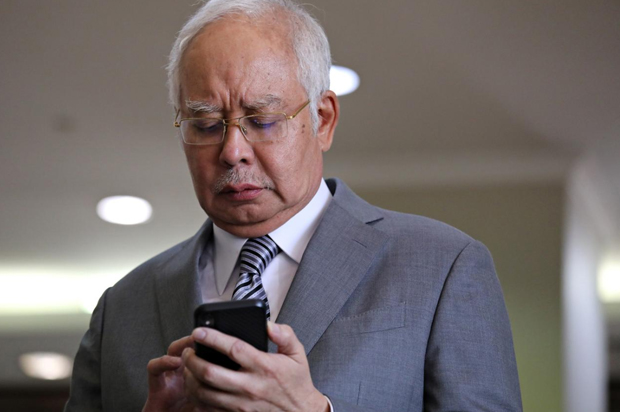
Kuala Lumpur, Jul 28: Malaysia's ex-leader Najib Razak was found guilty Tuesday in his first trial over the multi-billion-dollar 1MDB scandal, two years after the fraud contributed to the downfall of his long-ruling government.

The former prime minister could now face decades in jail after being convicted on all charges in the case related to the looting of sovereign wealth fund 1Malaysia Development Berhad.

Billions of dollars were stolen from the investment vehicle and spent on everything from high-end real estate to pricey art, while investment bank Goldman Sachs also became embroiled in the scandal.

Anger at the looting played a large part in the shock loss of Najib's long-ruling coalition in elections in 2018, and he was arrested and hit with dozens of charges following his defeat.

The verdict was a test of Malaysia's rule of law. It comes about five months after Najib's scandal-plagued party returned to power as part of a coalition, development observers had feared could affect the outcome of the case.

About 16 months after it began, the Kuala Lumpur High Court delivered the verdict in Najib's first trial, which centred on the transfer of 42 million ringgit ($9.9 million) from a former 1MDB unit, SRC International, into his accounts.

Najib had vehemently denied wrongdoing.

But Judge Mohamad Nazlan Mohamad Ghazali took apart all the arguments put forward by his defence, and found him guilty on the seven charges he faced.

"In conclusion, after considering all the evidence in this trial, I find the prosecution has successfully proven the case," the judge told the court.

The charges were one of abuse of power, three of criminal breach of trust and three of money-laundering.

The counts of abuse of power and criminal breach of trust are punishable by up to 20 years in jail each, while the money-laundering charges are punishable by up to 15 years each.

Sentencing was not handed down straight away. The 67-year-old will likely appeal and he may not be sent to jail immediately. If his conviction is upheld, he will also be barred from political office for several years.

Najib had insisted he was ignorant of the transactions.

The defence team portrayed Najib as a victim and instead sought to paint financier Low Taek Jho, a key figure in the scandal who has been charged in the US and Malaysia, as the mastermind.

Low, whose whereabouts are unknown, maintains his innocence.

Prosecutors insisted Najib was in control of the 1MDB unit, SRC International.

The return of Najib's party to power as part of a coalition in March followed the collapse of Mahathir Mohamad's reformist administration.

Since then, 1MDB-linked charges were unexpectedly dropped against the ex-leader's stepson Riza Aziz, a producer of Hollywood movie "The Wolf of Wall Street", in exchange for him agreeing to return assets to Malaysia.

Prosecutors also dropped dozens of charges against Najib ally Musa Aman, the former leader of Sabah state.

The amounts involved in Najib's first case are small compared to those in his second and most significant trial, which centres on allegations he illicitly obtained more than $500 million.

Malaysia had charged Goldman Sachs and some current and former staff, claiming large amounts were stolen when the bank arranged bond issues for 1MDB.

But the two sides agreed to a $3.9 billion settlement last week in exchange for charges being dropped.

Comments

Add new comment

  • Coastaldigest.com reserves the right to delete or block any comments.
  • Coastaldigset.com is not responsible for its readers’ comments.
  • Comments that are abusive, incendiary or irrelevant are strictly prohibited.
  • Please use a genuine email ID and provide your name to avoid reject.