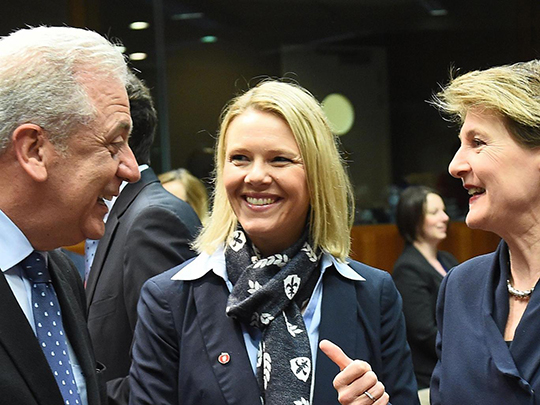
Norway Muslims demand minister's resignation after pork post

October 24, 2016

Norway, Oct 24: Norway's integration minister has been widely mocked and asked to "reconsider her position" after telling the country's Muslims to adapt to the country's culture.

norway

Sylvi Listhaug, from the anti-immigrant Progress Party, caused fury and confusion on Monday when she posted on Facebook on the eve of a national integration conference. “I think those who come to Norway need to adapt to our society,” read the post.

Ms Listhaug has since clarified the comment, which was liked more than 20,000 times, claiming she was misunderstood.

“Here we eat pork, drink alcohol and show our face. You must abide by the values, laws and regulations that are in Norway when you come here.”

The country's coalition government, which includes Ms Listhaug's party and the centre-right Conservative party, has been playing tough with the country's Muslims over the past week.

Ms Listhaug also echoed Prime Minister Erna Solberg who said in an interview that she would not personally employ someone wearing the Islamic niqab face veil.

Ms Listhaug's post however still drew criticism.

Comments

Well Wisher
 - 
Tuesday, 25 Oct 2016

Uncultured people speaking about culture, civilization.... very funny.

Add new comment

  • Coastaldigest.com reserves the right to delete or block any comments.
  • Coastaldigset.com is not responsible for its readers’ comments.
  • Comments that are abusive, incendiary or irrelevant are strictly prohibited.
  • Please use a genuine email ID and provide your name to avoid reject.
Agencies
July 1,2020

The ILO has warned that if another Covid-19 wave hits in the second half of 2020, there would be global working-hour loss of 11.9 percent - equivalent to the loss of 340 million full-time jobs.

According to the 5th edition of International Labour Organisation (ILO) Monitor: Covid-19 and the world of work, the recovery in the global labour market for the rest of the year will be uncertain and incomplete.

The report said that there was a 14 percent drop in global working hours during the second quarter of 2020, equivalent to the loss of 400 million full-time jobs.

The number of working hours lost across the world in the first half of 2020 was significantly worse than previously estimated. The highly uncertain recovery in the second half of the year will not be enough to go back to pre-pandemic levels even in the best scenario, the agency warned.

The baseline model – which assumes a rebound in economic activity in line with existing forecasts, the lifting of workplace restrictions and a recovery in consumption and investment – projects a decrease in working hours of 4.9 percent (equivalent to 140 million full-time jobs) compared to last quarter of 2019.

It says that in the pessimistic scenario, the situation in the second half of 2020 would remain almost as challenging as in the second quarter.

“Even if one assumes better-tailored policy responses – thanks to the lessons learned throughout the first half of the year – there would still be a global working-hour loss of 11.9 per cent at the end of 2020, or 340 million full-time jobs, relative to the fourth quarter of 2019,” it said.

The pessimistic scenario assumes a second pandemic wave and the return of restrictions that would significantly slow recovery. The optimistic scenario assumes that workers’ activities resume quickly, significantly boosting aggregate demand and job creation. With this exceptionally fast recovery, the global loss of working hours would fall to 1.2 per cent (34 million full-time jobs).

The agency said that under the three possible scenarios for recovery in the next six months, “none” sees the global job situation in better shape than it was before lockdown measures began.

“This is why we talk of an uncertain but incomplete recovery even in the best of scenarios for the second half of this year. So there is not going to be a simple or quick recovery,” ILO Director-General Guy Ryder said.

The new figures reflect the worsening situation in many regions over the past weeks, especially in developing economies. Regionally, working time losses for the second quarter were: Americas (18.3 percent), Europe and Central Asia (13.9 percent), Asia and the Pacific (13.5 percent), Arab States (13.2 percent), and Africa (12.1 percent).

The vast majority of the world’s workers (93 per cent) continue to live in countries with some sort of workplace closures, with the Americas experiencing the greatest restrictions.

During the first quarter of the year, an estimated 5.4 percent of global working hours (equivalent to 155 million full-time jobs) were lost relative to the fourth quarter of 2019. Working- hour losses for the second quarter of 2020 relative to the last quarter of 2019 are estimated to reach 14 per cent worldwide (equivalent to 400 million full-time jobs), with the largest reduction (18.3 per cent) occurring in the Americas.

The ILO Monitor also found that women workers have been disproportionately affected by the pandemic, creating a risk that some of the modest progress on gender equality made in recent decades will be lost, and that work-related gender inequality will be exacerbated.

The severe impact of Covid-19 on women workers relates to their over-representation in some of the economic sectors worst affected by the crisis, such as accommodation, food, sales and manufacturing.

Globally, almost 510 million or 40 percent of all employed women work in the four most affected sectors, compared to 36.6 percent of men, it said.

The report said that women also dominate in the domestic work and health and social care work sectors, where they are at greater risk of losing their income and of infection and transmission and are also less likely to have social protection.

The pre-pandemic unequal distribution of unpaid care work has also worsened during the crisis, exacerbated by the closure of schools and care services.

Even as countries have adopted policy measures with unprecedented speed and scope, the ILO Monitor highlights some key challenges ahead, including finding the right balance and sequencing of health, economic and social and policy interventions to produce optimal sustainable labour market outcomes; implementing and sustaining policy interventions at the necessary scale when resources are likely to be increasingly constrained and protecting and promoting the conditions of vulnerable, disadvantaged and hard-hit groups to make labour markets fairer and more equitable.

“The decisions we adopt now will echo in the years to come and beyond 2030. Although countries are at different stages of the pandemic and a lot has been done, we need to redouble our efforts if we want to come out of this crisis in a better shape than when it started,” Ryder said. 

Comments

Add new comment

  • Coastaldigest.com reserves the right to delete or block any comments.
  • Coastaldigset.com is not responsible for its readers’ comments.
  • Comments that are abusive, incendiary or irrelevant are strictly prohibited.
  • Please use a genuine email ID and provide your name to avoid reject.
News Network
January 21,2020

Beijing, Jan 21: The Chinese official investigating a pneumonia outbreak stemming from a new coronavirus said the disease can spread from person to person but can be halted with increased vigilance, as authorities on Tuesday confirmed a fourth death.

Zhong Nanshan said there was no danger of a repeat of the Severe Acute Respiratory Syndrome (SARS) epidemic that killed nearly 800 people globally during a 2002-2003 outbreak, which started in China, as long as precautions were taken.

"It took only two weeks to identify the novel coronavirus," state news agency Xinhua quoted Zhong as saying late on Monday.

The outbreak was still in its early stages and China had good surveillance and quarantine systems to help control it, he added.

The outbreak has spread from the central city of Wuhan to cities including Beijing and Shanghai, with more than 200 cases reported so far. Four cases have been reported outside China - in South Korea, Thailand and Japan.

Australia on Tuesday said it would screen passengers on flights from Wuhan amid rising concerns that the virus will spread globally as Chinese travellers take flights abroad for the Lunar New Year holiday starting this week.

Authorities around the globe, including in the United States and many Asian countries, have stepped up screening of travellers from Wuhan.

Chinese authorities confirmed a total of 217 cases of the virus in China as of 6 p.m. (1000 GMT) on Monday, state television reported, 198 of which were in Wuhan.

A fourth person died on Jan. 19, the Wuhan Municipal Health Commission said. The 89-year-old man, who had underlying health diseases including coronary heart disease, developed symptoms on Jan. 13 and was admitted to hospital five days later, it added.

Zhong, who is renowned in China for his work fighting SARS in 2003, confirmed that the virus can pass from person-to-person.

Fifteen medical workers in Wuhan had been diagnosed with pneumonia, with one other suspected case, the Wuhan Municipal Health Commission said. Of the infected staff, one was in critical condition.

In Shanghai, officials on Tuesday confirmed a second case involving a 35-year-man who had visited Wuhan in early January, and said they were monitoring four other suspected cases.

The virus causes a type of pneumonia and belongs to the same family of coronaviruses as SARS. Symptoms include fever and difficulty in breathing, which are similar to many other respiratory diseases and pose complications for screening efforts.

The World Health Organisation (WHO) said on Monday an animal source appeared most likely to be the primary origin of the outbreak and that some "limited human-to-human transmission" occurred between close contacts.

The Geneva-based U.N. agency convened an emergency committee for Wednesday to assess whether the outbreak constitutes an international health emergency and what measures should be taken to manage it.

So far, the WHO has not recommended trade or travel restrictions, but a panel of independent experts could do so or make other recommendations to limit spread.

Comments

Add new comment

  • Coastaldigest.com reserves the right to delete or block any comments.
  • Coastaldigset.com is not responsible for its readers’ comments.
  • Comments that are abusive, incendiary or irrelevant are strictly prohibited.
  • Please use a genuine email ID and provide your name to avoid reject.
News Network
March 25,2020

Wellington, Mar 25: New Zealand has declared a state of emergency as it prepares to go into an unprecedented lockdown late Wednesday for about a month.

The declaration temporarily gives police and the military extra powers. And Prime Minister Jacinda Ardern says any New Zealanders returning home from overseas who show symptoms of COVID-19 will be put in isolation at an approved facility.

“I have one simple message for New Zealanders today as we head into the next four weeks: ‘stay at home,’” Ardern said. “It will break the chain of transmission and it will save lives.”

Ardern said exceptions include people working crucial jobs, those leaving to pick up essentials like groceries, and those engaging in solitary exercise.

The country has 205 reported cases of the virus, although Ardern said that number could rise into the thousands before it begins to recede even with the strict measures being taken.

Comments

Add new comment

  • Coastaldigest.com reserves the right to delete or block any comments.
  • Coastaldigset.com is not responsible for its readers’ comments.
  • Comments that are abusive, incendiary or irrelevant are strictly prohibited.
  • Please use a genuine email ID and provide your name to avoid reject.