Norway Muslims demand minister's resignation after pork post

October 24, 2016

Norway, Oct 24: Norway's integration minister has been widely mocked and asked to "reconsider her position" after telling the country's Muslims to adapt to the country's culture.

norway

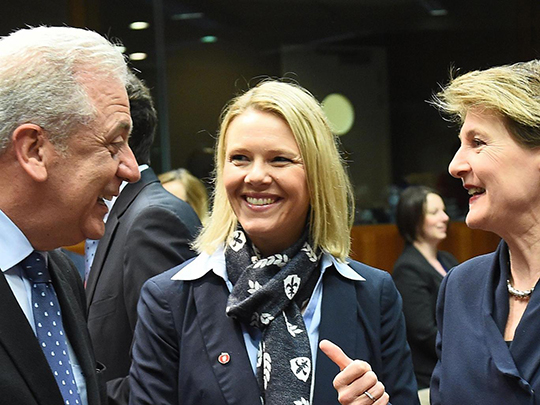
Sylvi Listhaug, from the anti-immigrant Progress Party, caused fury and confusion on Monday when she posted on Facebook on the eve of a national integration conference. “I think those who come to Norway need to adapt to our society,” read the post.

Ms Listhaug has since clarified the comment, which was liked more than 20,000 times, claiming she was misunderstood.

“Here we eat pork, drink alcohol and show our face. You must abide by the values, laws and regulations that are in Norway when you come here.”

The country's coalition government, which includes Ms Listhaug's party and the centre-right Conservative party, has been playing tough with the country's Muslims over the past week.

Ms Listhaug also echoed Prime Minister Erna Solberg who said in an interview that she would not personally employ someone wearing the Islamic niqab face veil.

Ms Listhaug's post however still drew criticism.

Comments

Well Wisher
 - 
Tuesday, 25 Oct 2016

Uncultured people speaking about culture, civilization.... very funny.

Add new comment

  • Coastaldigest.com reserves the right to delete or block any comments.
  • Coastaldigset.com is not responsible for its readers’ comments.
  • Comments that are abusive, incendiary or irrelevant are strictly prohibited.
  • Please use a genuine email ID and provide your name to avoid reject.
News Network
June 19,2020

United Nations, Jun 19: Half of the world's children -- one billion every year -- are affected by physical, sexual or psychological violence, suffering injuries and death because countries have failed to follow established strategies to protect them, the first report of its kind from the UN has said, with experts noting that the coronavirus-related lockdowns have left far too many youngsters stuck with their abusers.

While nearly all countries (88 per cent) have laws in place to protect minors, less than half (47 per cent) say they strongly enforce them, said the Global Status Report on Preventing Violence Against Children 2020 launched on Thursday.

Because countries have failed to follow established strategies to protect children, about one billion are affected each year by physical, sexual or psychological violence, it said.

"There is never any excuse for violence against children," WHO Director-General Tedros Adhanom Ghebreyesus said.

"We have evidence-based tools to prevent it, which we urge all countries to implement. Protecting the health and well-being of children is central to protecting our collective health and well-being, now and for the future," he said.

The report -- launched by the World Health Organisation, the UNICEF, the UNESCO, the Special Representative of the UN Secretary-General on Violence against Children and the End Violence Partnership -- charted progress in 155 countries against the "INSPIRE" framework, a set of seven strategies for preventing and responding to violence against children.

The report signaled a clear need in all countries to scale up efforts to implement them. It included the first ever global homicide estimates specifically for children under 18 years of age -- previous estimates were based on data that included 18 to 19-year olds.

According to the findings, in 2017, around 40,000 children were victims of homicide.

"Violence against children has always been pervasive, and now things could be getting much worse," UNICEF Executive Director Henrietta Fore said.

"Lockdowns, school closures and movement restrictions have left far too many children stuck with their abusers, without the safe space that school would normally offer. It is urgent to scale up efforts to protect children during these times and beyond, including by designating social service workers as essential and strengthening child helplines," she said.

UNESCO Director-General Audrey Azoulay said during the COVID-19 pandemic, and the related school closures, "we have seen a rise in violence and hate online – and this includes bullying".

"Now, as schools begin to re-open, children are expressing their fears about going back to school. It is our collective responsibility to ensure that schools are safe environments for all children. We need to think and act collectively to stop violence at school and in our societies at large," Azoulay said.

Stay-at-home measures including school closures have limited the usual sources of support for families and individuals such as friends, extended family or professionals.

This further erodes victims’ ability to successfully cope with crises and the new routines of daily life. Spikes in calls to helplines for child abuse and intimate partner violence have been observed, the report said.

While online communities have become central to maintain many children's learning, support and play, an increase in harmful online behaviors including cyberbullying, risky online behavior and sexual exploitation have been identified.

“Whilst this report was being finalised, confinement measures and the disrupted provision of already limited child protection services exacerbated the vulnerability of children to various forms of violence," said Najat Maalla M’jid, Special Representative of the UN Secretary-General on Violence against Children.

Of the INSPIRE strategies, only access to schools through enrolment showed the most progress with 54 per cent of the countries reporting that a sufficient number of children in need were being reached in this way.

Between 32 per cent and 37 per cent of the countries considered that victims of violence could access support services, while 26 per cent of the countries provided programmes on parent and caregiver support; 21 per cent of the countries had programmes to change harmful norms; and 15 per cent of the countries had modifications to provide safe physical environments for children, the report said.

Although a majority of countries (83 per cent) have national data on violence against children, only 21 per cent used these to set baselines and national targets to prevent and respond to violence against children, it added.

The report said about 80 per cent of countries have national plans of action and policies but only one-fifth have plans that are fully funded or have measurable targets. A lack of funding combined with inadequate professional capacity are likely contributing factors and a reason why implementation has been slow.

"Ending violence against children is the right thing to do, a smart investment to make - and it's possible. We can and must create a world where every child can thrive," Howard Taylor of the End Violence Partnership said.


Comments

Add new comment

  • Coastaldigest.com reserves the right to delete or block any comments.
  • Coastaldigset.com is not responsible for its readers’ comments.
  • Comments that are abusive, incendiary or irrelevant are strictly prohibited.
  • Please use a genuine email ID and provide your name to avoid reject.
Agencies
February 18,2020

British lawmaker Debbie Abrahams' e-Business visa was revoked as she was involved in anti-India activities and the cancellation was conveyed to her on February 14, government sources said on Tuesday.

Asserting that the grant, rejection or revocation of a visa or electronic travel authorisation is the sovereign right of a country, the sources said Abrahams was issued an e-Business visa on October 7 last year which was valid till October 5, 2020 for attending business meetings.

"Her e-Business visa was revoked on February 14, 2020 on account of her indulging in activities which went against India's national interest. The rejection of the e-Business visa was intimated to her on February 14," a source said.

Abrahams, who chairs a British parliamentary group on Kashmir, was denied entry into India upon her arrival at the New Delhi airport on Monday.

Government officials had said on Monday also that she was informed in advance that her e-visa had been cancelled.

Comments

Add new comment

  • Coastaldigest.com reserves the right to delete or block any comments.
  • Coastaldigset.com is not responsible for its readers’ comments.
  • Comments that are abusive, incendiary or irrelevant are strictly prohibited.
  • Please use a genuine email ID and provide your name to avoid reject.
News Network
February 12,2020

Saint Martin's Island, Feb 12: At least 15 women and children drowned and more than 50 others were missing after a boat overloaded with Rohingya refugees sank off southern Bangladesh as it tried to reach Malaysia Tuesday, officials said.

Some 138 people -- mainly women and children -- were packed on a trawler barely 13 metres (40 feet) long, trying to cross the Bay of Bengal, a coast guard spokesman told news agency.

"It sank because of overloading. The boat was meant to carry maximum 50 people. The boat was also loaded with some cargo," another coast guard spokesman, Hamidul Islam, added.

Nearly one million Rohingya live in squalid camps near Bangladesh's border with Myanmar, many fleeing the neighbouring country after a 2017 brutal military crackdown.

With few opportunities for jobs and education in the camps, thousands have tried to reach other countries like Malaysia and Thailand by attempting the hazardous 2,000-kilometre journey.

In the latest incident, 71 people have been rescued including 46 women. Among the dead, 11 were women and the rest children.

Anwara Begum said two of her sons, aged six and seven, drowned in the tragedy.

"We were four of us in the boat... Another child (son, aged 10) is very sick," the 40-year-old told news agency.

Fishermen tipped off the coast guard after they saw survivors swimming and crying for help in the sea.

The boat's keel hit undersea coral in shallow water off Saint Martin's Island, Bangladesh's southernmost territory, before it sank, survivors said.

"We swam in the sea before boats came and rescued us," said survivor Mohammad Hossain, 20.

Coast guard commander Sohel Rana said three survivors, including a Bangladeshi, were detained over human trafficking allegations.

An estimated 25,000 Rohingya left Bangladesh and Myanmar on boats in 2015 trying to get to Thailand, Malaysia and Indonesia. Hundreds drowned when overloaded boats sank.

Begum said her family paid a Bangladeshi trafficker $450 per head to be taken to Malaysia.

"We're first taken to a hill where we stayed for five days. Then they used three small trawlers to take us to a large trawler, which sank," she said.

Shakirul Islam, a migration expert whose group works with Rohingya to raise awareness against trafficking, said desperation in the camps was making refugees want to leave.

"It was a tragedy waiting to happen," he said.

"They just want to get out, and fall victim to traffickers who are very active in the camps."

Islam said in the past two months dozens of Rohingya reported approaches from traffickers to his OKUP migration rights group.

"Human smuggling and trafficking in the Bay of Bengal is particularly difficult to address as it requires concerted effort from multiple states," the Bangladesh head of UN agency the International Organization for Migration, Giorgi Gigauri, told news agency.

"The gaps in coordination are easily exploited by criminal networks."

Since last year, Bangladeshi authorities have picked up over 500 Rohingya from rickety fishing trawlers or coastal villages as they waited to board boats.

Trafficking often increases during the November-March period when the sea is safest for the small trawlers used by traffickers.

Bangladesh and Myanmar signed a repatriation deal to send back some Rohingya to their homeland, but none have agreed to return because of safety fears.

The charity Save the Children called on Myanmar to "take all necessary steps to ensure the Rohingya community can return to their homes in a safe and dignified manner".

"The tragic drowning of women and children... should be a wake-up call for us all," the group's Athena Rayburn said in a statement.

Comments

Add new comment

  • Coastaldigest.com reserves the right to delete or block any comments.
  • Coastaldigset.com is not responsible for its readers’ comments.
  • Comments that are abusive, incendiary or irrelevant are strictly prohibited.
  • Please use a genuine email ID and provide your name to avoid reject.