


This is not a Muslim ban; over 40 Muslim countries not affected by order: Trump

January 30, 2017

Washington, Jan 30: President Donald Trump insisted on Sunday that his executive order temporarily halting travel from seven majority-Muslim countries+ was "not a Muslim ban," after it was met with confusion, global outrage and huge protests+ across the United States.
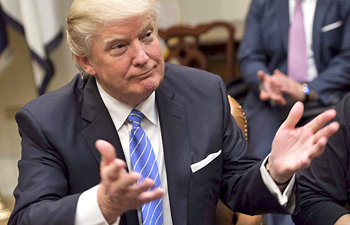
trumpban"America is a proud nation of immigrants and we will continue to show compassion to those fleeing oppression, but we will do so while protecting our own citizens and border. America has always been the land of the free and home of the brave," Trump said in a statement.

"This is not about religion — this is about terror and keeping our country safe," he said, adding that more 40 Muslim countries were not affected by his order.

His defense came+ in the form of an official written statement issued by the White House, a rare move for a president who has favored speaking directly to his audience via Twitter.

The president singled out the media, which he has attacked repeatedly since coming into office just over a week ago.

"We will keep it free and keep it safe, as the media knows," he said, referring to the United States.

"To be clear, this is not a Muslim ban, as the media is falsely reporting."

Trump signed the executive order on Friday, suspending the arrival of all refugees+ for at least 120 days, Syrian refugees indefinitely and barring citizens from Iran, Iraq, Libya, Somalia, Sudan, Syria and Yemen for 90 days.

While Trump has cited the September 11, 2001, attacks as justification for his move, he did not target any of the 9/11 hijackers' home countries — Egypt, Lebanon, Saudi Arabia and the United Arab Emirates.

Judges in at least four states with major international airports — Massachusetts, New York, Virginia and Washington — issued temporary stays to block parts of Trump's executive order, preventing authorities from deporting people who had been detained.

Trump recalled that his predecessor Barack Obama, a Democrat, had paused for six months in 2011 the Iraqi refugee program.

And he stressed that the seven countries targeted by his ban were also listed by Obama.

But the previous administration's restrictions were of a different sort, requiring visas for people having traveled to those countries in the past five years.

"We will again be issuing visas to all countries once we are sure we have reviewed and implemented the most secure policies over the next 90 days," Trump added.

"I have tremendous feeling for the people involved in this horrific humanitarian crisis in Syria. My first priority will always be to protect and serve our country, but as president I will find ways to help all those who are suffering."

Comments

PedoMhdFkdAmna
 - 
Monday, 30 Jan 2017

Why are 13 Muslim countries banned Israelis from entry ?

Ahmed K.C.
 - 
Monday, 30 Jan 2017

As per their claim 19 people who hijacked airlines on 9/11 were from GCC, namely, 15 from Saudi, 2 from UAE, 1 from Lebanon and 1 from Egypt.
But, no ban on above countries. If he really has DUM, should ban them and see the result.

PedoMhdFkdAmna
 - 
Monday, 30 Jan 2017

Good Trumpanna !

Dean
 - 
Monday, 30 Jan 2017

If he starts banning all terrorists then america will be left with only Muslims. :) We should also ban american products and outlets in Muslim countries. No Muslim should fly to US to show solidarity to the countries that were excluded. Canada is going to ban All Christians from entering Canada after yesterdays Masjid attack. First america should get out of Muslim Land and stop poking nose in Muslim countries for petrol.

Rikaz
 - 
Monday, 30 Jan 2017

Not good, racist president of America....

Add new comment

  • Coastaldigest.com reserves the right to delete or block any comments.
  • Coastaldigset.com is not responsible for its readers’ comments.
  • Comments that are abusive, incendiary or irrelevant are strictly prohibited.
  • Please use a genuine email ID and provide your name to avoid reject.
News Network
March 7,2020

Mysuru, Mar 7: Karnataka Minister for Medical Education K Sudhakar on Saturday said that State Government may consider suspending the touch-based Biometric time and Attendance system for its employees in view of the COVID-19 threat.

Speaking to media persons while inspecting the medical infrastructure at KR Hospital here on Saturday, he said that many IT companies have already suspended the Biometric Attendance system in a bid to prevent the spread of the virus. Given the threat perception, the government was also contemplating the same and would consider it. However, he did not specify the date.

With regard to the preparedness to handle the threat, the Minister said the government was extremely cautious since last 20 days and had taken all precautionary measures. “All international passengers at the airport are being screened and so far nearly 1 lakh passengers have been screened and anyone with symptoms will be quarantined for 28 days.’’

Comments

Add new comment

  • Coastaldigest.com reserves the right to delete or block any comments.
  • Coastaldigset.com is not responsible for its readers’ comments.
  • Comments that are abusive, incendiary or irrelevant are strictly prohibited.
  • Please use a genuine email ID and provide your name to avoid reject.
coastaldigest.com news network
May 27,2020

Bengaluru, May 27: A yet incomplete state-wide survey has revealed that there are over 53.99 lakh households vulnerable to the infection in Karnataka. The survey is being conducted by the government to find COVID-19 vulnerable population particularly with comorbidities and cases like SARI and ILI.

The survey, which is 67.16% complete so far, finds 1.37 lakh households across Karnataka have people with comorbid conditions, excluding a further 13,341 households with symptoms of Influenza Like Illness (ILI), Severe Acute Respiratory Infection (SARI) and Covid-19.

Over 48 lakh households have senior citizens, who on account of their age are at highest risk of death from the disease.

Munish Moudgil, Director of the State COVID War Room, clarified that households could have multiple types of vulnerable people. According to the survey data (which is dated May 26), Kalaburagi and Bengaluru Urban have the highest cases of SARI, ILI with 1,902 households and 1,703 households respectively, although these numbers are likely to rise, as the survey is still incomplete in these districts. 

A BBMP source said that 68% of the survey has been completed in the city, but the data has not been logged yet. The number of SARI/ILI cases is next highest in Shivamogga with 1,217 households, Mysuru with 1,200 and Davangere with 1,178.

The government regards SARI and ILI as indicators of coronavirus and on April 17, had passed an order instructing healthcare workers to test people with these conditions for the coronavirus. Consequently, 51 COVID-19 cases were discovered by testing people with these symptoms.

Belagavi, meantime, has reported the highest incidents of households with comorbid conditions with 12,427 identified so far, followed by Mandya with 9,289, Kalaburagi with 8,311, Shivamogga with 8,140 and Bengaluru Urban with 7,562. Importantly, 3,45,443 vulnerable people have been identified in Bengaluru Urban within 28.26% of data logged in so far.

Comments

Add new comment

  • Coastaldigest.com reserves the right to delete or block any comments.
  • Coastaldigset.com is not responsible for its readers’ comments.
  • Comments that are abusive, incendiary or irrelevant are strictly prohibited.
  • Please use a genuine email ID and provide your name to avoid reject.
News Network
June 20,2020

Bengaluru, Jun 20: The Karnataka Health Department has issued guidelines on the admission of COVID-19 patients in private hospitals after clinical assessment, mandating that the district surveillance officer (DSO) should be first informed to initiate further procedures, an official said on Friday.

"A health team sent by the DSO should visit the home or hospital where the patient is staying. The team should conduct a rapid assessment of his or her health condition," said Karnataka's Additional Chief Secretary Jawaid Akhtar.

In the rapid health condition assessment, the team should first check the patient's body temperature, followed by SpO2 (oxygen saturation) level and confirm if there are any comorbidities such as hypertension, diabetes, tuberculosis, HIV, cancer, stroke etc.

Depending on the health condition of patients, Akhtar said, two categories have been made.

"Those who have body temperature greater than 37.5 degrees Celsius, SpO2 level below 94 percent, elderly (above 60 years) and suffering from known comorbid conditions should be taken to a dedicated Covid hospital (DCH)," he said.

"All other patients, even if older but not suffering from co-morbidities, those below 60 and suffering from co-morbidities and asymptomatic cases should be taken to a dedicated Covid health centre (DCHC) or a private hospital as opted by the patient," he added.

Private hospitals have been asked to pitch in due to the rising number of cases in Karnataka. Currently, there are 2943 active cases in the state after 337 cases were reported on Friday.

"The patients are assessed clinically and evaluated at DCHCs or private hospitals with appropriate diagnostic tests. After evaluation, if the patients are asymptomatic, they are shifted to a COVID Care Centre (CCC) for further management," said Akhtar.

CCCs are expected to be equipped with ventilated rooms, pulse oximeters, handheld thermal scanners and blood pressure apparatus.

A nurse has to be present round the clock for every 50 patients and should visit each patient twice a day for assessment whereas the medical officer has to visit the CCC once a day. He should also be available on call in case of an emergency.

Staff serving food and others should wear personal protective equipment and an N-95 mask. Explaining the procedures at DCHCs, Akhtar said general examinations for medical conditions like body temperature, BP, pulse, oxygen saturation and urine output should be in place.

Investigations such as complete blood count, fasting blood sugar, random blood sugar, liver function tests, renal function tests, ECG and chest X-ray facilities should be available.

"DCHCs should ensure that above examinations are over in an orderly timeline of 24 hours and depending on the examination, the patient is continued to be lodged at the DCHC or sent to DCH or CCC," said the senior officer.

Likewise, the discharge policy should be done as per the protocols issued by the Health Department from time to time.

The Karnataka government is yet to fix an upper limit on the cost of treating COVID-19 patients in private hospitals. While reports indicated that this could be capped at Rs 5200 per day, health officials are yet to specify this is the case. Private hospitals in the state have asked the government to take a collaborative approach in deciding the fixed cap on treatment cost.

Comments

Add new comment

  • Coastaldigest.com reserves the right to delete or block any comments.
  • Coastaldigset.com is not responsible for its readers’ comments.
  • Comments that are abusive, incendiary or irrelevant are strictly prohibited.
  • Please use a genuine email ID and provide your name to avoid reject.