



Now, PM Modi likens army's surgical strike to Israel's exploits

October 18, 2016

Mandi, Oct 18: Prime Minister Narendra Modi today likened the army's anti-terror surgical strikes to Israel's exploits and said the Indian forces have shown they are no less than anybody.
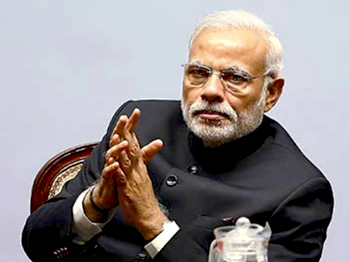
modi"Our army's valour is being discussed across the country these days. We used to hear earlier that Israel has done this. The nation has seen that Indian army is no less than anybody," he said.

Israel is known for its targeted military strikes against enemy countries and militant outfits.

Modi was speaking at a rally in Himachal Pradesh where he inaugurated three hydro-power projects.

The issue of surgical strikes has snowballed into a political row with the opposition accusing the BJP and its government of "milking" it for political benefits. The charge has been rejected by BJP which has insisted that it is taking the issue to the masses to boost the army's morale and highlight the strong political will of the Prime Minister.

Underscoring his commitment to the welfare of armed forces, Modi today said his government had fulfilled its promise of 'One-Rank, One-Pension' for ex-servicemen, an issue which he said had been hanging fire for over 40 years.

Previous governments, he said, duped the people by making tall claims and some of them even allocated Rs 200 crore-500 crore in this regard but never did an analysis of cost burden and how it could be executed.

"I did it and was puzzled to find that the economic burden kept rising. It worked to be more than Rs 10,000 crore," he said, adding that it was difficult for any government to make such a big allocation in one go.

Modi said he spoke to armed forces and offered to release the money in four installments to which they agreed.

"Over Rs 5,500 crore in first installment has been given. The rest will be to. A promise hanging fire for the last 40 years has been fulfilled," he said.

At the 'Parivartan Rally', Modi also targeted Virbhadra Singh, the Chief Minister of Himachal Pradesh where elections are due late next year, saying BJP chief ministers dedicated themselves to causes like drinking water and roads while the Congress leader was concerned about his own welfare.

"Do I need to explain what the current chief minister is known for?" he said and then added, "When BJP gave chief ministers, somebody dedicated himself to water, somebody to roads but when others came they dedicated so many things for their personal welfare," he said.

BJP has accused Singh of being involved in corruption but the Congress leader has rejected the charges and claimed that he was a victim of "political vendetta".

Comments

Naren kotian
 - 
Tuesday, 18 Oct 2016

Pakistani or rashtra drohi spotted. . haha ...why shud we strike china? Nimma maavana mane taraha gadda bitkondiro handicapped 6th century stinky people na China terrorism madsilikke kalihisolla ...we will strike Pakistan like our superb role model Israel. . we love the art of killing used by Israelis ...long live Israel. . we must strike mini Pakistanis also in this sane way ...

Honesty
 - 
Tuesday, 18 Oct 2016

Its been discussed thru modi bhakts and only in the cheddi media...
Please lets do it with CHINA also...

Add new comment

  • Coastaldigest.com reserves the right to delete or block any comments.
  • Coastaldigset.com is not responsible for its readers’ comments.
  • Comments that are abusive, incendiary or irrelevant are strictly prohibited.
  • Please use a genuine email ID and provide your name to avoid reject.
News Network
April 12,2020

Hyderabad, Apr 12: Indicating that prolonged lockdown to contain coronavirus spread may lead to job cuts in the Indian IT industry, NASSCOM former president R Chandrashekhar has said that the work-from-home culture may become a positive development in the long run as it opens up newer avenues and save investments by IT firms.

The former bureaucrat also said startups which are surviving on funds infused by venture capitalists may face tougher situations if the present scenario deteriorates.

"The larger companies may not be actually cutting jobs for two reasons. One is that they do not want to lose their employees and they have money to pay. Many of them ( big companies), even if they do shed some jobs it might be at the most people who are on temporary or intern type and all. But they would not want regular and permanent employees to go. So as long as they have sufficient flexibility in their books, they would continue," said NASSCOM former president.

"But beyond a point that it goes on, for let us say, two months or three months, then even for them, they will feel the pressure. They may not just keep on providing subsidies to the employees. So the key question will be how long that goes on," Chandrasekhar said.

He also said the work-from-home systems being adopted by several firms across the globe, including India, may have a negative impact on the industry in the short-term, but in the long run it would change the work culture which hitherto was not experienced by many of the IT firms in India.

 On impact of the prolonged lockdown on startups, he said it would be a big challenge for the budding enterprises as the investments they get are based on their ideas and future revenues and the present situation under which peoples movement is curbed may shackle their progress.

 "Where will they (startups) get money to pay salaries to their employees. Venture capital investors would not pay the money or invest their money to pay salaries because they are not in the charity business."

If the employees are not paid and if they leave and it is difficult for the startup againto come up. So the whole investment plan goes for a toss, he said.

Former chairman of NASSCOM, B V R Mohan Reddy said a clear picture as to what is going to happen has not yet emerged as the situation with all respects is still evolving. Reddy said there will be a demand shrinkage for the IT industry as the entire world is under stress. "There is no economy in this world that is going to do well in this situation.

So, therefore, there will be a demand shrinkage, he said, indicating tougher times of the industry ahead.

Comments

Add new comment

  • Coastaldigest.com reserves the right to delete or block any comments.
  • Coastaldigset.com is not responsible for its readers’ comments.
  • Comments that are abusive, incendiary or irrelevant are strictly prohibited.
  • Please use a genuine email ID and provide your name to avoid reject.
News Network
May 9,2020

Lucknow, May 9: The first patient to receive plasma therapy as an experimental treatment for coronavirus infection in Uttar Pradesh died following a heart attack on Saturday.

The patient, a 58-year-old doctor, was admitted at the King George’s Medical University (KGMU) here.

The doctor, who was on ventilator since the last 14 days, died on Saturday evening following a heart attack, KGMU Vice-Chancellor M L B Bhatt said.

Since he had high blood pressure and diabetes, he was under the continuous observation of doctors in the isolation ward, Bhatt said.

“The patient was in a stable condition. His lungs had improved, but he later developed urinary tract infection. Two reports of his samples came out as negative (for COVID-19) today,” the vice-chancellor said.

“He, however, suffered a heart attack around 5 pm. Despite all efforts, he could not be saved,” he said.

The doctor from Orai in Uttar Pradesh was administered plasma therapy at the state-run KGMU on April 26. He was administered the plasma donated by a doctor from Canada who was the first COVID-19 patient admitted at the hospital and later recovered.

Tulika Chandra of Blood Transfusion Department, KGMU said, "When the patient was given plasma therapy, his condition was very bad. His lungs, however, improved. But as he was an old patient with diabetes, he was kept on the ventilator.”

Convalescent Plasma Therapy is an experimental procedure for treating COVID-19 patients. In this treatment, plasma, a blood component, from a cured patient is transfused to a critically ill coronavirus patient.

The blood of a person who has recovered from COVID-19 develops antibodies to fight the virus. This therapy uses the antibodies from the blood of a cured patient to treat another critical patient.

The Union health ministry, however, had advised against considering the therapy to be a regular treatment for coronavirus, adding it should be used for research and trial purposes till there is a piece of robust scientific evidence to support its efficacy.

Comments

Add new comment

  • Coastaldigest.com reserves the right to delete or block any comments.
  • Coastaldigset.com is not responsible for its readers’ comments.
  • Comments that are abusive, incendiary or irrelevant are strictly prohibited.
  • Please use a genuine email ID and provide your name to avoid reject.
Agencies
July 30,2020

New Delhi, Jul 30: Even as COVID-19 cases continue to surge in various parts of India, more than 1 million people have recovered and discharged till now, informed Rajesh Bhushan, Secretary, Ministry of Health, here on Thursday.

"More than 1 million people have recovered from COVID-19 in the country. This landmark recovery has been achieved because of the selfless work and dedication of our doctors, nurses and frontline workers," Bhushan said at a press conference.

Giving the number of cured persons, Bhushan said, "More than 1,020,000 patients have recovered. They have been discharged. It is a great achievement."

He said, "The recovery rate has shown positive trends. It was 7.85 per cent in April and today it is 64.4 per cent, which is another heartening news which tells us that whatever battle is put by the Union government in collaboration with state governments is showing results."

"Sixteen states of the country have a recovery rate that is more than the national average. Of these, Delhi has a recovery rate of 88 per cent, Ladakh 80 per cent, Haryana 78 per cent, Assam 76 per cent, Telangana 74 per cent, Tamil Nadu & Gujarat 73 per cent, Rajasthan 70 per cent, Madhya Pradesh 69 per cent and Goa 68 per cent," Bhushan said.

He said effective clinical management lead to a decrease in case fatality rate. In June it was 3.33 per cent and now 2.21 per cent.

Bhushan said the case fatality rate in India today is 2.21 per cent and it's among the lowest in the world. Twenty-four states and Union Territories have lesser fatality rate than that of the country.

Herd immunity in a country of the size and population of India can not be a strategic option. It can only be achieved through immunisation.

"Over 18,190,000 tests have been conducted in the country including RT-PCR and rapid antigen tests. There has been a week-on-week increase in average tests per day. India is conducting 324 test per 10 lakhs population per day," Bhushan said.

He added, three vaccine candidates, are in phase 3 clinical trial. These three are in the US, UK and China. In India, two indigenously developed vaccine candidates are in phase I and II of clinical trials. 

Trial of the first vaccine involves 1,150 subjects at eight sites, second on 1,000 subjects at five sites.

Comments

Add new comment

  • Coastaldigest.com reserves the right to delete or block any comments.
  • Coastaldigset.com is not responsible for its readers’ comments.
  • Comments that are abusive, incendiary or irrelevant are strictly prohibited.
  • Please use a genuine email ID and provide your name to avoid reject.