



Now, PM Modi likens army's surgical strike to Israel's exploits

October 18, 2016

Mandi, Oct 18: Prime Minister Narendra Modi today likened the army's anti-terror surgical strikes to Israel's exploits and said the Indian forces have shown they are no less than anybody.
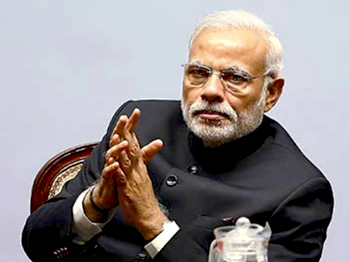
modi"Our army's valour is being discussed across the country these days. We used to hear earlier that Israel has done this. The nation has seen that Indian army is no less than anybody," he said.

Israel is known for its targeted military strikes against enemy countries and militant outfits.

Modi was speaking at a rally in Himachal Pradesh where he inaugurated three hydro-power projects.

The issue of surgical strikes has snowballed into a political row with the opposition accusing the BJP and its government of "milking" it for political benefits. The charge has been rejected by BJP which has insisted that it is taking the issue to the masses to boost the army's morale and highlight the strong political will of the Prime Minister.

Underscoring his commitment to the welfare of armed forces, Modi today said his government had fulfilled its promise of 'One-Rank, One-Pension' for ex-servicemen, an issue which he said had been hanging fire for over 40 years.

Previous governments, he said, duped the people by making tall claims and some of them even allocated Rs 200 crore-500 crore in this regard but never did an analysis of cost burden and how it could be executed.

"I did it and was puzzled to find that the economic burden kept rising. It worked to be more than Rs 10,000 crore," he said, adding that it was difficult for any government to make such a big allocation in one go.

Modi said he spoke to armed forces and offered to release the money in four installments to which they agreed.

"Over Rs 5,500 crore in first installment has been given. The rest will be to. A promise hanging fire for the last 40 years has been fulfilled," he said.

At the 'Parivartan Rally', Modi also targeted Virbhadra Singh, the Chief Minister of Himachal Pradesh where elections are due late next year, saying BJP chief ministers dedicated themselves to causes like drinking water and roads while the Congress leader was concerned about his own welfare.

"Do I need to explain what the current chief minister is known for?" he said and then added, "When BJP gave chief ministers, somebody dedicated himself to water, somebody to roads but when others came they dedicated so many things for their personal welfare," he said.

BJP has accused Singh of being involved in corruption but the Congress leader has rejected the charges and claimed that he was a victim of "political vendetta".

Comments

Naren kotian
 - 
Tuesday, 18 Oct 2016

Pakistani or rashtra drohi spotted. . haha ...why shud we strike china? Nimma maavana mane taraha gadda bitkondiro handicapped 6th century stinky people na China terrorism madsilikke kalihisolla ...we will strike Pakistan like our superb role model Israel. . we love the art of killing used by Israelis ...long live Israel. . we must strike mini Pakistanis also in this sane way ...

Honesty
 - 
Tuesday, 18 Oct 2016

Its been discussed thru modi bhakts and only in the cheddi media...
Please lets do it with CHINA also...

Add new comment

  • Coastaldigest.com reserves the right to delete or block any comments.
  • Coastaldigset.com is not responsible for its readers’ comments.
  • Comments that are abusive, incendiary or irrelevant are strictly prohibited.
  • Please use a genuine email ID and provide your name to avoid reject.
News Network
January 13,2020

Jan 13: For the first time in years, the government of India’s Prime Minister Narendra Modi is playing defense. Protests have sprung up across the country against an amendment to India’s laws — which came into effect on Friday — that makes it easier for members of some religions to become citizens of India. The government claims this is simply an attempt to protect religious minorities in the Muslim-majority countries that border India; but protesters see it as the first step toward a formal repudiation of India’s constitutionally guaranteed secularism — and one that must be resisted.

Modi was re-elected prime minister last year with an enhanced majority; his hold over the country’s politics is absolute. The formal opposition is weak, discredited and disorganized. Yet, somehow, the anti-Citizenship Act protests have taken hold. No political party is behind them; they are generally arranged by student unions, neighborhood associations and the like.

Yet this aspect of their character is precisely what will worry Modi and his right-hand man, Home Minister Amit Shah. They know how to mock and delegitimize opposition parties with ruthless efficiency. Yet creating a narrative that paints large, flag-waving crowds as traitors is not quite that easy.

For that is how these protests look: large groups of young people, many carrying witty signs and the national flag. They meet and read the preamble to India’s Constitution, into which the promise of secularism was written in the 1970’s.

They carry photographs of the Constitution’s drafter, the Columbia University-trained economist and lawyer B. R. Ambedkar. These are not the mobs the government wanted. They hoped for angry Muslims rampaging through the streets of India’s cities, whom they could point to and say: “See? We must protect you from them.” But, in spite of sometimes brutal repression, the protests have largely been nonviolent.

One, in Shaheen Bagh in a Muslim-dominated sector of New Delhi, began simply as a set of local women in a square, armed with hot tea and blankets against the chill Delhi winter. It has now become the focal point of a very different sort of resistance than what the government expected. Nothing could cure the delusions of India’s Hindu middle class, trained to see India’s Muslims as dangerous threats, as effectively as a group of otherwise clearly apolitical women sipping sweet tea and sharing their fears and food with anyone who will listen.

Modi was re-elected less than a year ago; what could have changed in India since then? Not much, I suspect, in most places that voted for him and his party — particularly the vast rural hinterland of northern India. But urban India was also possibly never quite as content as electoral results suggested. India’s growth dipped below 5% in recent quarters; demand has crashed, and uncertainty about the future is widespread. Worse, the government’s response to the protests was clearly ill-judged. University campuses were attacked, in one case by the police and later by masked men almost certainly connected to the ruling party.

Protesters were harassed and detained with little cause. The courts seemed uninterested. And, slowly, anger began to grow on social media — not just on Twitter, but also on Instagram, previously the preserve of pretty bowls of salad. Instagram is the one social medium over which Modi’s party does not have a stranglehold; and it is where these protests, with their photogenic signs and flags, have found a natural home. As a result, people across urban India who would never previously have gone to a demonstration or a political rally have been slowly politicized.

India is, in fact, becoming more like a normal democracy. “Normal,” that is, for the 2020’s. Liberal democracies across the world are politically divided, often between more liberal urban centers and coasts, and angrier, “left-behind” hinterlands. Modi’s political secret was that he was that rare populist who could unite both the hopeful cities and the resentful countryside. Yet this once magic formula seems to have become ineffective. Five of India’s six largest cities are not ruled by Modi’s Bharatiya Janata Party in any case — the financial hub of Mumbai changed hands recently. The BJP has set its sights on winning state elections in Delhi in a few weeks. Which way the capital’s voters will go is uncertain. But that itself is revealing — last year, Modi swept all seven parliamentary seats in Delhi.

In the end, the Citizenship Amendment Act is now law, the BJP might manage to win Delhi, and the protests might die down as the days get unmanageably hot and state repression increases. But urban India has put Modi on notice. His days of being India’s unifier are over: From now on, like all the other populists, he will have to keep one eye on the streets of his country’s cities.

Comments

Add new comment

  • Coastaldigest.com reserves the right to delete or block any comments.
  • Coastaldigset.com is not responsible for its readers’ comments.
  • Comments that are abusive, incendiary or irrelevant are strictly prohibited.
  • Please use a genuine email ID and provide your name to avoid reject.
News Network
February 5,2020

New Delhi, Feb 5: Taking on Delhi Chief Minister Arvind Kejriwal after Shaheen Bagh shooter Kapil Baisala was identified as an AAP worker by police, BJP chief J P Nadda on Tuesday said it exposed the party and Kejriwal who were playing with the country's security.

The Aam Aadmi Party hit back, questioning the police investigation.

In a series of tweets, Nadda said people of the country and Delhi today have seen the "dirty face" of AAP.

"For political longing, Kejriwal and his people even sold the security of the country. Earlier, Kejriwal used to insult the Army and advocate terrorists, but today relations with those who carry out their terrorist activities came to light," he said.

Nadda said he wanted to make it clear to Kejriwal that this country is bigger than any election, any government, and "this nation will not forgive those who play with its security. Kejriwal and his entire team have been exposed. The people of Delhi will give a befitting reply".

He claimed the entire country has seen "photos of Imam Hussain, the MLA and former minister of the Delhi government, with a radical terrorist organisation, PFI".

Days before Delhi goes to polls, police claimed that Baisala is a member of the Aam Aadmi Party. They said Baisala joined the party in early 2019 along with his father.

Police said it had photos of Baisala purportedly joining AAP along with his father Gaje Singh last year.

AAP's Rajya Sabha MP Sanjay Singh alleged that photos which were part of investigation were leaked to the BJP. He also said the party will approach the Election Commission to raise this issue, which has cropped up four days before the polling date.

"On whose instance, the police is giving statement? How did the photos which were part of the investigation reach the BJP? Before the news came out, Manoj Tiwari in the morning stated that the accused was from AAP. How did Manoj Tiwari get this news," Singh questioned in a press conference.

Union minister and BJP's in-charge for the Delhi polls, Prakash Javadekar, in a press conference alleged that "their (AAP's) designs are very clear from the beginning and they are trying every trick".

The whole conspiracy of AAP is to "divide society, cause fear in a community and create a vote bank," he charged.

Javadekar also claimed that photos of Baisala were recovered by police from his mobile phone although they were erased.

He also claimed that Baisala and his father were welcomed by Sanjay Singh at their joining of AAP.

"This proves AAP misleads youth and pushes them on the wrong path. AAP's strategy is to divide two communities, they want to instigate riots in Delhi," Javadekar alleged.

He further alleged that AAP leader Sanjay Singh had said violence would take place in Delhi. Their "conspiracy has been exposed by Delhi Police," he claimed.

"We condemn this politics of AAP," he said.

Javadekar also claimed this was "not an isolated incident" as AAP member Amanatullah Khan made a "very provocative speech" and the party supported Shaheen Bagh and did not give permission for the prosecution of members of the "tukde-tukde gang".

He hinted the BJP could approach the Election Commission against AAP over the issue.

Comments

Add new comment

  • Coastaldigest.com reserves the right to delete or block any comments.
  • Coastaldigset.com is not responsible for its readers’ comments.
  • Comments that are abusive, incendiary or irrelevant are strictly prohibited.
  • Please use a genuine email ID and provide your name to avoid reject.
News Network
June 23,2020

New Delhi, Jun 23: The Delhi High Court Tuesday granted bail to Jamia student Safoora Zargar, who is pregnant and was arrested under anti-terror law UAPA in a case related to communal violence in northeast Delhi during protests against the Citizenship Amendment Act, as Solicitor General Tushar Mehta did not oppose it on humanitarian grounds.

At the outset of the hearing, Mehta, representing Delhi Police, submitted that Zargar can be released on regular bail on humanitarian grounds and the decision has not been taken on merits of the case and should not be made a precedent.

Justice Rajiv Shakdher, who conducted the hearing through video conferencing, released Zargar, who is 23-week pregnant, on bail on furnishing a personal bond of Rs 10,000 and surety of like amount.

The court said she shall not indulge in any activity for which she has been charged with and shall not hamper the investigation or influence the witnesses.

Comments

Add new comment

  • Coastaldigest.com reserves the right to delete or block any comments.
  • Coastaldigset.com is not responsible for its readers’ comments.
  • Comments that are abusive, incendiary or irrelevant are strictly prohibited.
  • Please use a genuine email ID and provide your name to avoid reject.