


Now, PM Modi likens army's surgical strike to Israel's exploits

October 18, 2016

Mandi, Oct 18: Prime Minister Narendra Modi today likened the army's anti-terror surgical strikes to Israel's exploits and said the Indian forces have shown they are no less than anybody.
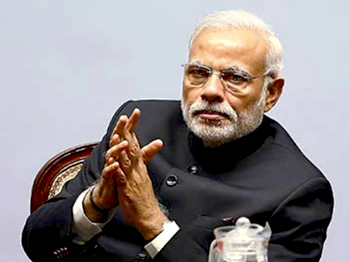
modi"Our army's valour is being discussed across the country these days. We used to hear earlier that Israel has done this. The nation has seen that Indian army is no less than anybody," he said.

Israel is known for its targeted military strikes against enemy countries and militant outfits.

Modi was speaking at a rally in Himachal Pradesh where he inaugurated three hydro-power projects.

The issue of surgical strikes has snowballed into a political row with the opposition accusing the BJP and its government of "milking" it for political benefits. The charge has been rejected by BJP which has insisted that it is taking the issue to the masses to boost the army's morale and highlight the strong political will of the Prime Minister.

Underscoring his commitment to the welfare of armed forces, Modi today said his government had fulfilled its promise of 'One-Rank, One-Pension' for ex-servicemen, an issue which he said had been hanging fire for over 40 years.

Previous governments, he said, duped the people by making tall claims and some of them even allocated Rs 200 crore-500 crore in this regard but never did an analysis of cost burden and how it could be executed.

"I did it and was puzzled to find that the economic burden kept rising. It worked to be more than Rs 10,000 crore," he said, adding that it was difficult for any government to make such a big allocation in one go.

Modi said he spoke to armed forces and offered to release the money in four installments to which they agreed.

"Over Rs 5,500 crore in first installment has been given. The rest will be to. A promise hanging fire for the last 40 years has been fulfilled," he said.

At the 'Parivartan Rally', Modi also targeted Virbhadra Singh, the Chief Minister of Himachal Pradesh where elections are due late next year, saying BJP chief ministers dedicated themselves to causes like drinking water and roads while the Congress leader was concerned about his own welfare.

"Do I need to explain what the current chief minister is known for?" he said and then added, "When BJP gave chief ministers, somebody dedicated himself to water, somebody to roads but when others came they dedicated so many things for their personal welfare," he said.

BJP has accused Singh of being involved in corruption but the Congress leader has rejected the charges and claimed that he was a victim of "political vendetta".

Comments

Naren kotian
 - 
Tuesday, 18 Oct 2016

Pakistani or rashtra drohi spotted. . haha ...why shud we strike china? Nimma maavana mane taraha gadda bitkondiro handicapped 6th century stinky people na China terrorism madsilikke kalihisolla ...we will strike Pakistan like our superb role model Israel. . we love the art of killing used by Israelis ...long live Israel. . we must strike mini Pakistanis also in this sane way ...

Honesty
 - 
Tuesday, 18 Oct 2016

Its been discussed thru modi bhakts and only in the cheddi media...
Please lets do it with CHINA also...

Add new comment

  • Coastaldigest.com reserves the right to delete or block any comments.
  • Coastaldigset.com is not responsible for its readers’ comments.
  • Comments that are abusive, incendiary or irrelevant are strictly prohibited.
  • Please use a genuine email ID and provide your name to avoid reject.
News Network
July 18,2020

New Delhi, Jul 18: The Covid-19 lockdown-led reduction in air pollution levels across five Indian cities, including Delhi and Mumbai, may have prevented about 630 premature deaths, and saved USD 690 million in health costs in the country, according to a new study.

Scientists, including those from the University of Surrey in the UK, assessed the levels of harmful fine particulate matter (PM2.5) from vehicles and other sources in five Indian cities -- Delhi, Mumbai, Kolkata, Chennai and Hyderabad -- since the beginning of the lockdown period.

The study, published in the journal Sustainable Cities and Society, compared these lockdown PM2.5 figures from 25 March up until 11 May, with those from similar periods of the preceding five years, and found that the measure reduced pollution levels in all these places.

According to the scientists, during this period, the levels of these harmful air pollutants reduced by 10 per cent in Mumbai, and by up to 54 per cent in Delhi.

"The percentage reduction for the other cities ranged from 24 to 32 per cent, which was slightly smaller than the measured values for Delhi and Mumbai," the scientists noted in the study.

"While the reduction in PM2.5 pollution may not be surprising, the size of the reduction should make us all take notice of the impact we have been having on the planet," said Prashant Kumar, a co-author of the study from the University of Surrey.

The scientists said these reductions in PM2.5 were comparable to those reported in other cities across the world, such as in Austria's capital Vienna (60 per cent), and Shanghai (42 per cent) in China.

They also calculated the monetary value of the reduced mortality due to air pollution and found that the lowered levels of PM2.5 may have saved 630 people from premature death, and USD 690 million in health costs in India.

Coronavirus India update: State-wise total number of confirmed cases, deaths on July 17

According to the researchers, the present lockdown situation offers observational opportunities regarding potential control systems and regulations for improved urban air quality.

They said an integrated approach might help in understanding the overall impacts of Covid-19 lockdown-style interventions and support the implementation of relevant policy frameworks.

"This is an opportunity for us all to discuss and debate what the 'new normal' should look like - particularly when it comes to the quality of the air we breathe," Kumar said.

Comments

Add new comment

  • Coastaldigest.com reserves the right to delete or block any comments.
  • Coastaldigset.com is not responsible for its readers’ comments.
  • Comments that are abusive, incendiary or irrelevant are strictly prohibited.
  • Please use a genuine email ID and provide your name to avoid reject.
News Network
April 8,2020

New Delhi, Apr 8: The Supreme Court on Wednesday suggested that all tests to identify coronavirus positive patients should be conducted free of cost and asked the Central government to look into creating a mechanism for providing reimbursement for the same.

A bench headed by Justice Ashok Bhushan, while hearing a PIL via video-conferencing, suggested that the test should be conducted free of cost in the identified private laboratories and said that the court will pass appropriate order on the matter.

The apex court was hearing a PIL filed by lawyer and petitioner Shashank Deo Sudhi seeking direction to the Centre and other respective authorities to provide free of cost the testing facility for COVID-19 to all citizens in the country.

Solicitor General Tushar Mehta submitted that 118 laboratories were doing 15,000 test capacity per day and added that 47 private laboratory chains have also been involved for the same.

During the hearing, the court asked the Centre to ensure private labs don't charge a high amount for the test and suggested that the government can create an effective mechanism for reimbursement from the government for tests.

Mehta said that they will look into the suggestion and will try to devise what can be done best.

Sudhi, on the other hand, submitted that testing of coronavirus is very expensive and therefore the Central government should take all necessary steps to provide free of cost the testing facility for COVID-19 kits and others to all citizens in the country.

Comments

Add new comment

  • Coastaldigest.com reserves the right to delete or block any comments.
  • Coastaldigset.com is not responsible for its readers’ comments.
  • Comments that are abusive, incendiary or irrelevant are strictly prohibited.
  • Please use a genuine email ID and provide your name to avoid reject.
News Network
February 9,2020

Mumbai, Feb 9: Given the slow progress on the ongoing Rs 38,000-crore capacity expansion at the four largest metro airports, and also the surging traffic, the snaky queues will continue at least till 2023, warns a report.

The four largest airports -- New Delhi, Mumbai, Bengaluru and Hyderabad -- handle more than half of the traffic and are operating at 130 per cent of their installed capacity. These airports are under a record Rs 38,000-crore capex but the capacity will not come up before end-2023, says a Crisil report.

“With the dip in traffic growth largely behind, we expect congestion at the top four airports of New Delhi, Mumbai, Bengaluru and Hyderabad, which handle more than half of the load, to continue till about FY23,” says the report.

Already these airports are operating at over 130 percent of installed capacity, and the ongoing healthy traffic growth this operating rate is expected to rise further in the next 12 months.

“Operationalising of capacities in the following two fiscals will bring down utilisation levels albeit still high at over 90 per cent by fiscal 2023 and that is despite an unprecedented Rs 38,000 crore capex being undertaken by the operators of these airports over five fiscals 2020-24,” says the report.

Despite this unprecedented capex that is debt-funded, ratings are likely to be stable given the strong cash flows expected due to healthy traffic growth, low project risks associated with the capex and improving regulatory environment, notes the report.

“Capacity at these four airports will increase a cumulative 65 per cent to 228 million annually (from 138 million now) by fiscal 2023. However, traffic is expected to grow strong at up to 10 per cent per annum over the same period. Since additional capacities will become operational in phases only by fiscal 2023, high passenger growth will add to congestion till then,” warn the report.

High utilisation will ride on pent-up demand (accumulated in 2019 as traffic was impacted with the grounding of Jet Airways) and one-off issues with new aircraft of certain airlines.

Further impetus will also come from improving connectivity to lower-tier cities and reducing fare difference between air and rail. Increasing footfalls at airports provide a leg-up to non-aero streams such as advertising, rentals, food and beverage and parking, which comprise around half of the revenue of airports already.

These are expected to grow strongly at over 10-12 per cent, also supported by higher monetisation avenue coming along with current capex. The other half of revenue (aero revenue) is an entitlement approved by the regulator, providing a pre-determined, fixed return over the asset base and a pass-through of costs.

Aero revenue is also expected to get a bump up during fiscals 2022-24, when a new tariff order for airports is likely. Overall aggregate cash flows are likely to double by fiscal 2024 and provide a healthy cushion against servicing of debt contracted for capex, the report concludes.

Comments

Add new comment

  • Coastaldigest.com reserves the right to delete or block any comments.
  • Coastaldigset.com is not responsible for its readers’ comments.
  • Comments that are abusive, incendiary or irrelevant are strictly prohibited.
  • Please use a genuine email ID and provide your name to avoid reject.