


Now, PM Modi likens army's surgical strike to Israel's exploits

October 18, 2016

Mandi, Oct 18: Prime Minister Narendra Modi today likened the army's anti-terror surgical strikes to Israel's exploits and said the Indian forces have shown they are no less than anybody.
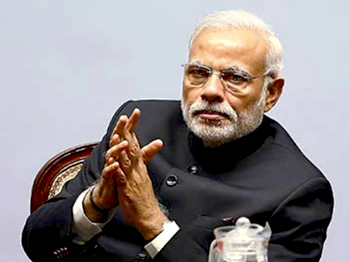
modi"Our army's valour is being discussed across the country these days. We used to hear earlier that Israel has done this. The nation has seen that Indian army is no less than anybody," he said.

Israel is known for its targeted military strikes against enemy countries and militant outfits.

Modi was speaking at a rally in Himachal Pradesh where he inaugurated three hydro-power projects.

The issue of surgical strikes has snowballed into a political row with the opposition accusing the BJP and its government of "milking" it for political benefits. The charge has been rejected by BJP which has insisted that it is taking the issue to the masses to boost the army's morale and highlight the strong political will of the Prime Minister.

Underscoring his commitment to the welfare of armed forces, Modi today said his government had fulfilled its promise of 'One-Rank, One-Pension' for ex-servicemen, an issue which he said had been hanging fire for over 40 years.

Previous governments, he said, duped the people by making tall claims and some of them even allocated Rs 200 crore-500 crore in this regard but never did an analysis of cost burden and how it could be executed.

"I did it and was puzzled to find that the economic burden kept rising. It worked to be more than Rs 10,000 crore," he said, adding that it was difficult for any government to make such a big allocation in one go.

Modi said he spoke to armed forces and offered to release the money in four installments to which they agreed.

"Over Rs 5,500 crore in first installment has been given. The rest will be to. A promise hanging fire for the last 40 years has been fulfilled," he said.

At the 'Parivartan Rally', Modi also targeted Virbhadra Singh, the Chief Minister of Himachal Pradesh where elections are due late next year, saying BJP chief ministers dedicated themselves to causes like drinking water and roads while the Congress leader was concerned about his own welfare.

"Do I need to explain what the current chief minister is known for?" he said and then added, "When BJP gave chief ministers, somebody dedicated himself to water, somebody to roads but when others came they dedicated so many things for their personal welfare," he said.

BJP has accused Singh of being involved in corruption but the Congress leader has rejected the charges and claimed that he was a victim of "political vendetta".

Comments

Naren kotian
 - 
Tuesday, 18 Oct 2016

Pakistani or rashtra drohi spotted. . haha ...why shud we strike china? Nimma maavana mane taraha gadda bitkondiro handicapped 6th century stinky people na China terrorism madsilikke kalihisolla ...we will strike Pakistan like our superb role model Israel. . we love the art of killing used by Israelis ...long live Israel. . we must strike mini Pakistanis also in this sane way ...

Honesty
 - 
Tuesday, 18 Oct 2016

Its been discussed thru modi bhakts and only in the cheddi media...
Please lets do it with CHINA also...

Add new comment

  • Coastaldigest.com reserves the right to delete or block any comments.
  • Coastaldigset.com is not responsible for its readers’ comments.
  • Comments that are abusive, incendiary or irrelevant are strictly prohibited.
  • Please use a genuine email ID and provide your name to avoid reject.
News Network
August 8,2020

The Kozhikode International Airport located at Karipur is not safe for the landing of flights in rainy season, according to an air-safety expert, who had warned the aviation ministry and the civil aviation regulator about this in 2011. 

The warning was particularly about the dangers of permitting passenger aircraft to land on runway 10 of the airport during rains and unfavourable wind conditions. 

Nine years later, on August 7, 2020, the warning became a reality when an Air India Express pilots landed in tailwind conditions and the aircraft overshot the tabletop runway to drop off the end and crash.

 “An aircraft landing on runway 10 in tailwind will experience poor braking action due to heavy rubber deposits … All such flights … are endangering the lives of all on board,’’ said Capt Mohan Ranganathan, in a letter sent on June 17, 2011 to then director general of civil aviation Bharat Bhushan and Nasim Zaidi, chairman of a civil aviation safety advisory committee, which was formed after the May 2010 Mangaluru air crash which killed 158 people.

“My warning issued after the Mangaluru crash was ignored. It is a table-top runway with a down slope. The buffer zone at the end of the runway is inadequate,” Capt Ranganathan said. Given the topography, he pointed out, the airport should have a buffer of 240m at the end of the runway, but it only has 90m (which the DGCA had approved). “Moreover, the space on either side of the runway is only 75m instead of the mandatory 100m,” he added.

Capt Ranganathan said there is no guideline for operations on a table-top runway when it is raining. “Runway 10 approach should not be permitted in view of the lack of runway end safety area (RESA) and the terrain beyond the end of the runway. RESA of 240m should be immediately introduced and runway length has to be reduced to make the operations safe,” his letter said.

If an aircraft is unable to stop within the runway, there is no RESA beyond the end. The ILS localiser antenna is housed on a concrete structure and the area beyond is a steep slope. “The Air India Express accident in Mangalore should have alerted AAI to make the runway conditions safe. We have brought up the issue of RESA during the initial Casac-sub group meetings. We had specifically mentioned that the declared distances for both runways have to be reduced in order to comply with ICAO Annex 14 requirement,” Capt Ranganathan said.

He said the condition of the runway strip was known to DGCA teams that have been conducting inspection and safety assessments. “Have they considered the danger involved? Did the DGCA or the airlines lay down any operational restrictions or special procedures?”

The letter also refers to Approach and Landing Accident Reduction (ALAR) training, which is supposed to be mandatory before every monsoon, but airlines don’t follow it, he said. “70% of accidents take place during approach and landing and that is why this training is essential,” he added.

stm88 info live rtp slot

slot auto scatter hitam

Comments

Add new comment

  • Coastaldigest.com reserves the right to delete or block any comments.
  • Coastaldigset.com is not responsible for its readers’ comments.
  • Comments that are abusive, incendiary or irrelevant are strictly prohibited.
  • Please use a genuine email ID and provide your name to avoid reject.
News Network
January 1,2020

Jan 1: The ban on the practice of instant triple talaq, making it a penal offence and the increase in the strength of Supreme Court judges were two of the major achievements of the law ministry in 2019.

In July, Parliament gave its nod to The Muslim Women (Protection of Rights on Marriage) Bill, 2019. The new law makes talaq-e-biddat or any other similar form of talaq having the effect of instantaneous and irrevocable divorce pronounced by a Muslim husband void and illegal.

It makes it illegal to pronounce talaq three times in spoken, written or through SMS or WhatsApp or any other electronic chat in one sitting.

According to the new law, any Muslim who pronounces the illegal form of talaq upon his wife shall be punished with imprisonment for a term which may extend to three years, and shall also be liable to fine.

During the year, four new judges were appointed to the Supreme Court in September, taking its strength to 34, the highest-ever.

However, vacancies in high courts and lower courts are on the rise and convincing state governments and the 25 high courts to come on board to create an all-India judicial service to recruit judges for the subordinate courts tops the agenda of the Law Ministry in 2020.

Besides creating a consensus on setting up the All-India Judicial Services, the ministry will also have to focus on filling up vacancies in the high court. On an average, the vacancies stood at 400 throughout this year.

With more than 5,000 positions of judicial officers in district and subordinate courts lying vacant, the Law Ministry has pitched for setting up all-India judicial services.

The sanctioned strength of the judicial officers in district and subordinate courts was 22,644. The number of judicial officers in position and vacant posts is 17,509 and 5,135, respectively.

The government has proposed that while states and high courts can recruit judicial officers, the Union Public Service Commission (UPSC) can hold pan-India entrance tests.

The ministry has made it clear that such services would not encroach on the powers of the states.

As of now, the selection and appointment of judges in subordinate courts is the responsibility of the high courts and state governments concerned.

The Narendra Modi government has given a fresh push to the long-pending proposal to set up the new service to have a separate cadre for the lower judiciary in the country.

But there is a divergence of opinion among state governments and respective high courts on the constitution of the All India Judicial Service (AIJS).

One of the problems cited is that since several states have used powers under Code of Criminal Procedure (CrPC) and Code of Civil Procedure (CPC) to declare that the local language would be used in lower courts even for writing orders, a person say selected from Tamil Nadu may find it difficult to hold proceedings in states like Uttar Pradesh and Bihar.

The other point of opposition is that an all India service may hamper the career progression of state judicial services officers.

Another key issue the ministry has to handle in 2020 is vacancies in the 25 high courts.

Throughout 2019, on an average, the high courts faced a shortage of 400 judges.

According to Law Ministry data, as on September 1, the high courts had 414 vacant positions as compared to the sanctioned strength of 1,079 judges. The figure was 409 in August and 403 in July, as per the data.

A three-member Supreme Court collegium recommends the names of candidates for appointment as high court judges. In case of appointments to the Supreme Court, the collegium consists of five top judges of the top court.

High court collegiums shortlist candidates for their respective high courts and send the names to the law ministry.

The ministry, along with background check reports by the Intelligence Bureau, forwards it to the Supreme Court collegium for a final call.

The government has maintained that appointment of judges in the high courts is a "continuous collaborative process" between the Executive and the Judiciary, as it requires consultation and approval from various Constitutional authorities.

Vacancies keep arising on account of retirement, resignation or elevation of judges and increase in judges' strength. In June last year, the vacancy position stood at 399, while it was 396 in May.

In April, 399 posts of judges were vacant, while the figure was 394 in March. The vacancy position in February stood at 400 and in January, it was 392, according to the data collated by the Department of Justice.

Over 43 lakh cases are pending in the 25 high courts.

Another priority would be the finalisation of the memorandum of the procedure to guide the appointment and transfer of the Supreme Court and high court judges. The issue had now been pending for over two years now with the SC collegium and the government failing to reach a consensus.

Successive governments have also been working on making India a hub of international arbitration. It has taken several steps to change laws dealing with commercial disputes.

Comments

Add new comment

  • Coastaldigest.com reserves the right to delete or block any comments.
  • Coastaldigset.com is not responsible for its readers’ comments.
  • Comments that are abusive, incendiary or irrelevant are strictly prohibited.
  • Please use a genuine email ID and provide your name to avoid reject.
News Network
June 19,2020

New Delhi, Jun 19: Petrol price on Friday was hiked by 56 paise per litre and diesel by 63 paise a litre, taking the cumulative increase in rates to Rs 7.11 and Rs 7.67 per litre respectively in less than two weeks.

Petrol price in Delhi was hiked to Rs 78.37 per litre from Rs 77.81, while diesel rates were increased to Rs 77.06 a litre from Rs 76.43, according to a price notification of state oil marketing companies.

Rates have been increased across the country and vary from state to state depending on the incidence of local sales tax or VAT.

This is the 13th daily increase in rates in a row since oil companies on June 7 restarted revising prices in line with costs, after ending an 82-day hiatus in rate revision.

In 13 hikes, petrol price has gone up by Rs 7.11 per litre and diesel by Rs 7.67 a litre.

The freeze in rates was imposed in mid-March soon after the government hiked excise duty on petrol and diesel to shore up additional finances.

Oil PSUs Indian Oil Corp (IOC), Bharat Petroleum Corp Ltd (BPCL) and Hindustan Petroleum Corp Ltd (HPCL) instead of passing on the excise duty hikes to customers adjusted them against the fall in the retail rates that was warranted because of fall in international oil prices to two decade low.

International oil prices have since rebounded and oil firms are now adjusting retail rates in line with them.

Comments

Add new comment

  • Coastaldigest.com reserves the right to delete or block any comments.
  • Coastaldigset.com is not responsible for its readers’ comments.
  • Comments that are abusive, incendiary or irrelevant are strictly prohibited.
  • Please use a genuine email ID and provide your name to avoid reject.