



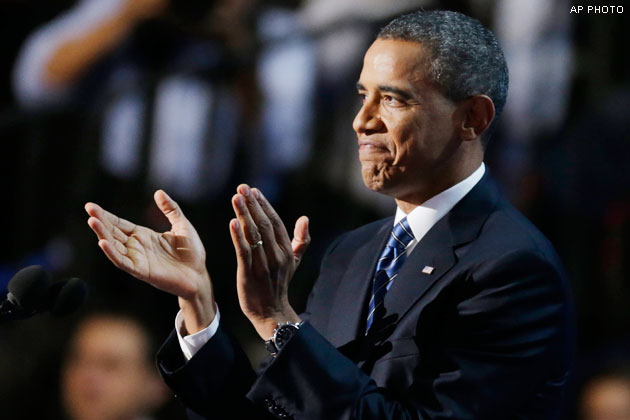
Obama most admired foreign leader in India: Poll

September 12, 2012

Obama_Admired

Washington, September 12: US President Barack Obama is the most admired foreign leader in India and a majority of city dwellers in the country want him re-elected, an opinion poll said on Monday.


"About seven-in-ten city dwellers (71 per cent) who say they are following the US election closely want US president Barack Obama to be re-elected," said Pew Global Research Center, releasing the results of its major opinion poll conducted in India.


The poll also found that Indians have more favorable view of America than other major powers.


A majority of Indians living in cities have a favorable view of the United States (58 per cent), a positive opinion of Americans (57 per cent) and confidence in Obama (60 per cent), it said.


"Such confidence in Obama is one likely reason a majority of city-dwelling Indians (57 per cent) back his international policies, approve his handling of global economic problems and say relations with the US have improved in recent years," it said.


"A majority of urban Indians (56 per cent would also like to see President Obama re-elected. Among those who say they are closely following the election, a 71 per cent-majority wants Obama to have four more years.


"The American president's support in Indian cities is roughly comparable among men and women and people of all ages. His backing is slightly stronger among urbanites with a college education or a higher income," Pew said.


Obama, in fact, is the most admired foreign leader in India.


"Far fewer have confidence in Russian President Vladimir Putin (35 per cent), Chinese President Hu Jintao (22 per cent) and German Chancellor Angela Merkel (20 per cent).


The low ratings of Merkel and Hu, at least, are likely tied to the fact that about half are unfamiliar with either leader," it said.


According to the Pew survey, Indians in cities are also generally supportive of the exercise of US power, both hard and soft. They broadly favour (73 per cent) American-led efforts to fight terrorism and a plurality (48 per cent) backs US drone strikes targeting extremists in countries such as Pakistan, Yemen and Somalia.


Most of them (69 per cent) also admire US scientific and technological advances, with college-educated, urban Indians being particular fans.


Comments

Clifton
 - 
Sunday, 31 Jan 2016

I'm gone to inform my little brother, that he should also pay
a quick visit this weblog on regular basis to take updated from most
up-to-date reports.

Also visit my web page :: ranking suplementów na mase: http://goo.gl/VmAFcx

Add new comment

  • Coastaldigest.com reserves the right to delete or block any comments.
  • Coastaldigset.com is not responsible for its readers’ comments.
  • Comments that are abusive, incendiary or irrelevant are strictly prohibited.
  • Please use a genuine email ID and provide your name to avoid reject.
News Network
May 3,2020

London, May 3: The British government had a contingency plan for prime minister Boris Johnson’s death as his condition deteriorated while he battled COVID-19 last month in intensive care, Johnson said in an interview with The Sun newspaper.

Johnson returned to work on Monday, a month after testing positive for COVID-19. Johnson, 55, spent 10 days in isolation in Downing Street from late March, but was then was taken to London’s St Thomas’ Hospital where he received oxygen treatment and spent three nights in intensive care.

“They had a strategy to deal with a ‘death of Stalin’-type scenario,” Johnson, 55, was quoted as saying by The Sun. “It was a tough old moment, I won’t deny it.”

After Johnson was discharged, St Thomas’ said it was glad to have cared for the prime minister, but the hospital has given no details about the gravity of his illness beyond stating that he was treated in intensive care.

Johnson and his fiancée, Carrie Symonds, on Saturday announced the name of their newly born son as Wilfred Lawrie Nicholas, partly as a tribute to two of the intensive care doctors who they said had saved Johnson’s life.

“The doctors had all sorts of arrangements for what to do if things went badly wrong,” Johnson said of his COVID-19 battle. “The bloody indicators kept going in the wrong direction.”

He said doctors discussed invasive ventilation.

“The bad moment came when it was 50-50 whether they were going to have to put a tube down my windpipe,” he said. “That was when it got a bit . . . they were starting to think about how to handle it presentationally.”

Comments

Add new comment

  • Coastaldigest.com reserves the right to delete or block any comments.
  • Coastaldigset.com is not responsible for its readers’ comments.
  • Comments that are abusive, incendiary or irrelevant are strictly prohibited.
  • Please use a genuine email ID and provide your name to avoid reject.
March 27,2020

London, Mar 27:  British Prime Minister Boris Johnson said Friday he has tested positive for the new coronavirus, but remains in charge of the U.K.'s response to the outbreak.

Johnson's office said he was tested on the advice of the chief medical officer after showing mild symptoms.

It said Johnson is self-isolating at his 10 Downing St. residence and continuing to lead the country's response to COVID-19.

In a video message, Johnson said he had a temperature and a persistent cough.

Over the last 24 hours I have developed mild symptoms and tested positive for coronavirus.

I am now self-isolating, but I will continue to lead the government’s response via video-conference as we fight this virus.

Together we will beat this. #StayHomeSaveLives pic.twitter.com/9Te6aFP0Ri

— Boris Johnson #StayHomeSaveLives (@BorisJohnson) March 27, 2020
"Be in no doubt that I can continue, thanks to the wizardry of modern technology, to communicate with all my top team, to lead the national fightback against coronavirus."

Earlier this week Britain’s Prince Charles announced that he had tested positive for the virus.

Comments

Add new comment

  • Coastaldigest.com reserves the right to delete or block any comments.
  • Coastaldigset.com is not responsible for its readers’ comments.
  • Comments that are abusive, incendiary or irrelevant are strictly prohibited.
  • Please use a genuine email ID and provide your name to avoid reject.
News Network
May 21,2020

Canberra, May 21: Australian Prime Minister Scott Morrison and his Indian counterpart, Narendra Modi, are looking forward to deepening the countries' strategic relationship, with both sides expected to sign a range of pacts from defence to trade in strategic sectors amid heightened tensions with China over Beijing's response to coronavirus pandemic.

During a virtual summit, scheduled to take place on June 4, both leaders are expected to ramp up efforts to diversify Australia's export markets and find trusted suppliers of vital products and components, a local newspaper, The Australian reported on Tuesday.

The new agreements will focus on reliable supply chains in key strategic sectors, including medical goods, technology and critical minerals, amid heightened tensions with China over Beijing's response to coronavirus pandemic.

The leaders will seal a new defence agreement allowing reciprocal access to bases and co-operation on military technology projects, while a new education partnership will be on the table to help overcome Australian university reliance on Chinese students.

The talks in terms of strategic convergence, now have greater significance as COVID-19 exacerbates the strategic contest between the US and China, and forces like-minded countries to seek out reliable partners.

Australian farmers could also benefit, with talks underway on expanding agricultural exports to India, including barley, as China throws up new trade barriers, media reports stated.

The virtual summit follows the cancellation of Morrison's planned state visit to India in January due to the bushfires.

Morrison said last year, ahead of his planned visit, that India was "a natural partner for Australia", referring to the countries' "shared values" -- a point of differentiation with China.

Former Department of Foreign Affairs and Trade secretary Peter Varghese, who wrote a landmark report on the bilateral relationship in 2018, was quoted by the newspaper as saying that India would be even more important to Australia in the post-COVID world. "If one of the lessons from COVID is that countries need to spread their risk, then finding new markets or building up existing markets is a crucial part of that," he added.

Varghese noted that India, a member of the Quadrilateral Security Dialogue along with Australia, Japan and the US, was a vital strategic partner to Australia in helping "constrain China's ambitions to be the predominant power".

"That shared objective between Australia and India of not wanting to see the region dominated by China is a key component of building up our geopolitical relationship," he told The Australian.

The summit also follows recent talks between Australian Foreign Minister Marise Payne and Indian counterpart Subrahmanyam Jaishankar on the pandemic response and Australia's call for an independent inquiry, which was overwhelmingly backed at the World Health Assembly on Tuesday.

Australia wants to support India to develop a domestic critical minerals processing industry, which would provide Western nations with an alternative to sourcing the materials from China.

Meanwhile, India has strong expertise as a manufacturer of drugs and medical equipment, while Australia is a centre of biomedical research, opening the possibility for closer co-operation in the key sector, the media reported further.

Comments

Add new comment

  • Coastaldigest.com reserves the right to delete or block any comments.
  • Coastaldigset.com is not responsible for its readers’ comments.
  • Comments that are abusive, incendiary or irrelevant are strictly prohibited.
  • Please use a genuine email ID and provide your name to avoid reject.