



An ode to M S Subbulakshmi, the nightingale

September 18, 2016

New Delhi, Sep 18: As a child, 'Kunjamma', as M S Subbulakshmi was fondly called, learnt to play veena from her mother and sang in the temples of Madurai but little did she know that one day she would be known as 'the Queen of Carnatic music'.mss
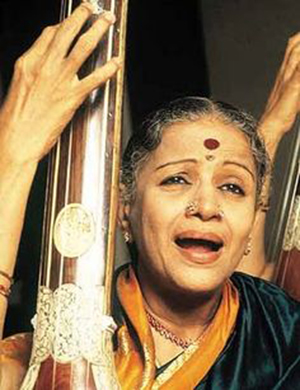
In her book, "Kunjamma-Ode to a Nightingale", renowned Bharatanatyam dancer and choreographer, Lakshmi Vishwanathan captures some of the interesting moments from Subbulakshmi's glorious life to celebrate her birth centenary on September 16.

Vishwanathan, who knew the singer closely, says Subbulakshmi's mastery of classical ragas combined with her unforgettable screen performances made her a rare genius.

"I believe when she sang the angels in heaven seemed to dance, for such was her melodious voice," says the author while comparing Subbulakshmi to iconic opera singer, Maria Callas.

The 130-page book, published by Roli Books, speaks volumes of Subbulakshmi's journey from a little girl who loved singing to the heights of musical glory.

"Although she felt she was interpreting music, her audience felt she was creating it. Herein lay her genius. Many great artists had left their imprint on various songs.

"Subbulakshmi's uniqueness, however, lay in making the audience remember only the way in which she sang these songs," writes the author in her book.

Subbulakshmi wanted to make a name of her own in music since her childhood. She practiced everyday for long hours, strictly abiding by the rules of Carnatic music.

"... she began singing at temples and marriages but her recitals were so impressive that her reputation began to grow. The Gramophone Company of India invited her regularly to Madras to record albums," says the artist.

The singer's recording of Tyagaraja's song 'Evarimata' in Raga 'Kambodhi' became a hit with record sales and earned her the title Evarimata M S Subbulakshmi. The big break in Subbulakshmi's life came after she was invited to sing in Bombay as part of a festival.

She had to almost cancel the event since the violinist who was to accompany her declined at the last minute. But Subbulakshmi's destiny seemed to be in the city.

"The concert was re-scheduled and since all other artists left for Bombay someone would be required to escort her. A young man who loved music volunteered in spite of having a severe toothache at that time. He was a go-getter who would be useful in Bombay. He was tall and handsome T Sadasivam."

Smitten by her voice, Sadasivam decided to marry her. "The only way he could devote all his energy to this task was by marrying her. In a simple and a private ceremony they were married at the temple of Thiruneermalai, an ancient hill shrine on the outskirts of Madras," writes the author.

Sadasivam didn't want Subbulaskhmi's music to be restrained to concerts and recordings. He had the dream of taking it to the common man. And nothing could be better than the cinema.

Subbulakshmi acted in film 'Meera' at the behest of her husband and became the incarnation of the people's vision overnight.

"He was of the opinion that if Subbulakshmi wants to act in a film it could not be a mere entertainer. It would need to carry a universal message for the masses. After much deliberations she chose herself the story of Meera," Vishwanathan writes.

The fifties and sixties which marked the peak of Subbulakshmi's career and status made her the ultimate diva of Carnatic music. Subbulakshmi learnt bhajans and devotional songs from a host of masters like Dilip Kumar Roy and Srinivasan Rao Vyas.

The book speaks specifically of her immortal bhajans, sung in virtually every Indian language with singular devotion.

"Her immortal bhajans and her devotion won a place for herself in the hearts of the people- the final destination that fate had ordained for her," reads the book.

Comments

Add new comment

  • Coastaldigest.com reserves the right to delete or block any comments.
  • Coastaldigset.com is not responsible for its readers’ comments.
  • Comments that are abusive, incendiary or irrelevant are strictly prohibited.
  • Please use a genuine email ID and provide your name to avoid reject.
News Network
January 2,2020

New Delhi, Jan 2: Hoping her cinematic voice can help bring about lasting change in how society perceives acid attack survivors, actor Deepika Padukone says her latest film Chhapaak should ideally be so impactful that there won't be need for another story on acid violence.

After all, cinema is in itself such a powerful medium, Deepika told news agency ahead of the release of the film, which is based on the life of acid attack survivor and activist Laxmi Agarwal.

The idea behind the social drama is to invoke empathy and understanding rather than paint women who have undergone the ordeal as victims, the actor, who has also produced the film, said in a telephonic interview from Mumbai.

"Beyond the gruesomeness, the violence and all of that, there is a story of the human spirit and hope. That's why we're telling the story," she said.

Deepika, 33, said it was a story that spoke to her and she felt pride in attaching herself to the project.

Chhapaak, directed by Meghna Gulzar and featuring Vikrant Massey, is the second mainstream film to focus on the subject after 2019 Malayalam movie Uyare starring Parvathy Thiruvothu.

"I hope we won't have to constantly tell stories on acid attack survivors for us to see change. I hope with our film we begin to see that change for ourselves as a society and for acid attack survivors.

"If we don't, then we've done something wrong as a society. Cinema in itself is such a powerful medium that hopefully just through this one film we will hopefully be able to see that kind of change and impact," Deepika said.

The actor said there was not much planning behind the decision to back the film financially.

"Sometimes certain films need a little more hand holding, a little more love and support. I felt like I would be adding a little more value as a producer.

"This is a film I'm very proud of, not just from the script point of view but even in terms of the story and its message," she said.

The film, which releases on January 10, will be Deepika's first release in two years and comes after her marriage to frequent co-star Ranveer Singh.

The actor said she used the time to creatively replenish herself.

"It was about finding a film worthy of putting out there. It's not that work at my end had stopped. I was constantly looking for scripts that challenged and excited me.

"I would look at it as time for creative fertility. It's important to nurture yourself. The work that goes on behind the scenes... most often we're constantly on a film set, but whether it's meeting with writers and directors, looking for scripts... That is also part of the creative process and that's what I've been doing."

The title Chhapaak instantly evokes the image of acid being splattered, and Deepika said the director wanted a word for the film's name that could also lend itself to a song.

"I think she said 'chhapaak', which is the sound of a splash, is something that could adapt or lend itself beautifully to a song. Perhaps, it also has to do with fluidity. So on one hand, liquid is known to take different forms, a liquid such as this (acid) can change someone's life forever," she said.

Comments

Add new comment

  • Coastaldigest.com reserves the right to delete or block any comments.
  • Coastaldigset.com is not responsible for its readers’ comments.
  • Comments that are abusive, incendiary or irrelevant are strictly prohibited.
  • Please use a genuine email ID and provide your name to avoid reject.
News Network
January 23,2020

Jan 23: Calling himself an optimist who believes in the goodness of people, director Kabir Khan says everything these days is being looked at through the prism of religion but India is about more than that.

The director of blockbusters such as Bajrangi Bhaijaan and Ek Tha Tiger said he is happy he has a platform as a filmmaker to present a counterpoint to the prevailing narrative based on religious fault lines.

"I’m an optimist who believes in the goodness of the people. But yes, there is a certain level of bigotry that has crept in. Everything is being looked at through the prism of religion but India is not about that.

"It sounds like a cliché but when I was growing up, I was not aware of my religion. That was the greatness of this country,” Kabir told news agency.

He said he is a product of a mixed marriage and is pained to see the social fabric being tattered.

“I have celebrated the best that Indian secularism has to offer. But to see the greatness of this country being simplified and broken down into religious fault lines is a painful experience,” he added.

According to Kabir, it is dangerous to see history through the prism of religion, whether in cinema or society. But it is important to revisit history to know what happened and one can always find something that is relevant for the present, he said.

The director, who started as a documentary filmmaker, returns to his roots for a five-episode series on Subhas Chandra Bose's Indian National Army, The Forgotten Army: Azaadi Ke Liye, on Amazon Prime, his most expensive project yet.

Asked whether this is a difficult time for filmmakers, Kabir said he believes art thrives in the time of strife and, as a storyteller, his politics will always reflect in his work.

“Every film has its politics and every filmmaker has to reflect his or her politics. Every film of mine will reflect my politics and it will never change according to the popular mood of the audience. But a film should not be just about that. Politics should be in the layers beneath," he said.

He terms his 2015 Salman Khan-starrer Bajrangi Bhaijaan an "extremely political" film. At face value, it can also be enjoyed as the story of a mute Pakistani girl who drifts into India and is taken back to her homeland by a Hanuman devotee. But there is so much more. The "chicken song", for instance, was a sly reference to the beef ban controversy at the time, he said.

"I won’t say it is a difficult time for me as a filmmaker. It is good that I have a platform where I can talk and present a counterpoint and I refuse to believe that the entire country believes the narrative that is being sent out. There are millions and millions of people, and perhaps the majority, that does not believe. And if I present the counterpoint, they will think about it.”

Discussing his new series, the director said it has always fascinated him that the sacrifice of the men and women who comprised the INA is just a forgotten footnote in history.

“I wanted to make something that stands the test of time. It goes down in posterity,” Khan, who first explored the subject in a Doordarshan documentary 20 years ago, said.

For the documentary, he traveled with former INA officers Captain Lakshmi Sahgal and Captain Gurbaksh Singh Dhillon from Singapore to India via erstwhile Burma, retracing the route that the INA followed.

“The documentary got me a lot of attention and acclaim but the story just never left me. It's actually the first script I ever wrote and I landed up with that script in Bombay from Delhi. I realised very soon that nobody's going to give me a budget of this size to make my first film.

"And then after every film, I would pick up the script and say, ‘Okay, this is the one I want to make’, because this is the story that made me want to become a filmmaker. On the way, I ended up making eight other films but this is really the story that I wanted to make,” he said.

Kabir is happy that the story has come out as a series, not a film, as it would have required to compromise with the budget and other elements.

"Without giving any numbers, this is the most expensive project I have ever worked on… It required that kind of budget."

Kabir believes the INA was responsible for bringing down the morale of the British establishment, which realised it would be impossible to keep the country colonised without the support of the local army.

"There are a lot of debates and discussions about what happened with the INA and the controversies around it. The whole point is that, if you want to judge what the Army did, sure that's your prerogative, but at least get to know what they did. Nobody knows what happened with the Army from 1942 to 1945."

He added that 55,000 men and women of the INA fought for independence and 47,000 of them died.

"Not a single person from that Army was ever taken back into the independent Army, which is such an amazing fact... the fact that the British called them traitors became the narrative and we also started assuming that they were traitors."

"They were the only women's regiment in the whole world 70 years ago. That's what they thought about women's importance in society. I don't know whether they will be happy with what the current situation is," he said.

Comments

Add new comment

  • Coastaldigest.com reserves the right to delete or block any comments.
  • Coastaldigset.com is not responsible for its readers’ comments.
  • Comments that are abusive, incendiary or irrelevant are strictly prohibited.
  • Please use a genuine email ID and provide your name to avoid reject.
News Network
July 25,2020

Bhubaneswar, Jul 25: The COVID-19 pandemic has hit many people hard, and the latest victim of the pandemic is Bollywood actor Kartika Sahoo from Odisha. With the entertainment industry almost non-functional and most productions on hold, the actor is forced to sell vegetables for a living.

Sahoo, who hails from the from Garadpur block of the Kendrapada district in Odisha, said that he went to Mumbai to try his luck in Bollywood at the age of 17. For many years he worked as a bodyguard to film stars and cricketers such as Amitabh Bachchan and Sachin Tendulkar, among others.

Lady luck shone on him in 2018, and he landed noticeable roles in the action sequences of many movies, he said while speaking with news agency. He also has a fight sequence with Akshay Kumar in his upcoming film 'Sooryavanshi'.

Just before the nationwide lockdown which started on March 22, Sahoo had returned home to Odisha after shooting a fight sequence in Jaipur. Since then, with no work, the actor has been living off his savings to sustain his family. But, after four months of no work, and a medical emergency, a major part of his savings was drained.

To find work, he moved to state capital Bhubaneswar, but to no avail. In the end, Sahoo had to resort to selling vegetables in Rasulgad there.

Sahoo is still hopeful and said that he'll again try his luck in Bollywood once the situation is back to normal, till then he'll struggle, like others, for survival.

Comments

Add new comment

  • Coastaldigest.com reserves the right to delete or block any comments.
  • Coastaldigset.com is not responsible for its readers’ comments.
  • Comments that are abusive, incendiary or irrelevant are strictly prohibited.
  • Please use a genuine email ID and provide your name to avoid reject.