


'One Nation, One Election' will create confusion among voters: Deve Gowda

Agencies
June 20, 2019

Bengaluru, Jun 20: Former prime minister and JD(S) supremo H D Deve Gowda on Thursday said, "’One Nation, One Election’, holding simultaneous polls to the Lok Sabha and state assemblies -- would create confusion among the voters.

"I have my own apprehensions about it. I feel we are not so advanced," he told reporters in Bengaluru, a day after Prime Minister Narendra Modi called an all-party meeting in New Delhi to build a consensus on the idea.

It was announced after the meeting that a committee for giving "time-bound" suggestions on "One Nation, One Election" would be set up by the prime minister. Deve Gowda said, "There are some people who welcomed it and some who did not. Let us be honest. The only thing is, there is one polling booth here and another polling booth for the Assembly polls that side. There will be confusion. That is the one disadvantage where I am little bit perturbed."

He said there would be somebody to guide the voters, which the Election Commission (EC) alone could do and not the political agents as they were not permitted. Deve Gowda said when elections were held using paper ballots, officials gave separate paper slips to the voters if polls to the Lok Sabha and state assemblies took place simultaneously.

“The process used to clear the doubts among the voters,” he added. “However, now that elections take place using electronic voting machines (EVMs), there will be a problem if simultaneous polls are held,” Deve Gowda, whose party is in the ruling alliance with the Congress in Karnataka, said.

Comments

Peacelovers
 - 
Friday, 21 Jun 2019

Implement only in your rss land Gujarat. We not requireally any Jews backing policy in India

Add new comment

  • Coastaldigest.com reserves the right to delete or block any comments.
  • Coastaldigset.com is not responsible for its readers’ comments.
  • Comments that are abusive, incendiary or irrelevant are strictly prohibited.
  • Please use a genuine email ID and provide your name to avoid reject.
News Network
August 8,2020

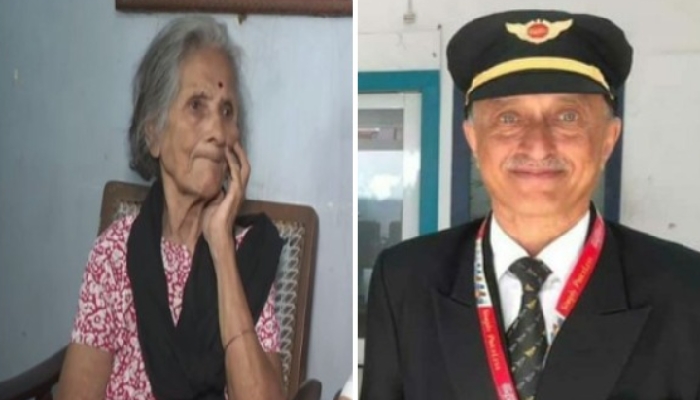
Nagpur, Aug 8: "He was a great son and always the first one to help others in need. He sacrificed his life for the country," said Neela Sathe, the mother of late captain DV Sathe, who was flying the Air India flight that crash-landed at Kozhikode airport on Friday, claiming 18 lives.

Indian Army Retired Colonel Vasant Sathe and his wife Neela lost both their sons in line of duty. The couple is originally from Nagpur, Maharashtra.

Speaking to news agency, Neela broke into tears and said, "He was a great son and always the first one to help others in need. 

His teachers still appreciate him. During the Ahmedabad floods, he saved the children of the soldiers by lifting them in his arms. I wish God would have called us instead of him."

"Both our children sacrificed their lives for the country," she added.

Remembering DV Sathe's childhood, Neela talked about every that moment when he made his parents proud.

Neela told with great pride that Captain DV Sathe had received the Sword of Honor and had also won eight medals in the Air Force.

Neela last talked to DV Sathe over phone call a few days ago during which captain told her mother not to go out of the house amid COVID-19 crisis as if something happens to her, he won't be able to bear that.

Vasant, captain's father retired as a colonel after serving in the Army for 30 years, following the footsteps of their father, both his sons joined too the Army.

Their elder son Vikas, was in the Army, and at the age of 22, he was martyred in an accident in Ferozepur in 1981. Their younger son Deepak (DV Sathe), who served as a pilot in Air India after serving in the Indian Air Force, died in the plane crash on Friday.

An Air India Express plane carrying 190 passengers including 10 infants skidded while landing at Karipur Airport in Kozhikode on Friday evening.

Comments

Add new comment

  • Coastaldigest.com reserves the right to delete or block any comments.
  • Coastaldigset.com is not responsible for its readers’ comments.
  • Comments that are abusive, incendiary or irrelevant are strictly prohibited.
  • Please use a genuine email ID and provide your name to avoid reject.
Agencies
May 31,2020

New Delhi, May 31: The fourth phase of the coronavirus-triggered lockdown, which began on May 18, saw 85,974 COVID-19 cases till 8 am on Sunday, which is nearly half of the total cases reported in the country so far.

Lockdown 4.0, which will end on May 31 midnight, has accounted for 47.20 per cent of the total coronavirus infection cases, number crunching from the Union Health Ministry data reveals.

The lockdown, which was first clamped on March 25 and spanned for 21 days, had registered 10,877 cases, while the second phase of the curbs that began on April 15 and stretched for 19 days till May 3, saw 31,094 cases.

The third phase of the lockdown that was in effect for 14 days ending on May 17, recorded 53,636 cases till 8 am of May 18.

The country had registered 512 coronavirus infection cases till March 24.

India is the ninth worst-hit nation by the COVID-19 pandemic as of now.        

The first case of COVID-19 in India was reported on January 30 from Kerala after a medical student of Wuhan university, who had returned to India, tested  positive for the virus.

India registered its highest single-day spike of COVID-19 cases on Sunday, with 8,380 new infections reported in the last 24 hours, taking the country's tally to 1,82,143, while the death toll rose to 5,164, according to the Union Health Ministry.

The number of active COVID-19 cases stood to 89,995, while 86,983 people have recovered and one patient has migrated, it said.

"Thus, around 47.75 per cent patients have recovered so far," a senior Health Ministry official said.

With the fourth phase of lockdown ending on Sunday, the Home Ministry on Saturday said 'Unlock-1' will be initiated in the country from June 8 under which the nationwide lockdown will be relaxed to a great extent, including opening of shopping malls, restaurants and religious places, even as strict restrictions will remain in place till June 30 in the country's worst-hit areas.

While announcing the extension of the lockdown in containment zones across the country, the Home Ministry said temples, mosques, churches and other religious places and shopping malls will be allowed to open in a phased manner from June 8, while a decision on opening of schools and colleges will be taken in July in consultation with states.

Comments

Add new comment

  • Coastaldigest.com reserves the right to delete or block any comments.
  • Coastaldigset.com is not responsible for its readers’ comments.
  • Comments that are abusive, incendiary or irrelevant are strictly prohibited.
  • Please use a genuine email ID and provide your name to avoid reject.
News Network
March 27,2020

Mumbai, Mar 27: The Reserve Bank of India (RBI) on Friday lowered the key repo rate by 75 basis points to 4.4 per cent in a bid to arrest the economic slowdown amid coronavirus (COVID-19) outbreak.
The reverse repo rate now stands at 4 per cent, down by 90 basis points, said RBI Governor Shaktikanta Das adding this has been done to make it unattractive for banks to passively deposit funds with the central bank and instead lend it to the productive sectors.
The six-member monetary policy committee (MPC) met on March 24, 25 and 27 and voted 4:2 in favour of the repo rate reduction. The MPC also decided to continue with the accommodative stance as long as it is necessary to revive growth and mitigate the impact of COVID-19 on the economy while ensuring that inflation remains within the target.
"The need of the hour is to shield the economy from the pandemic," said Das. "We need to mitigate the impact of coronavirus, revive economic growth and provide financial stability."
Repo rate is the rate at which a country's central bank lends money to commercial banks, and the reverse repo rate is the rate at which it borrows from them.
The RBI Governor further said that the economic growth and inflation projection will be highly contingent depending on the duration, spread and intensity of the pandemic.
"Global economic activity has come to a near standstill as COVID-19 related lockdowns and social distancing are imposed across a widening swathe of affected countries. Expectations of a shallow recovery in 2020 from 2019's decade low in global growth have been dashed," said Das.
"The outlook is now heavily contingent upon the intensity, spread and duration of the pandemic. There is a rising probability that large parts of the global economy will slip into recession," he said.
However, the RBI has injected liquidity of Rs 2.8 lakh crore via various instruments equal to 1.4 per cent of GDP. "Along with today's measures, liquidity measures equal to 3.2 per cent of GDP. The RBI will take continuous measures to ensure liquidity in the system."
The RBI governor has said that all banking institutions can offer a three-month moratorium on all loans for a period of three months. The RBI has also allowed banks to restructure the working capital cycle for companies without worrying that these will have to be classified as a non-performing asset (NPA).
The three-month moratorium will permit banks to avoid a large onset of NPAs during the 21-day lockdown and keep their books healthy.
Das said banks and other financial institutions should do all they can to keep credit flowing to economic agents facing financial stress on account of the isolation that the virus has imposed.
"Market participants should work with regulators like the RBI and the Securities and Exchange Board of India (SEBI) to ensure the orderly functioning of markets in their role of price discovery and financial intermediation," he said.

Comments

Add new comment

  • Coastaldigest.com reserves the right to delete or block any comments.
  • Coastaldigset.com is not responsible for its readers’ comments.
  • Comments that are abusive, incendiary or irrelevant are strictly prohibited.
  • Please use a genuine email ID and provide your name to avoid reject.