Over 13,000 spend last 10 days of Ramadan at Prophet’s Mosque

Arab News
June 18, 2017

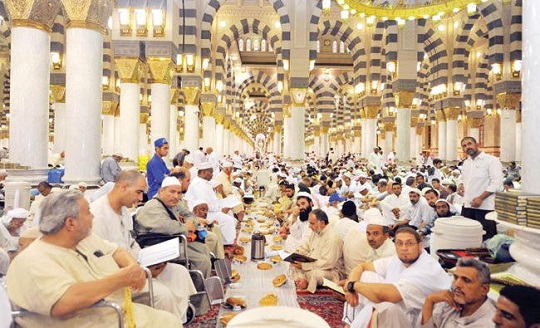
Madinah, Jun 18: The Presidency of the Two Holy Mosques announced the number of mutakifeen — those who seclude themselves in the Prophet’s Mosque for the last 10 days of Ramadan — numbered 13,575.

middleast

Of this number, 11,432 are men and 2,143 are women, according to an undersecretariat official, Saud Al-Saedi, who was quoted by the Saudi Press Agency (SPA).

Three areas have been designated for men and one for women. Both areas are provided with trained employees and technical equipment, he said, adding that all stayers are registered within an electronic system. There are rules that must be followed, such as keeping the area clean, not disturbing other worshipers, not damaging the mosque walls and furniture, and ending their stay by the end of Isha prayer, the night of Eid Al-Fitr.

Al-Saedi said that next year, those who plan itikaf at the Prophet’s Mosque — from within and outside the country — can register online and receive cards before they arrive at the mosque.

SR250,000 for a suite in Makkah

In Makkah, the price for a 10-day stay in a five-star, Haram-overlooking suite is SR250,000 ($66,664), while prices start from SR40,000 in hotels around the Grand Mosque but not overlooking it, according to an Al-Eqtisadiah report. Lower hotel prices are found in more distant areas.

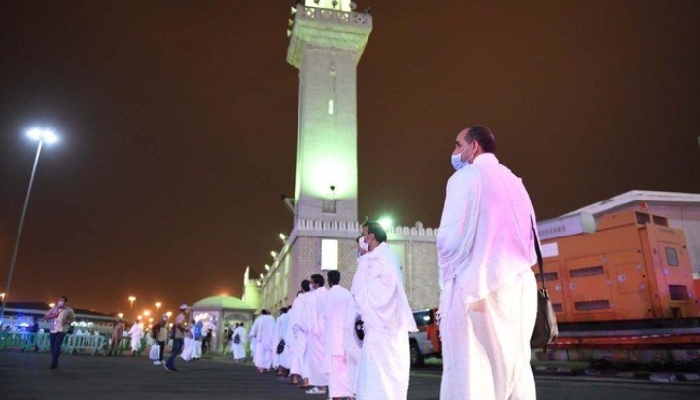
The Emergency Forces Department in Madinah is operating under directions from the king, crown prince and deputy crown prince regarding visitors to the Two Holy Mosques. During the last 10 days of Ramadan, the department’s Prophet’s Mosque Force continues to organize and handle the masses, grouping them on the basis of capacity, from Al-Salam Gate to the Holy Rawdha, and then to the Baqeea Graveyard Gate, said Commander Col. B’jad bin Majed Al-Harbi.

He said the number of worshipers will significantly increase in the last two days of Ramadan and more staff will be deployed to prevent people from blocking walkways.

Comments

shamon
 - 
Monday, 19 Jun 2017

It is illogic for the Hotels in Makkah and Madinah for charging too high. Saudi Govt should take note of this. Hoteliers swhould not misuse the opportunity. This is illegal and illogic. what will be their answer ont he day of judgement?

Add new comment

  • Coastaldigest.com reserves the right to delete or block any comments.
  • Coastaldigset.com is not responsible for its readers’ comments.
  • Comments that are abusive, incendiary or irrelevant are strictly prohibited.
  • Please use a genuine email ID and provide your name to avoid reject.
News Network
June 12,2020

Beirut, Jun 12: Angry Lebanese protesters blocked roads across the country with burning tyres, debris and their vehicles, incensed over the local currency's depreciation by more than 25 percent in just two days.

The demonstrations from northern Akkar and Tripoli to central Zouk, the eastern Bekaa Valley, Beirut and southern Tyre and Nabatieh on Thursday were some of the most widespread in months of upheaval over a calamitous economic and financial crisis.

Protesters set ablaze a branch of the Central Bank, vandalised several private banks and clashed with security forces in several areas. At least 41 people were injured in Tripoli alone, according to the Lebanese Red Cross.

"I'm really pissed off, that's all. If politicians think they can burn our hearts like this the fire is going to reach them too," unemployed computer engineer Ali Qassem, 26, told Al Jazeera after pouring fuel onto smouldering tyres on a main Beirut thoroughfare.

Tens of thousands of Lebanese have lost jobs in the past six months and hundreds of businesses have shuttered as a dollar shortage led the Lebanese pound to slide from 1,500 to $1 last summer - where it was pegged for 23 years - to roughly 4,000 for each US dollar last month.

But the slide turned into a freefall between Wednesday and Thursday when the pound plummeted to roughly 5,000 to $1 on black markets, which have become a main source of hard currency. There was widespread speculation the rate hit 6,000 or even 7,000 pounds to the dollar, though most markets stopped trading.

Protesters began amassing on streets across the country before sunset and increased into the thousands across the country as the night fell.

Prime Minister Hassan Diab cancelled all meetings scheduled for Friday to hold an emergency cabinet session at 9:30am and another at 3pm at the presidential palace to be headed by President Michel Aoun.

The pound's collapse is the perhaps the biggest challenge yet for Diab's young cabinet, which gained confidence in February after former prime minister Saad Hariri's government was toppled by an unprecedented October uprising that had the country's economic crisis at its core.

Economy Minister Raoul Nehme told Al Jazeera that there was "disinformation" being circulated about the exchange rate on social media and said he was investigating possible currency manipulation.

"I don't understand how the exchange rate increased by so much in two days," he said.

Many protesters have pitted blame on Central Bank governor Riad Salameh, nominally in charge of  keeping the currency stable. But they have also called on the government to resign.

"If people want reform between dawn and dusk, that's not going to work, and if someone thinks they can do a better job then please come forward," Nehme said.

"But what we can't have is a power vacuum - then the exchange rate won't be 5000, it'll be a catastrophe."

'Everyone paying the price'

When protesters set a large fire in Beirut's Riad al-Solh Square, which lies at the foot of a grand Ottoman-era building that serves as the seat of government, firefighters did not intervene to extinguish it.

It later became clear why: Civil Defence told local news channel LBCI they had run out of diesel to fuel their firetrucks.

Basic imports such as fuel have been hit hard by the currency crisis, making already-weak state services increasingly feeble.

A half-dozen or so police officers with Lebanon's Internal Security Forces observed the scene unfolding in front of them in the square.

"Why do you destroy shops and things and attack us security forces - do you think we're happy? Go and f****** break that wall or go to the politicians' houses," one police officer told Al Jazeera, referring to a large concrete barrier separating protesters from the seat of government.

"In the end we are with you and we want the country to change. Don't you dare think we're happy. My salary is now worth $130," the officer said.

The currency's spectacular fall seems to have pushed many Lebanese to put common interests above their differences.

Large convoys of men on motorbikes from Shia-majority areas of southern Beirut joined the demonstrations on Thursday, though they have clashed with protesters many times before - including at a protest on Saturday.

Some chanted sectarian insults, leading to brief clashes in areas that were formerly front lines during the country's devastating 15-year civil war.

Instead, the motorbike-riding demonstrators on Thursday chanted: "Shia, Sunni, F*ck sectarianism."

"We are Shia, and Sunnis and Christian are our brothers," Hisham Houri, 39, told Al Jazeera, perched on a moped with his fiancee behind him just a few metres from a pile of burning tyres.

The blaze sent thick black smoke into the sky towards an iconic blue-domed mosque and church in downtown Beirut.

"Politicians play on these sectarian issues and sometimes succeed, but in the end, they'll fail because all the people have been hurt," he said. "The dollar isn't just worth 6,000 for Shias or for Sunnis, everyone is paying that price."


Comments

Add new comment

  • Coastaldigest.com reserves the right to delete or block any comments.
  • Coastaldigset.com is not responsible for its readers’ comments.
  • Comments that are abusive, incendiary or irrelevant are strictly prohibited.
  • Please use a genuine email ID and provide your name to avoid reject.
Agencies
July 31,2020

Jeddah, Jul 31: Hajj 2020 pilgrims arrived in Muzdalifah Thursday night to rest after spending the day in Arafat.

Earlier, the pilgrims scaled Mount Arafat to pray and repent, as a highly unusual Hajj approached its climax. They listened to a sermon delivered by Sheikh Abdullah Al-Manea and prayed Dhuhr and Asr prayers together at the Al-Namirah Mosque in Arafat.

This year’s pilgrimage is the smallest in modern times, after the number of participants was greatly restricted to prevent the spread of the coronavirus. 

Tight security was in place around the foot of the rocky hill outside Makkah, also known as Jabal Al-Rahma or Mount of Mercy, in preparation for the high point of the annual ritual.

Video footage shown on state television showed the pilgrims setting off on their climb to the summit. They wore face masks and observed strict social-distancing rules imposed by Saudi authorities.As sprinklers sprayed water on them to provide relief from the summer desert heat, the pilgrims raised their palms as they climbed the slopes of the hill — the site of Prophet Muhammad’s last sermon. When they reached the top they recited holy verses and prayed for forgiveness for their sins.

Earlier, the pilgrims were taken in buses from Mina to Mount Arafat. Strict precautionary measures were in place, with each group accompanied by security teams, ambulances and civil defense vehicles. 

When they arrived, their temperatures were checked before they entered Namirah Mosque to hear a sermon that was translated into 10 languages.

“The camps were set up for pilgrims in Arafat early on,” said Minister of Hajj and Umrah Muhammad Salih Bentin. The sermon at Namirah Mosque was delivered by Sheikh Abdullah Al-Manea, who led the pilgrims in noon and afternoon prayers.

“During Hajj this year, we reiterate that it is essential for pilgrims, as well as everyone assisting them, to adhere to the precautionary regulations that have been implemented,” Al-Manea, a member of the Council of Senior Scholars, said during his sermon. “This is to be done for their own safety.

“Precautions have been put in place to protect lives against the damage that the pandemic can cause, and also to actualize Islam’s teachings pertaining to safeguarding human life by Allah’s permission.”

The stay in Arafat is described as the pinnacle of Hajj and Muslims around the world reflect the actions of pilgrims by asking for forgiveness and praying for their deepest desires.
Pilgrims left Arafat in coaches for Muzdalifah after sunset and will pray the Maghrib and Isha prayers there.

After sunset prayers, the pilgrims made their way down Mount Arafat to Muzdalifah, where they will spend the night before the final Hajj ritual, the symbolic stoning of the devil. 

This year, each pilgrim received sanitized pebbles in advance of the event on Friday, which is the first day of Eid Al-Adha.
This year the Kingdom faced the unprecedented challenge of ensuring pilgrims attending Hajj were protected as much as possible from the risks of the coronavirus.

They will then sleep, pray the Fajr prayer there tomorrow and then leave for Mina.

Comments

Add new comment

  • Coastaldigest.com reserves the right to delete or block any comments.
  • Coastaldigset.com is not responsible for its readers’ comments.
  • Comments that are abusive, incendiary or irrelevant are strictly prohibited.
  • Please use a genuine email ID and provide your name to avoid reject.
Gulf News
April 12,2020

Hyderabad, Apr 12: In the backdrop of rising tide of anti-Muslim hatred and Islamophobia on the social media, a company in Dubai sacked an employee from Hyderabad for his hate-filled posts on Facebook.

Bala Krishna Nakka from Hyderabad, who was working as Chief Accountant at Dubai’s Moro Hub Data Solutions Company, was sacked after his Facebook went viral evoking widespread condemnation. The man had posted images on his Facebook page which showed Muslims as suicide bombers wearing bombs in the form of coronavirus cells.

It triggered demands both on Facebook and Twitter for action against him. In a quick response the company announced that the person was being sacked from his job, as the company had zero tolerance towards hate propaganda.

Moro Hub said in a statement: “At Moro, we take a zero tolerance attitude to material that is or may be deemed Islamophoic or hate speech. The tweets that we have been alerted to do not, in any way, reflect Moro’s brand values.”

Since the outbreak of coronavirus in India, a more intense hate propaganda has been unleashed by right wing elements on social media targeting India’s Muslim minority, some of whom are based in Gulf region.

As both the mainstream media, especially Indian TV channels, as well as social media users, have unleashed a campaign linking the spread of virus to a Muslim missionary organisation, the Tableeghi Jamaat, in India, a fresh war of words has broken out on social media.

While some activists have taken up it on themselves to highlight the hate propaganda and draw the attention of employers to such hate mongers, the right wing social media handles have also launched their own counter-offensives against such activists.

Comments

Add new comment

  • Coastaldigest.com reserves the right to delete or block any comments.
  • Coastaldigset.com is not responsible for its readers’ comments.
  • Comments that are abusive, incendiary or irrelevant are strictly prohibited.
  • Please use a genuine email ID and provide your name to avoid reject.