


Over 13,000 spend last 10 days of Ramadan at Prophet’s Mosque

Arab News
June 18, 2017

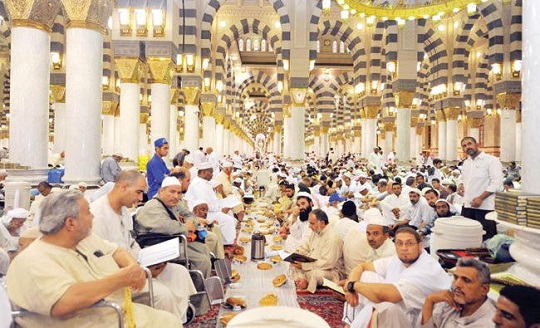
Madinah, Jun 18: The Presidency of the Two Holy Mosques announced the number of mutakifeen — those who seclude themselves in the Prophet’s Mosque for the last 10 days of Ramadan — numbered 13,575.
middleast

Of this number, 11,432 are men and 2,143 are women, according to an undersecretariat official, Saud Al-Saedi, who was quoted by the Saudi Press Agency (SPA).

Three areas have been designated for men and one for women. Both areas are provided with trained employees and technical equipment, he said, adding that all stayers are registered within an electronic system. There are rules that must be followed, such as keeping the area clean, not disturbing other worshipers, not damaging the mosque walls and furniture, and ending their stay by the end of Isha prayer, the night of Eid Al-Fitr.

Al-Saedi said that next year, those who plan itikaf at the Prophet’s Mosque — from within and outside the country — can register online and receive cards before they arrive at the mosque.

SR250,000 for a suite in Makkah

In Makkah, the price for a 10-day stay in a five-star, Haram-overlooking suite is SR250,000 ($66,664), while prices start from SR40,000 in hotels around the Grand Mosque but not overlooking it, according to an Al-Eqtisadiah report. Lower hotel prices are found in more distant areas.

The Emergency Forces Department in Madinah is operating under directions from the king, crown prince and deputy crown prince regarding visitors to the Two Holy Mosques. During the last 10 days of Ramadan, the department’s Prophet’s Mosque Force continues to organize and handle the masses, grouping them on the basis of capacity, from Al-Salam Gate to the Holy Rawdha, and then to the Baqeea Graveyard Gate, said Commander Col. B’jad bin Majed Al-Harbi.

He said the number of worshipers will significantly increase in the last two days of Ramadan and more staff will be deployed to prevent people from blocking walkways.

Comments

shamon
 - 
Monday, 19 Jun 2017

It is illogic for the Hotels in Makkah and Madinah for charging too high. Saudi Govt should take note of this. Hoteliers swhould not misuse the opportunity. This is illegal and illogic. what will be their answer ont he day of judgement?

Add new comment

  • Coastaldigest.com reserves the right to delete or block any comments.
  • Coastaldigset.com is not responsible for its readers’ comments.
  • Comments that are abusive, incendiary or irrelevant are strictly prohibited.
  • Please use a genuine email ID and provide your name to avoid reject.
Agencies
June 5,2020

Dubai, Jun 5: A new set of coronavirus guidelines for UAE hotels has been published by the National Emergency Crisis and Disasters Management Authority.

The guidelines, released late Thursday, require all employees to be tested for Covid-19 before reopening, and to be re-tested every 15 days.

Hotels are expected to provide an infrared thermometer and thermal camera, with employee temperatures to be tested several times per working day.

Any guest or employee showing coronavirus symptoms will not be permitted to enter hotel facilities, the guidelines stress.

Hotels must also leave a 24-hour gap between guests leaving a room, and the next guests arriving.

Facilities such as restaurants, cafes, gyms, swimming pools and beaches in hotels will resume operation under a minimum capacity.

Customers must have their temperatures taken before they enter.

The working hours of restaurants and cafes will be from 6am until 9pm, allowing four people to sit at the same table with 2.5 metres left between tables. Menus must be sterilised after each use.

Comments

Add new comment

  • Coastaldigest.com reserves the right to delete or block any comments.
  • Coastaldigset.com is not responsible for its readers’ comments.
  • Comments that are abusive, incendiary or irrelevant are strictly prohibited.
  • Please use a genuine email ID and provide your name to avoid reject.
News Network
April 12,2020

Apr 12: Parents in Abu Dhabi affected by the Covid-19 situation can seek help from the authorities in paying off their children's school fees, it was announced on Sunday.

The Abu Dhabi Media Office took to Twitter to announce the reprieve. The Authority for Social Contribution - Ma'an and Abu Dhabi Department of Education and Knowledge (Adek) "will support parents with children attending private schools in #AbuDhabi who are affected by the current economic challenges, by paying school fees or providing devices for distance learning".

The move is part of the 'Together We Are Good' programme which aims to support residents impacted by the Covid-19 coronavirus crisis in the country.

"Parents can call the toll-free helpline on 800-3088 or register their request at http://togetherwearegood.ae. The closing date for fee assistance applications is 23rd April 2020," the media office tweeted.

Comments

Add new comment

  • Coastaldigest.com reserves the right to delete or block any comments.
  • Coastaldigset.com is not responsible for its readers’ comments.
  • Comments that are abusive, incendiary or irrelevant are strictly prohibited.
  • Please use a genuine email ID and provide your name to avoid reject.
News Network
July 23,2020

Beirut, Jul 23: The pandemic will exact a heavy toll on Arab countries, causing an economic contraction of 5.7% this year, pushing millions into poverty and compounding the suffering of those affected by armed conflict, a U.N. report said Thursday.

The U.N.'s Economic and Social Commission for Western Asia expects some Arab economies to shrink by up to 13%, amounting to an overall loss for the region of $152 billion.

Another 14.3 million people are expected to be pushed into poverty, raising the total number to 115 million — a quarter of the total Arab population, it said. More than 55 million people in the region relied on humanitarian aid before the COVID-19 crisis, including 26 million who were forcibly displaced.

Arab countries moved quickly to contain the virus in March by imposing stay-at-home orders, restricting travel and banning large gatherings, including religious pilgrimages.

Arab countries as a whole have reported more than 830,000 cases and at least 14,717 deaths. That equates to an infection rate of 1.9 per 1,000 people and 17.6 deaths per 1,000 cases, less than half the global average of 42.6 deaths, according to the U.N.

But the restrictions exacted a heavy economic toll, and authorities have been forced to ease them in recent weeks. That has led to a surge in cases in some countries, including Lebanon, Iraq and the Palestinian territories.

Wealthy Gulf countries were hit by the pandemic at a time of low oil prices, putting added strain on already overstretched budgets. Middle-income countries like Jordan and Egypt have seen tourism vanish overnight and a drop in remittances from citizens working abroad.

War-torn Libya and Syria have thus far reported relatively small outbreaks. But in Yemen, where five years of civil war had already generated the world's worst humanitarian crisis, the virus is running rampant in the government-controlled south while rebels in the north conceal its toll.

Rola Dashti, the head of the U.N. commission, said Arab countries need to “turn this crisis into an opportunity” and address longstanding issues, including weak public institutions, economic inequality and over-reliance on fossil fuels.

“We need to invest in survival, survival of people and survival of businesses,” she said.

Comments

Add new comment

  • Coastaldigest.com reserves the right to delete or block any comments.
  • Coastaldigset.com is not responsible for its readers’ comments.
  • Comments that are abusive, incendiary or irrelevant are strictly prohibited.
  • Please use a genuine email ID and provide your name to avoid reject.