


Over 13,000 spend last 10 days of Ramadan at Prophet’s Mosque

Arab News
June 18, 2017

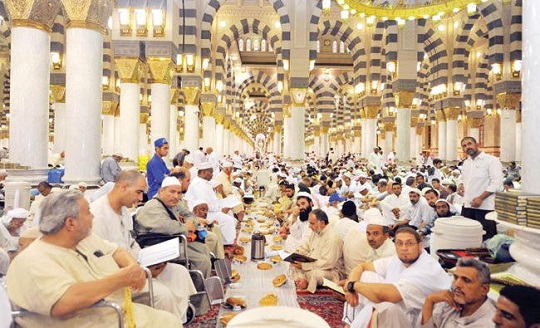
Madinah, Jun 18: The Presidency of the Two Holy Mosques announced the number of mutakifeen — those who seclude themselves in the Prophet’s Mosque for the last 10 days of Ramadan — numbered 13,575.
middleast

Of this number, 11,432 are men and 2,143 are women, according to an undersecretariat official, Saud Al-Saedi, who was quoted by the Saudi Press Agency (SPA).

Three areas have been designated for men and one for women. Both areas are provided with trained employees and technical equipment, he said, adding that all stayers are registered within an electronic system. There are rules that must be followed, such as keeping the area clean, not disturbing other worshipers, not damaging the mosque walls and furniture, and ending their stay by the end of Isha prayer, the night of Eid Al-Fitr.

Al-Saedi said that next year, those who plan itikaf at the Prophet’s Mosque — from within and outside the country — can register online and receive cards before they arrive at the mosque.

SR250,000 for a suite in Makkah

In Makkah, the price for a 10-day stay in a five-star, Haram-overlooking suite is SR250,000 ($66,664), while prices start from SR40,000 in hotels around the Grand Mosque but not overlooking it, according to an Al-Eqtisadiah report. Lower hotel prices are found in more distant areas.

The Emergency Forces Department in Madinah is operating under directions from the king, crown prince and deputy crown prince regarding visitors to the Two Holy Mosques. During the last 10 days of Ramadan, the department’s Prophet’s Mosque Force continues to organize and handle the masses, grouping them on the basis of capacity, from Al-Salam Gate to the Holy Rawdha, and then to the Baqeea Graveyard Gate, said Commander Col. B’jad bin Majed Al-Harbi.

He said the number of worshipers will significantly increase in the last two days of Ramadan and more staff will be deployed to prevent people from blocking walkways.

Comments

shamon
 - 
Monday, 19 Jun 2017

It is illogic for the Hotels in Makkah and Madinah for charging too high. Saudi Govt should take note of this. Hoteliers swhould not misuse the opportunity. This is illegal and illogic. what will be their answer ont he day of judgement?

Add new comment

  • Coastaldigest.com reserves the right to delete or block any comments.
  • Coastaldigset.com is not responsible for its readers’ comments.
  • Comments that are abusive, incendiary or irrelevant are strictly prohibited.
  • Please use a genuine email ID and provide your name to avoid reject.
coastaldigest.com news network
June 16,2020

Dubai, Jun 16: In a humanitarian gesture, a UAE-based Pakistani businessman has come forward to offer free interim accommodation options to covid lockdown hit expatriates. 

The men benefitted from Ali Rao's housing initiative include Indians, Pakistanis and Africans. 

Inspired by the ongoing efforts taken by the UAE leadership to take care of all UAE residents, Ali Rao, CEO of Rao Holdings LLC in Dubai is offering free shared accommodation to unemployed male bachelors and workers, especially expatriates who do not have a place to stay.

Ali Rao currently has a capacity of 100 accommodation options that he wishes to offer to those who cannot afford house rent. 

"We have already placed 25 such men in these housing options spread across Al Quoz, Jebel Ali and Muhaisnah areas of Dubai," Ali Rao told local media. He works in collaboration with major charities in Dubai, who refer the cases to Rao.

"One of our companies - the property management division - deals with industrial housing accommodation. We decided to put this space to good use when I came across media articles that highlighted the plight of these homeless men," he said. 

Rao has already sheltered 25 homeless workers in the Al Quoz area. "We have received applications for 35 more, however, many of these men are due to return to their home countries, so we are awaiting confirmation from the charities," he explained. He has provided them with free Wi-Fi, bedding, blankets, bedsheets, and pillows.

"In one unit, we provide them with food and the other unit, social workers and the associated charities deliver food," he added. The housing is exclusively for men and not for women and families. "Many are seeking jobs, so they needed Wi-Fi. I went to the camps today and set up a Wi-Fi connection. Someone wanted to eat eggs, so we got him some eggs and rice. These are simple things most of us take for granted, but to many people this is vital," he added.

Since most of the residents are looking to return to their home countries, Rao is also in the process of providing them with air tickets.

"If the need arises, we will add more units," he explained. Rao said, "The ongoing pandemic has hit everyone hard, especially those with no security to fall back on. The economic and income disparities have only increased in this time, with those dependent on daily wages being rendered homeless in massive numbers across the globe."

He added, "I felt heartbroken and if I would stand by and watch, I would feel very small as a human being, I won't be able to stand in front of the creator I thought to myself. These are some very difficult times for all of us."

A beneficiary of the programme said, "I am very happy with this initiative as living outside in the summer is very difficult. It's very hot. I want to thank God and this company for providing me with a roof over my head."

Comments

Add new comment

  • Coastaldigest.com reserves the right to delete or block any comments.
  • Coastaldigset.com is not responsible for its readers’ comments.
  • Comments that are abusive, incendiary or irrelevant are strictly prohibited.
  • Please use a genuine email ID and provide your name to avoid reject.
News Network
April 20,2020

Apr 20: Eight Indians, including two engineers, have died due to the novel coronavirus in Saudi Arabia, according to a media report on Sunday.

Mohammed Aslam Khan, an electrical engineer in Makkah, and Azmatullah Khan, an engineer at the Makkah Haram power station, have died due to the COVID-19, Saudi Gazette reported.

Aslam Khan, aged 51, who hailed from Meerut in Uttar Pradesh, was admitted to King Faisal Hospital, Makkah on April 3, following worsening of his condition after being infected with fever and throat pain.

He had been on ventilator for more than two weeks and breathed his last on Saturday night, the paper said.

Khan is survived by wife and a daughter and a son. His wife and children are under self-imposed home quarantine.

Azmatullah Khan, from Telangana, died of coronavirus on Friday.

Mujeeb Pukkottoor, a prominent Indian social worker and general secretary of Makkah chapter of Kerala Muslim Cultural Center, told the paper that the body of Khan was buried in Makkah on Sunday.

Khan, aged 65, had been working with Saudi Binladin Group for the last 32 years.

Fakre Alam, an employee at the Haram Project of Saudi Binladin Group in Makkah, died on Sunday due to infection, the paper said.

Barkt Ali Abdullatif Fakir, an electrical technician working in Medina, also died of coronavirus, it said.

According to the Saudi Ministry of Health’s daily report published on April 14, the number of coronavirus infected cases among workers of Saudi Binladin Group in various parts of the Kingdom stood at 117, and these included 70 cases in Makkah.

The first two Indian fatalities were reported from Medina and Riyadh earlier this month with the death of Shebnaz Pala Kandiyil (29) and Safvan Nadamal (41), both from Kerala.

Mohammed Sadiq, from Hyderabad, working in Jeddah and Suleman Sayyid Junaid (Maharashtra) are other Indians who died due to COVID-19 in the Gulf kingdom, the paper said.

Shebnaz from Panoor in Kannoor district died on April 3 and his body was buried in Medina on April 7. He came back to the Kingdom March 3 after his marriage in January.

Safvan, a taxi driver from Chemmad in Malappuram district, died on April 2 and was buried in Riyadh on April 8.

Comments

Add new comment

  • Coastaldigest.com reserves the right to delete or block any comments.
  • Coastaldigset.com is not responsible for its readers’ comments.
  • Comments that are abusive, incendiary or irrelevant are strictly prohibited.
  • Please use a genuine email ID and provide your name to avoid reject.
Agencies
July 31,2020

Mount Arafat, July 30: Muslim pilgrims converged Thursday on Saudi Arabia's Mount Arafat for the climax of this year's hajj, the smallest in modern times and a sharp contrast to the massive crowds of previous years.

A tight security cordon has been erected all around the foot of the rocky hill outside Mecca, also known as Jabal al-Rahma or Mount of Mercy.

Pilgrims, donning masks and observing social distancing, were brought in buses from neighbouring Mina, state television showed, as Saudi authorities impose measures to prevent a coronavirus outbreak.

They were subject to temperature checks and attended a sermon -- which state media said was translated into 10 languages -- before they set off on the climb to the summit for hours of Koran recitals and prayers to atone for their sins.

The scene was strikingly different to last year's ritual when a sea of pilgrims ascended Mount Arafat, marshalled by tens of thousands of stewards in a bid to prevent any crushes.

After sunset prayers, pilgrims will make their way down Mount Arafat to Muzdalifah, another holy site where they will sleep under the stars to prepare for the final stage of hajj, the symbolic "stoning of the devil".

It takes place on Friday and also marks the beginning of Eid al-Adha, the festival of sacrifice.

The hajj, one of the five pillars of Islam and a must for able-bodied Muslims at least once in their lifetime, is usually one of the world's largest religious gatherings.

But only up to 10,000 people already residing in the kingdom will participate in this year's ritual, compared with 2019's gathering of some 2.5 million from around the world.

"You are not our guests but those of God, the custodian of the two holy mosques (Saudi Arabia's King Salman) and the nation," Hajj Minister Mohammad Benten said in a video released by the media ministry on Wednesday.

Security cordon

A security cordon has been thrown around the holy sites to prevent any security breaches, an interior ministry spokesman said.

Riyadh faced strong criticism in 2015 when some 2,300 worshippers were killed in the deadliest stampede in the gathering's history.

But this year, those risks are greatly reduced by the much smaller crowd.

The pilgrims have all been tested for the virus, and foreign journalists were barred from this year's hajj, usually a huge global media event.

As part of the rites completed over five days in the holy city of Mecca and its surroundings, the pilgrims converged on Mount Arafat after spending the night in Mina.

A district of Mecca, Mina sits in a narrow valley surrounded by rocky mountains, and is transformed each year into a vast encampment for pilgrims.

They began the hajj on Wednesday with their first "tawaf", the circumambulation of the Kaaba, a large structure in Mecca’s Grand Mosque towards which Muslims around the world pray.

The Kaaba is draped in a black cloth embroidered in gold with Koranic verses and known as the kiswa, which is changed each year during the pilgrimage.

Pilgrims were brought inside the mosque in small batches, walking along paths marked on the floor, in sharp contrast to the normal sea of humanity that swirls around the Kaaba during hajj.

Comments

Add new comment

  • Coastaldigest.com reserves the right to delete or block any comments.
  • Coastaldigset.com is not responsible for its readers’ comments.
  • Comments that are abusive, incendiary or irrelevant are strictly prohibited.
  • Please use a genuine email ID and provide your name to avoid reject.