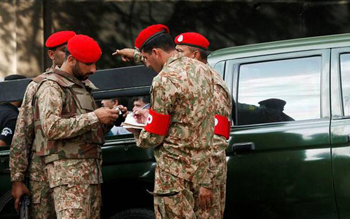
Over 2 days, Pakistan hangs 8 'hardcore terrorists' sentenced by military courts

May 18, 2017

New Delhi, May 18: Pakistan, in quick succession, hanged eight "hardcore terrorists" over a period of two days. The executions were announced by the Directorate of the Inter-Services Public Relations (ISPR), the Pakistan military's media wing, in similarly worded press releases.paikstan

Four men were executed on Wednesday while another four were hanged today. The executions took place at an unspecified jail in the Khyber Pakhtunkhwa province.

The four terrorists executed today were identified as Muhammad Ibrahim, Rizwan Ullah, Sardar Ali and Sher Muhammad Khan. Those executed on Wednesday were named Ahmed Ali, Asghar Khan, Haroon ur Rasheed and Gul Rehman.

According to the ISPR, all the eight men were active members of the Tehreek-e-Taliban Pakistan and were tried under Pakistan's military court system, the same system that sentenced Indian national Kulbhushan Jadhav to death.

Notably, the practice of trying civilians suspected of terrorism was renewed by two years in March this year, news agency reported on Wednesday. The military courts were first set up for a two-year period after the December 2014 attack at an army-run school in Peshawar in which more than 150 people, mostly children, were killed.

The eight terrorists executed on Wednesday and Thursday were accused of various offenses of terrorism, "including killing of innocent civilians, destruction of educational institutions, attacking Armed Forces of Pakistan and Law Enforcement Agencies", the ISPR said. The four men executed today were further accused of "destruction of communication/ electricity infrastructure".

According to Justice for Pakistan, a human rights law firm based out of Lahore, Pakistan has executed 457 people since the 2014 Peshawar attack.

According to news agency, Pakistani officials have maintained that the country's military courts serve as a deterrent against terrorism. However, human rights groups have raised questions about the secrecy with which the military courts function.

Comments

Add new comment

  • Coastaldigest.com reserves the right to delete or block any comments.
  • Coastaldigset.com is not responsible for its readers’ comments.
  • Comments that are abusive, incendiary or irrelevant are strictly prohibited.
  • Please use a genuine email ID and provide your name to avoid reject.
Agencies
March 26,2020

Washington, Mar 26: Indian-American hoteliers have come forward to rescue the stranded Indian students in the US following implementation of lockdown measures in the country in response to the rapidly-spreading coronavirus pandemic, offering them free accommodation and free meals.

With the students scrambling for a roof over their heads after being asked to vacate their hostels and India banning international flights for a week from March 22 due to the coronavirus pandemic, more than 6,000 rooms in nearly 700 hotels were offered to them by Wednesday following a call from the Indian Embassy.

The Indian Embassy have been running a round-the-clock helpline since last week for the students in the US, who number over 2,50,000.

Most of these hotels offered are in and around universities and colleges, but the hotel owners from across the country have come up in large numbers to the call given by community leaders, who have roped in Asian American Hotel Owners Association (AAHOA) for the purpose.

India's Ambassador to the US Taranjit Singh Sandhu said in a tweet, "It is heartening to see that Indian; Indian-American and other hotel owners are coming forward to help people with accommodation in these testing times. Together we can overcome the fight against COVID19!"

"The Indian community has come together to help the student and many hotel owners have offered their rooms free of cost to them. Many of them are also offering free meals to these students," Chicago-based community leader Nirav Patel told PTI.

Indian-American hotelier couple K K Mehta and Chandra Mehta have offered more than 100 rooms to Indian students at their two prime properties each near the Times Square and Barclays Center in New York City, said Jaipur Foot USA chairman Prem Bhandari on behalf of the hotels.

The Indian Consulate in New York had contacted them about this 10 days ago, he said.

"These students are the future of both India and the United States. All the top Indian-American CEOs, scientists and doctors came to this country as a student. It's our moral duty to help them with our resources," Bhandari said.

Regional director of AAHOA Upper Midwest Kalpesh Joshi said they had created a master list of the availability hotel rooms, which was being constantly updated.

Free accommodation would be allocated in coordination with the Indian Embassy and its consulates, he said.

"The Indian Embassy and its consulates are working tirelessly to get these students rooms," he added.

Joshi has also sent out a video message to his hotelier colleagues: "Because of the coronavirus outbreak, our Indian students in the US are out of shelter. Let's work together. As a hotelier, I would like to request all my hotelier friends to come forward... let's provide some rooms to the students."

Boston-based Computer Society of India (North America) has collaborated with AAHOA to help students and Indian IT professionals searching for emergency accommodation due to the COVID-19 lockdown.

Anyone who is having financial hardship will be given hotel accommodation either free of cost or the rates will not be more than USD 50, said the Computer Society of India (North America).

Minesh Patel, the chairman of Virginia Asian American Store Association, said between Richmond, Norfolk, and Virginia Beach, Indian-American hotel owners can help in arranging accommodation for over 500 Indian students.

Florida-based Vipul Patel, the national president of Asian American Store Owners Association, said support for the Indian students have been pouring in from the Indian-American hoteliers.

"I have not come across any hotel owner who said no to us," Patel said.

Rooms would be allocated to students on the recommendation of the Indian Embassy and its consulates in Houston, Chicago, Atlanta, San Francisco and New York.

The Indian Consulate in New York was the first to take a lead in this regard. It has worked with Hammock Worldwide Hotels and Resorts to provide temporary accommodation for the students at a flat rate of USD 50 per night.

Joshi said that initially there was a suggestion to charge a convenience fee of USD 20-25 per day from the students.

"But when a few of them offered free rooms and free meals, everyone agreed to it," he said.

According to Johns Hopkins University coronavirus tracker, the number of deaths caused by the novel coronavirus in the US rose to 1,031 with 68,572 confirmed cases. The US has the third highest number of confirmed cases behind China and Italy.


Comments

Add new comment

  • Coastaldigest.com reserves the right to delete or block any comments.
  • Coastaldigset.com is not responsible for its readers’ comments.
  • Comments that are abusive, incendiary or irrelevant are strictly prohibited.
  • Please use a genuine email ID and provide your name to avoid reject.
News Network
June 26,2020

Washington, Jun 26: The United States reported more than 39,000 new coronavirus cases on Thursday, its highest-ever single-day count as the government relaxed restrictions and is downplaying the threat of the deadly virus.

According to the Washington Post, experts believe there is a troubling lack of consistent, unified messaging from President Donald Trump and Vice President Mike Pence. They have downplayed the danger and denigrated effective disease defences such as mask-wearing, testing, and social distancing.

Churches, beaches, and bars are filling up with people and so are hospital beds, the report said.

The counties home to Dallas, Phoenix, and Tampa all reported record-high averages on at least 15 straight days in June.

The hardest-hit states are California, Texas, Florida and those that thought they had the virus under control, like Utah and Oregon.

"I think the politicians are in denial," said Kami Kim, director of the Division of Infectious Disease and International Medicine at the University of South Florida.

The chief of the Division of Pediatric Infectious Diseases at the University of Utah Health, Andrew T. Pavia, is of the view that the push to reopen quickly even as cases climb sends a dangerous and inaccurate message.

"On the one hand, you get messages from politicians and the business community that we have to go, go, go and open up," he said. "On the other hand, you're seeing epidemiological indicators that we still have to be very careful."

"It's cognitive dissonance," he added.

The Trump administration has tried to downplay the rising number. Pence called concerns about another surge of infections "overblown," the product of media "fearmongering."

Some governors have followed the administration's lead, blaming rising caseloads on more testing.

Testifying before a congressional committee this week, Anthony S. Fauci, the nation's top infectious-diseases expert, said the new cases were "a disturbing surge" spurred by community transmission rather than testing.

"That's something I'm really quite concerned about," Fauci said. "A couple of days ago, there were 30,000 new infections. That's very disturbing to me."

Several states like Arizona, Arkansas, the Carolinas, Mississippi, Tennessee, Texas and Utah have recently reported new highs in the number of coronavirus patients hospitalized.

"We're seeing a 40 per cent increase in the last two weeks in hospitalizations," said Dallas County Judge Clay Jenkins (D), the jurisdiction's top elected official. "We're by far at our record numbers, and we're at record numbers in north Texas. Houston is at a record, the state is at a record." The Texas Medical Center in Houston, a massive medical complex, reported Thursday that 100 per cent of the beds in its intensive care unit are occupied.

Comments

Add new comment

  • Coastaldigest.com reserves the right to delete or block any comments.
  • Coastaldigset.com is not responsible for its readers’ comments.
  • Comments that are abusive, incendiary or irrelevant are strictly prohibited.
  • Please use a genuine email ID and provide your name to avoid reject.
News Network
April 26,2020

Apr 26: The remarkable story of an airman who overcame prejudice to become one of only a handful of Indian fighter pilots in the First World War has emerged in newly-released archive files by the UK's Commonwealth War Graves Commission (CWGC).

Lieutenant Shri Krishna Chanda Welinkar is one of the thousands of moving stories from the war preserved in family correspondence and being brought alive as part of a digitisation project.

The never-before-published files contain thousands of letters, pictures and other papers sent between the Commission and the next of the kin of First World War dead.

Among them is the story of Welinkar, who hailed from Bombay in colonial India. After much hardship and discrimination, he eventually became a pilot and went missing while on patrol over the skies above the Western Front in June 1918.

His family had to wait nearly three years before they finally knew for certain that he had died, and his grave was located.

“For everyone who died in the First World War, there was inevitably a partner, parent or child back home who had questions. The heartbreaking letters in CWGC's archive give us an insight into what it was like for those families trying to come to terms with their loss,” said Andrew Fetherston, chief archivist for CWGC.

“They are stories that show desperate searches for closure, former enemies uniting and, on many occasions, the sad realisation that a missing loved one would always remain so. We are pleased to be able to make this invaluable piece of World War history accessible to a new generation and help deepen our understanding of how the First World War impacted those who were left behind,” he said.

Welinkar was one of the 1.3 million Indians who answered the call to fight for the British Empire. Nearly 74,000 never saw their homeland again and are remembered today in cemeteries and memorials throughout the world, including France, Belgium, the Middle East and Africa.

Welinkar was a well-educated man studying at Cambridge University. He trained to become an aviator in Middlesex and wished to join the Royal Flying Corps, later known as the Royal Air Force.

Upon attempting to enlist, Welinkar encountered the same prejudices as his other fellow Indian airmen and was encouraged to become an air mechanic instead.

He was eventually given a commission in the Royal Flying Corps as an Officer. In 1918, he was posted to France and patrolled the skies above the Western Front.

In June 1918, Lieutenant Welinkar embarked on what would be his final patrol; he did not return and was reported missing. His fate remained unknown for many months afterwards.

The newly-released e-files chronicle the remarkable discovery of Welinkar and his final resting place long after the war had ended. Colonel Barton, who knew Welinkar, acted on behalf of his mother and helped find her missing son. They spoke to former enemies and honed their search to the grave of an unidentified man, buried by the Germans as “Oberleutnant S.C. Wumkar” in a grave in Rouvroy, Belgium.

The body was later moved and reinterred in Hangard Communal Cemetery Extension but it wasn't until the vital clue, found in the original German burial records in February 1921, that it was confirmed beyond doubt this grave was of Welinkar's.

In May 1921, Colonel Barton, on behalf of Welinkar's mother, requested that a Commission headstone be placed on the grave with the following personal inscription: “To the Honoured Memory of One of the Empire's Bravest Sons”.

This records – known as Enquiry Files – are part of a collection of nearly 3,000 files which have never been made available to the public before. Nearly half have been digitised so far, alongside a previously unreleased collection of more than 16,000 photographs held in negatives in the Commission's archive.

The files, internally referred to simply as E-Files, contain correspondence between the CWGC and the next of kin of the war dead. They often contain letters, typed memos between Commission staff and on occasion photos, maps and diagrams.

CWGC only holds an enquiry file for a small proportion of the 1.7 million people it commemorates from the Commonwealth. Today it is only possible to release those surviving records from the First World War because correspondence with families of Second World War casualties often involves people still alive today and cannot be made public for many years, due to the UK's data protection rules.

To date, more than 1,300 of the surviving 3,000 First World War enquiry files have been digitised.

The CWGC commemorates the 1.7 million Commonwealth servicemen and women who died during the two World Wars. It also holds and updates an extensive and accessible records archive, while operating over 23,000 locations in more than 150 countries and territories.

Comments

Add new comment

  • Coastaldigest.com reserves the right to delete or block any comments.
  • Coastaldigset.com is not responsible for its readers’ comments.
  • Comments that are abusive, incendiary or irrelevant are strictly prohibited.
  • Please use a genuine email ID and provide your name to avoid reject.