Overeating, stress = high BP, diabetes = chronic kidney diseases: Dr Vivek Pathak

[email protected] (CD Network | Photos by Suresh)
June 15, 2015

Mangaluru, Jun 15: Stating that diabetes and high blood pressure are the two primary reasons for chronic kidney diseases (CKD), Dr Vivek Pathak, a renowned nephrologist, said that the prevention of such diseases is cheaper to undergoing treatment later.

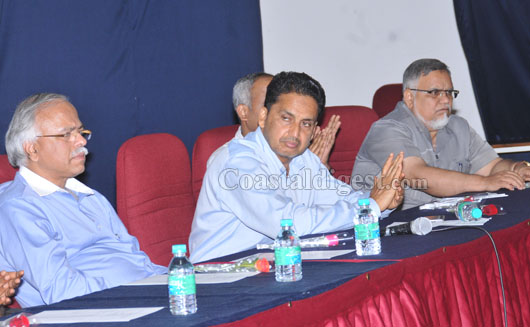
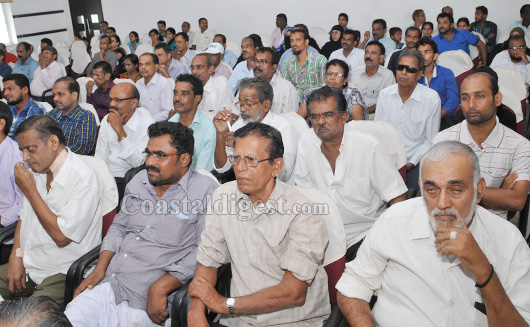
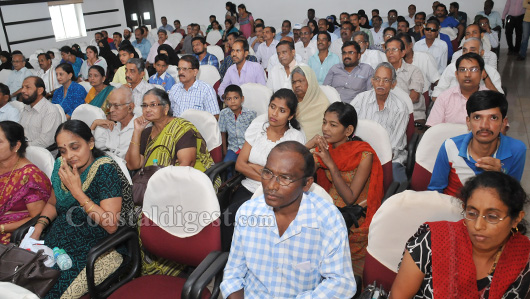
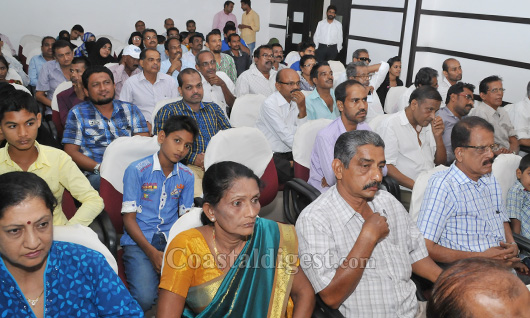
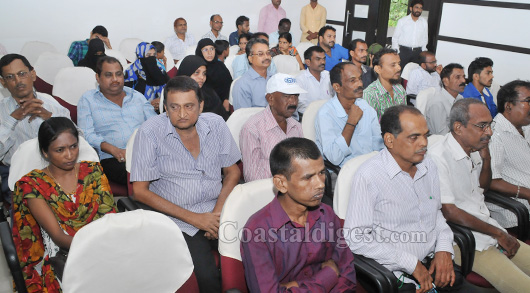
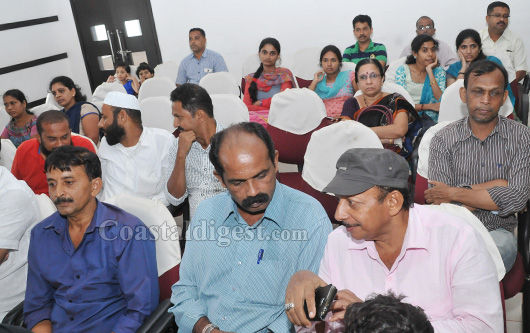
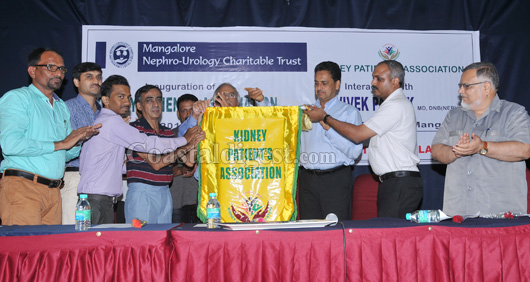
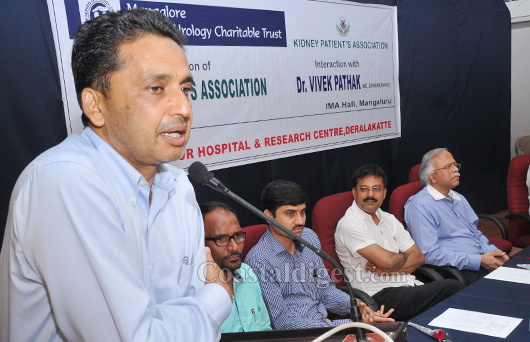
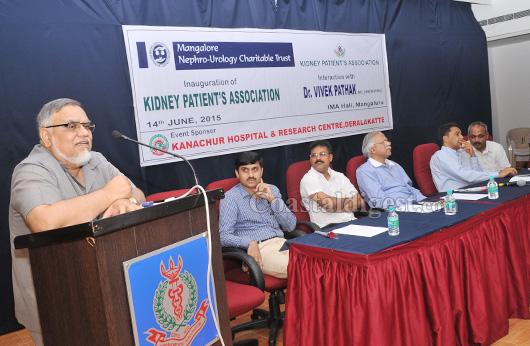
Dr Pathak, a consultant nephrologist at Kovai Medical Center and Hospitals, Coimbatore, known for steroids-free kidney transplantations, was speaking at the inauguration of Kidney Patients’ Association in the city on Sunday.
Kidney association 14 1

“Overeating leads to obesity which in turn leads to diabetes and high BP. No one dies by eating less,” he reminded, adding that stress also would invariably contribute to diabetes and high blood pressure.

Besides diabetes and high BP, such diseases could also happen hereditarily, especially when marriages were done among close relatives. Such practices should stop, he said.

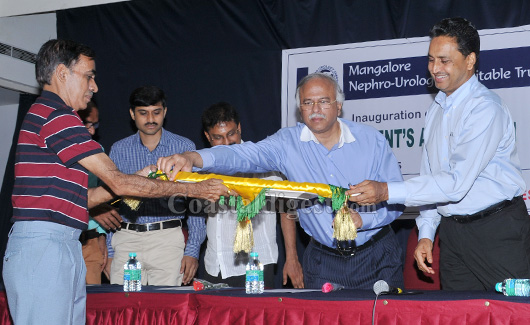
Earlier, the association was formally inaugurated by A B Ibrahim, Deputy Commissioner, DK. Speaking on the occasion, he said that CKD were not included in health schemes because of the alleged involvement of kidney rackets.

Kidney association 14 1

However, it was true that patients were forced to undergo physical and financial ordeal, he said. “I will send a proposal to the government to bring them under the Vajpayee Arogyashree scheme,” Mr. Ibrahim said.

In his introductory address, Umar U.H., one of the members of Mangalore Nephro-Urology Charitable Trust that is promoting the association, said unlike other diseases, kidney disease would not be known till both the kidneys were damaged. While many other diseases were covered under government health schemes, chronic kidney diseases were not part of them.
Kidney association 14 1

Those undergoing dialyses as well as transplantation would have to spend thousands of rupees every month for medicines and treatment, he said.

Mohammed Saleem, chairman of the Trust, said it had been conducting awareness programmes on kidney diseases for the past three years. So far, help from society — associations, organisations, temple committees, Masjid jamats etc. — was being taken for treatment or dialysis of poor kidney patients. However, such a practice cannot go for long and the association was conceptualised.

Besides creating a corpus for the financial needs of patients, the association would also work as a collective to demand facilities for them, Dr. Saleem said.

Every dialysis centre would have information centres of the association where new patients would be informed about the procedure of treatment and available alternatives. It would primarily aim at disseminating information, he said.
Kidney association 14 1

Kidney association 14 1

Kidney association 14 1

Kidney association 14 1

Kidney association 14 1

Kidney association 14 1

Kidney association 14 1

Kidney association 14 1

Kidney association 14 1

Kidney association 14 1

Comments

Michel
 - 
Thursday, 18 Feb 2016

I havee been surfing online more than 3 hours today, yet I never found any interesting article like yours.
It is pretty worth enough for me. Personally, if all site owners and
bloggerrs made gookd content as you did, the internet will be much
more useful than ever before.

Here is my web-site; private storage gold iras (Florene: http://www.fellas.nl/Activiteiten/Activiteit/26-04-2013/TGIF-borrel_Gro…)

Levi
 - 
Friday, 29 Jan 2016

Many researchers believe that cinnamon might help
maintain normal levels of blood glucose levels.
Results noticed in patients have been administered 3 doses of cinnamon every day for 40 days included lowered blood triglycerides, reduced blood sugar, and decreased cholesterol.
Cinnamon was also given in other experiments alongside a placebo and
patients who received the cinnamon were found to possess significantly lower amounts of glucose inside blood.

Also visit my homepage diabetes
diet: http://diabetesbetter.com/

Add new comment

  • Coastaldigest.com reserves the right to delete or block any comments.
  • Coastaldigset.com is not responsible for its readers’ comments.
  • Comments that are abusive, incendiary or irrelevant are strictly prohibited.
  • Please use a genuine email ID and provide your name to avoid reject.
News Network
July 15,2020

Bengaluru, Jul 15: Toyota Kirloskar Motor (TKM) has announced temporary halt of production at its plant in Bidadi, which is on the outskirts of Bengaluru.

“Halting production will be from July 14 (second shift) to July 22 (first shift) and this is in accordance with the directives issued by the Government of Karnataka as well as to support the Govt. in their constant efforts to flatten the curve of the rising Covid-19 positive cases in Karnataka,” a statement from the company said.

Bengaluru Urban and Rural, and other districts are, are under lockdown from 8 pm on July 14 to 5 am on July 22.

“Since the onset of the pandemic, TKM has adopted a very proactive and multi-faceted approach to safeguard the physical as well as the mental well-being of all its stakeholders including customers, its employees, dealer and supplier partners,” the company said.

“The office staff at TKM’s corporate and regional offices, continue to work from home to help mitigate risks. In addition to the safety protocols that are being followed, TKM has provided safety kits containing essential items like sanitisers, 3 ply masks and handwashes to 5000 employees, their family members and their neighbourhoods.

“TKM understands the urgency of the situation. During these difficult times, TKM is taking obligatory actions to contain further spread and will continue to respond in accordance with guidance issued by the Government and its internal standards,” it added.

Comments

Add new comment

  • Coastaldigest.com reserves the right to delete or block any comments.
  • Coastaldigset.com is not responsible for its readers’ comments.
  • Comments that are abusive, incendiary or irrelevant are strictly prohibited.
  • Please use a genuine email ID and provide your name to avoid reject.
News Network
August 2,2020

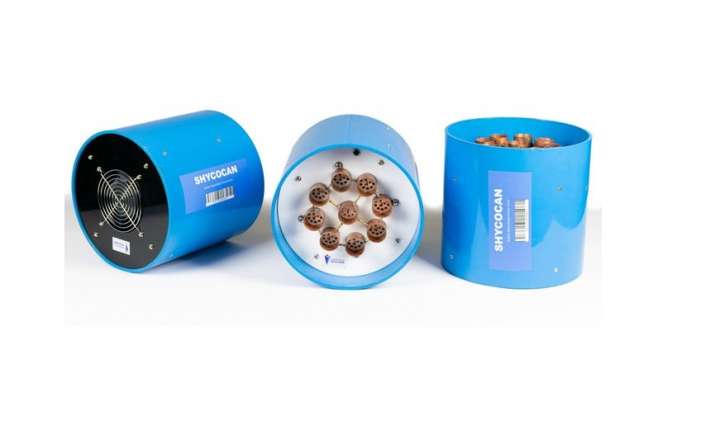
Bengaluru, Aug 2: Bengaluru based Centre for Advanced Research and Development (CARD), the research wing of organisation De scalene has come up with a device called "SHYCOCAN" (Scalene Hypercharge Corona Canon) which neutralizes the coronavirus.

Speaking to news agency Dr Rajah Vijay Kumar, Chairman, Organisation De Scalene said that the device will not kill any bacteria or fungus, however, neutralizes the coronavirus particles.

"The device was tested for its safety and efficacy and is soon going to be manufactured and marketed in the US under the Enforcement Discretion policy of USFDA and in Europe as the device is CE compliant and is CE marked," said Kumar.

He also added the device will cover a volume of 10,000 cubic feet.

The device Scalene Hypercharge Corona Canon (SHYCOCAN) is intended to be used in the residential, industrial and commercial environment and is designed for active containment by attenuation of Corona family of viruses. (Laboratories de Especialidades Immunological S.A. de C.V, Virucidal Activity concludes 99.9 per cent virus elimination), Kumar asserted.

"SHYCOCAN operates on regular 110/240V - 50/60 Hz wall socket and is a plug and play device, that delivers the necessary signals to a photon mediated electrons emitters (PMEE), that produces hypercharge high-velocity electrons by photon mediation that interacts with the negative seeking S-protein of Corona family of viruses thus reducing infectivity and prevent air and surface borne transmission of corona family of viruses," said Kumar.

The device does not use any chemicals, or any other consumables and does not produce harmful ozone gas or any other substances and is completely safe for use in any environment, he added.

"The attack mechanism of the Virus starts with the initial attachment of the virion to the host cell, it is initiated by interactions between the S-protein and its receptor on the "negative" cell membrane. The sites of receptor binding domains (RBD) within the S1 region of a coronavirus S-protein vary depending on the virus. 

The S-protein/receptor interaction is the primary determinant for a coronavirus to infect a host species and governs the tissue tropism of the virus. However, the end result is the fusion and release of the viral genome into the cytoplasm," said Kumar.

He continued saying that the counter mechanism by the device SHYCOCAN is that if negative seeking is the guidance mechanism of the S- Protein, attracted by the transmembrane potential of the host cells, then breaking this mechanism would block the Coronavirus infectivity and spread.

"The device has been in use for more than a year at the S-CARD campus, the headquarters of Scalene," said Kumar.

Comments

Add new comment

  • Coastaldigest.com reserves the right to delete or block any comments.
  • Coastaldigset.com is not responsible for its readers’ comments.
  • Comments that are abusive, incendiary or irrelevant are strictly prohibited.
  • Please use a genuine email ID and provide your name to avoid reject.
coastaldigest.com news network
February 7,2020

Newsroom, Feb 7: Prime Minister Narendra Modi’s recent statement that there is no detention camp in India is no more a lie. That doesn’t mean that there are no detention camps in the country, but the name of the camps have changed. 

In December, at a mega rally at Ramlila Maidan, meant to launch the BJP's campaign for the assembly elections in Delhi, Mr Modi had stated: “The rumour of detention centres being spread by the Congress and urban Naxals is totally false. This is being done with a bad intention to destroy the country, it’s filled with evil motives; this is a lie, lie, lie.” He had further claimed: “Neither are any of the country’s Muslims being sent to detention centres nor is there any detention centre in India”

In reality there are at least six detention camps in jails in Assam to house foreigners found staying in India illegally. A month prior to PM’s statement, Union minister of the state for home affairs Nityanand Rai had revealed that the six camps in Assam housed 1,043 foreigners — 1,025 Bangladeshis and 18 Myanmarese. Apart from these, at least ten new detention centres are coming up.

Outside Assam too, the Maharashtra government, under the then chief minister Devendra Fadnavis, had identified land for the state’s first detention centre for illegal immigrants.

Besides, in a case relating to illegal immigrants in Karnataka High Court in November this year, the Centre had told the court that it had written to all state governments in 2014 and sent a follow-up letter in 2018 to have detention centres to house foreign nationals illegally staying in India.

Karnataka’s first detention centre, apparently meant to lodge illegal immigrants and migrants overstaying in the country, is already open in Sondekoppa village on the outskirts of Bengaluru. The facility with several rooms, a kitchen and toilets has been kept ready on the directions of the government. 

Meanwhile, Union Minister of state for home Nityanand Rai has told the Lok Sabha that the name "detention centre" has now been changed to "holding centre".

Comments

Add new comment

  • Coastaldigest.com reserves the right to delete or block any comments.
  • Coastaldigset.com is not responsible for its readers’ comments.
  • Comments that are abusive, incendiary or irrelevant are strictly prohibited.
  • Please use a genuine email ID and provide your name to avoid reject.